Embodying Light

Photograph © 2021 Peggy Kornegger

In her inaugural poem, Amanda Gorman spoke of being light in the world. In doing so, she opened the door wide so that light could shine in, in all its radiance and power. Her words echoed out from the podium around the world and across the centuries. Standing invisible beside her were immigrants and enslaved people, civil rights activists and suffragists, Parkland students and pacifists, poets and day laborers. All those who have envisioned a freer, more compassionate world and lived and died for it were there in spirit to witness a shift in consciousness becoming visible at last.

You could feel the energy shift and recognize it in the faces of those present, speaking, singing, and seeing herstory/history in the making. Many of the women, like new Vice President Kamala Harris, wore luminous purple, others sunshine yellow, some radiant red or crimson. The colors were visible light. Permeating everything was a vibrant energy of transformation and change. The traditional songs that were sung—”This Land Is Your Land” and “Amazing Grace”—took on a deeper tone of inclusiveness and gratitude. Even the national anthem sounded somehow different, as Lady Gaga, wearing a golden peace dove, passionately sang the words. The feeling in the hearts of those listening, there or at home, was relief at having collectively survived an extremely challenging, painful time into a new dawn. Four years fell away, 200 years fell away, 2,000 years fell away. This is the Great Shift into Light that has been foretold by elders and seers for millennia.

I was continually moved to tears during the songs and speeches. It wasn’t patriotism I was feeling; it was profound gladness that this country had narrowly escaped falling further into fascism, that light was visible ahead of us and all around us, that humanity was reaching a new level of awakening. The colors of the thousands of flags spread out on the mall seemed to show a rainbow expanse of possibilities—for all people everywhere. Ultimately, it’s not about countries and presidents (though they can hold symbolic places in the world’s histories); it’s about the evolving of human consciousness and the emergence of a shared life on this planet based in love, compassion, and celebration of diversity.

I could see and feel it coming into being on January 20. Amanda Gorman gave voice to the words that were written on our souls before we entered this particular lifetime. We are all playing our parts, none of us extraneous or unimportant. Each of us is unique in our life purpose and inner vision and thus absolutely indispensable in the weaving of the greater tapestry of freedom, peace, and loving kindness here on Earth.

Poets and politicians and people of all kinds are being moved by something just now coming into humanity’s awareness. We are here to live out a sacred promise made eons ago across the cosmos. We have come to this planet to live the Light, our soul light, and share that light in all we say and do. This is the time we were born for. We are standing, souls shining. We are Light embodied.
Woodstock and Its Legacy

Photograph © 2018 Peggy Kornegger

Fifty years ago, in August 1969, nearly a half million young people gathered on a farm in rural New York for “three days of peace and music.” Contrary to warnings about how it would all go wrong, peace and music are exactly what occurred. In spite of the huge crowds, rain, mud, and countless challenges, love and community prevailed. The impact of that peaceful spirit was felt across the country and around the world. Woodstock Nation, whether you were there in person or not, defined a generation. Its legacy continues today.

In California, where I had moved from the Midwest, I was living out my own flower-child dreams in the late 1960s. The counterculture’s vision of peace, love, and flower power was everywhere, and the energy of Woodstock and Haight-Asbury linked both coasts. The music events and peace demonstrations I went to in San Francisco had a very similar high vibration. When I look at film of the Woodstock festival now, I feel it all again. So many iconic moments: Joan Baez’s unmistakable voice ringing out over the hillside, “I dreamed I saw Joe Hill last night…” Sly and the Family Stone singing “Wanna take you higher,” echoed by half a million people. And Richie Havens opening the festival with “Freedom”—a perfect description of the greater message of Woodstock.

In the many years since then, that message has been carried forward in the hearts of those who attended as well as those who read or heard about it. Woodstock showed that one generation’s dream of freedom, peace, love, and community is possible. It was made real at Woodstock. And it has continued to live in the consciousness of subsequent generations in spite of increasing challenges.

War, racism, and violence were predominant issues in the United States in the 1960s, and we continue to face them today. As racial hatred of immigrants, gun violence, and destruction of the environment escalate, the voices calling out for radical change also grow. More and more individuals and groups are speaking out for peace, social justice, diversity, and connection through community. Somewhere in the collective consciousness, we know it can be different. We remember Woodstock, despite many efforts over the years to dismiss it as a childish unrealistic dream that no longer exists.

The Woodstock legacy does exist. Every time someone speaks up for peace and freedom or acts with loving kindness, the dream is revived, and the memory is awakened. If complete strangers can love their neighbors—the people sitting right next to them in very crowded conditions—for several days, then we can love our local and global neighbors in the same way, for even longer periods of time. It takes open hearts and open minds to reach that critical mass. And that is the transformation that is now taking place beneath the turbulence of a world in transition.

If the Age of Aquarius first dawned in the 1960s, then its emergence continues today, and its full flowering is yet to come. At some point, the prophecy of universal peace and love will come to pass. You and I are here to assist in that birth. Woodstock was just the beginning.

Are You Twins?

Photograph © 2019 Peggy Kornegger
My partner/wife Anne and I have been together 36 years, married 5 years. During that time, we have been present to many changes in consciousness about and reactions to LGBTQ people. It is a time of great expansion on this planet. At the moment, it can feel like everything is going backwards, but it’s really just the rising and falling of waves of change. Awareness is definitely continuing to open and flower, even in the most unexpected places.

As a couple, Anne and I have experienced one particularly humorous reaction/interaction over the years that has repeated itself in place after place, with slight variations. After looking at us curiously for a moment, complete strangers will ask either “Are you twins?” or “Are you sisters?” When we say “no,” their faces register disbelief. This was especially true 30 years ago when the general public had little awareness about same-sex couples.

On one occasion, in Santa Fe, New Mexico, two individuals came into a store just to ask if we were twins. We found this particularly funny because we were in the midst of a conversation with the storeowner who was asking the same thing! When this kind of inquiry first began to happen, we said little other than “no” (especially while traveling) because acts of hatred and violence against those in the LGBTQ community were not uncommon, and we knew we had to be cautious in what we revealed to strangers. Anne would often divert the conversation by saying that she had a twin brother.

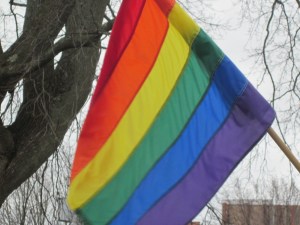
As the gay/lesbian rights movement grew over the years and more and more people courageously came out in their lives, a dramatic shift in the collective consciousness began to occur. In May 2004, Massachusetts (where we lived at the time) became the first state to allow legal marriages of same-sex couples. State after state followed. In 2013, the Defense of Marriage Act (DOMA) was struck down, and it became legal at the federal level. Thousands joyfully flew rainbow flags throughout the nation, and rainbow lights even graced the White House. It became much more commonplace for people to recognize a same-sex couple when they saw one, particularly in Massachusetts.

Today, of course, negative opinions about LGBTQ individuals and anyone else considered “different” are re-surfacing, all fed by fear. But those on the receiving end of these attitudes are not turning back and becoming invisible, even in the face of threats, anger, and violence. Acceptance and love has entered the collective conversation at the national and international level, and that is a genie that cannot be returned to the bottle.

When Anne and I married in 2014, we were surrounded by those who loved us, and waves of love radiated out from all of those present in the most magical of ways. We continue to live in that radiance in spite of whatever divisiveness is playing out in the national media and in the underside of public consciousness. Our openness about being who we are has been tested recently as we moved from Massachusetts to Florida, a state historically not known for its support of LGBTQ rights. We didn’t know what to expect, but we have been pleasantly surprised so far.

Yes, there have been replays of the “twins” conversation, but sweet ones. In January, we were celebrating our 36th anniversary at the local botanical garden. As we stood waiting to enter, a woman next to us struck up a conversation, and soon that familiar series of questions began: “Are you twins?” “No.” “Sisters?” “No” “Oh, just really good friends then?” At this point, I said: “We’re married—5 years. And today we’re celebrating 36 years together.” The woman immediately responded, “That’s wonderful! Congratulations!” And the woman next to her echoed, “Congratulations!” with a big smile on her face. The man beside her wished us a “Happy Anniversary.” Smiles all around.

Assumptions, yours or mine, can separate us from each other. I’m finding that you can never assume anything about someone else’s beliefs or lifestyle. You just have to be willing to be yourself and to hold love in your heart. Generally, that is what you will receive in return. Just yesterday, we had a mini-replay of the above conversation, and when the woman heard we had been together 36 years, her face lit up and her eyes softened with tears as she looked back and forth at us. “That’s so wonderful and so unusual for anyone to stay together that long. You are blessed.” Yes, we are. And may such blessings as these multiply and circle the globe, filling every heart with limitless love.

A Love Story

Photograph © 2017 Peggy Kornegger
Mt. Auburn Cemetery, in Cambridge, Massachusetts, has been my spiritual and nature sanctuary for more than twenty years. Filled with towering trees, flowering bushes, and wildflowers, as well as ponds, hills, and dells, it is the closest I come to being in the country while living not far from Boston’s urban landscape. I walk there in silent meditation at all times of the year, and every spring I spend countless hours observing the annual migration of songbirds from Central and South America. Hundreds of birds come through Mt. Auburn, and some nest there, because of its abundance of trees and other natural features.

The history of the cemetery itself as well as those buried there, known and unknown, is quite interesting too, but I usually pay only fleeting attention to the angel sculptures and carved gravestones, as my eyes are focused upward, looking through my binoculars at orioles, tanagers, and warblers. I always take note of Longfellow’s and Margaret Fuller’s graves as I pass, but other than that, the birds and nature are my primary reasons for being there. All that changed one Saturday last month, however, when, as I rounded a turn on a familiar hillside path, I suddenly noticed a gravestone I had not noticed previously.

My eyes were first drawn to a quote by the Dalai Lama etched in the stone: “Be kind whenever possible. (It is always possible.).” Wondering who had chosen it (one of my own favorites), I glanced at the names above it. Immediately, I saw that they were both women and were both born in 1949. One was still alive, and the other had died in 2013. Just below these dates was the single line: “Married on June 15, 2004.” The story this simple gravestone told may have been invisible to some, but to me, another lesbian, it was crystal clear. These two women had married immediately after same-sex marriage became legal in Massachusetts in May of 2004, and one had died nine years later. As the emotional impact of that hit me, I glanced down further at the bottom of the stone, where I read the following sentence: “Together we could do anything.”

This completely undid me, and I began to sob openly. Fortunately, no one was nearby. I just stood there and let my heart completely break open with love and sorrow for these women who had shared their lives, at long-last legally recognized, and then been separated by death. I could not help but feel close to them because my partner Anne and I had also married when same-sex marriage became legal (after 31 years together). Our ceremony was held on June 22, 2014 (three years ago today) at Mt. Auburn Cemetery’s Auburn Lake, not far from where I was standing at that moment. The parallels sent chills up and down my spine.

Part of Anne’s and my decision to marry was that we didn’t want to regret not having had a special ceremony to share our love with friends and family, even though our relationship was not a new one. I could only imagine how these two women felt—about how important their marriage and those nine years were to them. A delicate etching at the top of the stone shows a path leading to distant mountains and a table in the foreground with an open book on it, cat below. I imagined them hiking, reading, and loving their cat together, just as Anne and I have done. I also pictured the surviving partner choosing the images as a way of cherishing those memories.

Our lives are so intertwined, we human souls. We think we are living distinctly individual destinies, but at moments like this, we see the larger picture, filled with synchronistic commonality. Really, there is only one destiny, and that is love. When we meet—beautiful gender-free spirits in human form—and allow love to fill us, yes, we can do anything, together. We can touch hearts beyond our own lifetimes with the sheer power of the love we embody and share.

• Dedicated to Julie Felty and Susan Donaldson

It’s All About Love, Always

Photograph © 2017 Peggy Kornegger

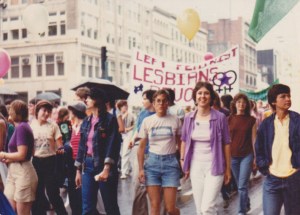
A few weeks ago, I watched the four-part series “When We Rise,” about the recent history of the LGBTQ community in the U.S. and the fight for our basic human rights, including marriage equality. At the end, I felt emotionally exhausted, like I had relived the last 39 years of my life. I lived in San Francisco in 1978 at the time of the California Briggs Initiative to ban gay/lesbian schoolteachers, thankfully defeated, and the shooting death of gay city supervisor Harvey Milk. In 1981, I moved back to Boston, right before the beginning of the AIDS epidemic, which would take the lives of thousands of gay men. Every year I took part in the AIDS Walk to raise money for those with AIDS, and I lost dear friends on both coasts to this terrible disease. In 1987 and 1993, I marched on Washington for LGBTQ rights and freedom, and each year there was a Pride March in Boston (in June, to coincide with the 1969 Stonewall uprising in New York). Those were years of great sadness and loss, and yet the love in our hearts and the hope that together we could bring about change kept us going.

In 2004, Massachusetts became the first state to legalize same sex marriage, and the movement for marriage equality continued to gain momentum. In 2013, the Supreme Court struck down DOMA (the Defense of Marriage Act), and in 2015, it ruled in favor of same sex marriage nationwide. My partner and I, who had been together for 31 years, married in 2014, with family and friends celebrating with us. Suddenly, seemingly out of nowhere, the national consciousness had shifted significantly toward love and inclusiveness over bigotry and hatred. We all had gotten so used to living with secrecy, fear, and the threat of violence that when acceptance appeared, it was almost shocking—extremely emotional and powerful for each of us. But it had not really been sudden; years of activism and private and public “coming out” had brought about the change. The rainbow lights shining across the country on national monuments, as well as the White House, reflected the magical new reality we were all experiencing.

However, today in 2017, a new administration, accompanied by a conservative backlash, is already beginning to whittle away at our hard-won gains, beginning with transgender rights. LGBTQ community members are currently the top target for acts of hatred in the Boston area. We are not done. Freedom, equality, and justice for all people are ideals that must be lived and upheld every single day. We do that by not giving up, by not allowing outrage or depression to overrule the universal compassion and kindness in our hearts. Intolerance still exists, but we are here to live our love, and we won’t stop. Not now, not ever. The music of our hearts and souls will carry us forward.

Photograph © Peggy Kornegger

I have changed in so many ways in the last 39 years, yet the core of me remains the same. I too am here to live love in the world. When I am meditating alone or in spiritual circles, when I am marching in demonstrations, when I am speaking my truth, I am centered in that love. A living prayer for love that includes friends and strangers alike around the world. Our hearts and souls link us together into one family. We are all connected, we very diverse humans on planet Earth, reaching out for freedom, equality, and the right to self-expression. In the deepest part of our being, we are not so different; we all want similar things in this life. Ultimately, it’s all about love. Always.

In Memoriam: Gilbert Baker, who in 1978 created the first rainbow flag in San Francisco, died last Friday, March 31, at the age of 65. That first hand-dyed and hand-stitched rainbow flag became the international symbol for LGBTQ pride and freedom.