Life as Drama…and Serenity

There are times when life feels like those famous drama masks that denote comedy and tragedy in theatrical productions. One mask is smiling, the other crying. On any given day, I can experience both laughter and tears, joy and sorrow. Sometimes both simultaneously. Each year brings new ways that life unfolds in all its dramatic diversity. Yet, underneath it all runs a balancing stream of serenity.

When I was growing up in the Midwest, I remember wondering, a bit fearfully, about the meaning of life as I looked up at the vast star-filled night sky. I wanted to be 9 years old forever, safely reading books in the branches of my favorite climbing tree. But I also wanted to travel the world. My life unfolded in ways that included both those ways of being, as well as extended spiritual exploration.

I continued to be an avid reader (and later a writer and editor) as well as a lover of Nature. I traveled extensively, swimming with wild dolphins in Costa Rica, whales in Hawaii; hiking Machu Picchu in Peru, the Alps in Switzerland. Vision quests in Montana and spiritual ceremonies with Maya elders at sacred sites in Guatemala. Over time, I came to realize that every bit of it was part of my soul’s journey for this lifetime, finding equilibrium among inner and outer experiences.

Growing older has brought unexpected challenges (e.g., breast cancer survivor), but ultimately these have taught me patience, acceptance, and resilience, day by day. Sadness about the passing of family members and friends, as well as apprehension about my own eventual death, are also part of aging. Still, simultaneously, my life is filled with so much joy and love: good friends, old and new, and my dear partner, Anne, with whom I’ve shared 43 years (!) of wonderful life adventures. Each morning we open the door to sunlight over the treetops and birds singing (robins, cardinals, song sparrows, goldfinches). Who could not feel grateful for blessings such as these?

I’ve learned that whether you are crying or laughing, 9 or 90, there is always some beauty to be found in the world (in spite of political conflict or personal pain)—in Nature and in the loving kindness of friends and strangers alike. At any time, I can set aside the tearful mask and pick up the smiling one; let go of worry and embrace trust. Each moment holds all of life. Sometimes we need to cry and release sorrow. But we also need to laugh and find the sweetness of life. And make our way to the inclusive space of neutrality and peace that lives within.

The soul is timeless, not attached to the human framework of hours/minutes; it is beyond circumstance and action/reaction. In our souls we are pure Presence, and we know we are infinite. The temporary form we inhabit while on Earth has experiences while the eternal soul observes everything. Eventually, it all blends together as One. Any separation is an illusion that we realize as we transition, or if we are fortunate, at moments of awakened awareness while we are still in physical form.

With each second that passes, with each precious breath we take, we can open our heart of hearts to a soul vision that will guide our lives to the serenity within the drama. We are here in our human lives to do just that. It is what is meant by Peace on Earth.

Suffs: Keep Marching!

Earlier this week, I watched the inspiring Broadway musical Suffs for the third time (once live in Boston; twice on PBS, New York show filmed). With both compassion and humor, Suffs focuses on the lives of the suffragists who fought for (and won) women’s right to vote in the years 1913–1920 (a 72-year struggle begun in 1848 at Seneca). This is classic women’s herstory, including the first women’s suffrage march on Washington in 1913 and later hunger strikes by imprisoned activists. All the characters are real people, movingly and powerfully portrayed: Alice Paul, Ida B. Wells, Lucy Burns, Carrie Chapman Catt, Mary Church Terrell, Inez Milholland, Doris Stevens, Ruza Wenclawska…. Several of the women’s names and life stories were unfamiliar to me, even though I had been deeply involved in the women’s movement in the 1970s (when the last scene of Suffs takes place).

I first encountered contemporary feminism when I took a class on the subject in 1971 at San Diego State University. In 1973, I enrolled in the Feminist Studies program at Goddard-Cambridge Graduate School, specifically Women’s Literature. We were a small group of eight women, reading many “lost” women authors, whose work we had to find in used bookstores or library archives. We were living on the cusp of the creation of women’s presses that reprinted these out-of-print, little-known works by women. It was an exciting time to be entering the feminist movement because new women’s groups, periodicals, and publishers were appearing all the time.

Several members of our graduate group, myself included, became editors/writers for the Boston feminist magazine Second Wave, as well as the Women & Literature Collective, who published an annotated bibliography of international women writers. Women’s distribution networks, bookstores, and print conferences became gateways for sharing feminist thought and creativity. Health centers and shelters for homeless or battered women were forming. In addition, most of us were active in local and national marches for women’s rights and human rights (ERA, LGBTQ, anti-racism, pro-unions).

Looking back, I see it as a time of great hope and optimism about the future. A few of us had been peace and civil rights activists in the 1960s, and we brought that positive view of the possibilities for change with us. Whatever our backgrounds, we knew there was still a long way to go to achieve full equal rights for all women. There were conflicts and disagreements about direction and focus, even as we tried hard to work together.

One of the most interesting parts of Suffs is that such conflicts also arose in the suffragist movement. And there were those, younger or older, who thought they knew best how to proceed. Cary Chapman Catt and Alice Paul were equally determined in their individual visions for the future. As was Ida B. Wells, who stood strongly for the necessity of addressing racism and working for the rights of all people.

Watching Suffs, I could see the long view of a century of change, continuing to this day. None of us are the same people we were earlier in our lives. The suffragists lived intensely focused lives as strong women dedicated to creating a better world for women, moving forward step by step, even in the face of obstacles, misunderstandings, and impatience. The feminists of the 70s and 80s were similar in our strength and dedication despite challenges. Today, whatever we call ourselves (or perhaps we have discarded labels entirely), we continue to hold the vision of a more equal, inclusive, and peaceful world in our hearts. And, as the final song in Suffs, expresses this, we “keep marching, keep marching….”
—————
Note: Suffs will be free to view on YouTube and PBS through the end of July:  https://www.pbs.org/video/suffs-efgkiq/. After that date, you need to join PBS Passport to view it. Definitely worth seeing—writing, music, and acting all outstanding!
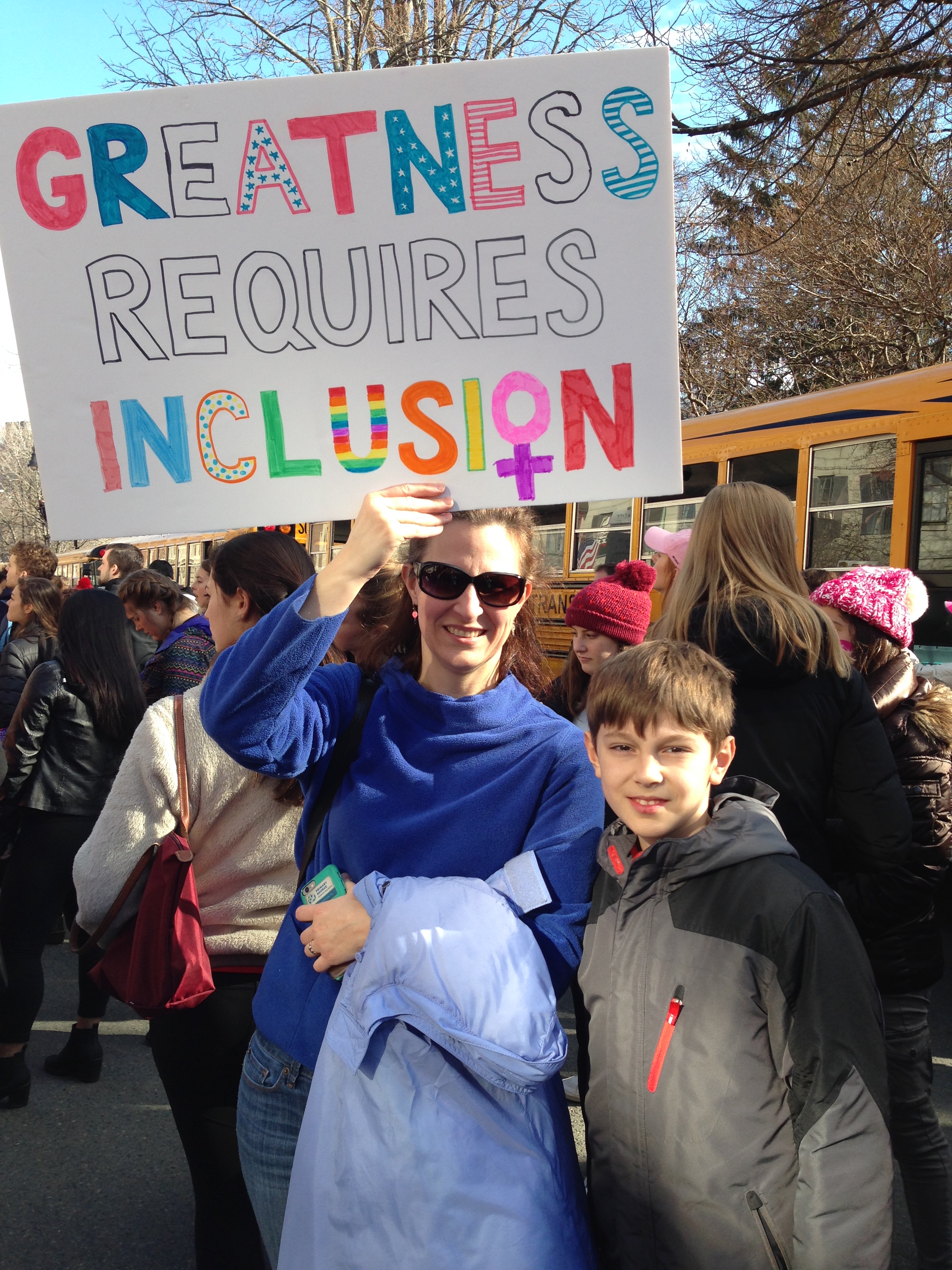
**Photos above are from the 2017 Women’s March, Boston, Massachusetts.


Spring Stillness and Sound

One sunny day this past April, I spent several hours walking among the trees, flowers, dells, and ponds of my favorite nature sanctuary, Mt. Auburn Cemetery. Spring is pure paradise at Mt. Auburn: Leave your physical form at the front gate and become one with the spirit of seasonal rebirth all around you! There is an underlying stillness that fills the air. Even the birdsong and wind through the trees seem to arise from that stillness.

I could feel it in my own heart as I listened to the trilling of hundreds of American toads at Halcyon Lake and sat next to the sunning turtles at Willow Pond. My eyes closed, I sensed both the life-force energy and the profound silence within the sounds of spring. All motivation for movement of any kind fell away. I stopped taking the occasional nature photo—it felt like a distraction. 

I was reminded of visiting the Hopi mesas in Arizona, where the indigenous people there ask that visitors not use cameras or take pictures. I can remember a sense of relief and letting go into the immediacy of the experience. No striving to record what was happening, just a release into Presence, fully connected, heart and soul. The Hopi in their wisdom know that this is the essence of daily life, being fully present. This memory filled my awareness as I opened my eyes and saw the turtles with their heads raised to the warmth and light of the sun. In sitting with them, I too was fully present.

Temples, spiritual sanctuaries, and libraries usually request that visitors observe silence while there. Cemeteries too ask for quiet, in respect for those who have passed and those who may be grieving. I feel that Mother Nature asks this of us as well in all natural settings. When the noise of traffic, machinery, and human voices falls away, there is just silence, the essential stillness of the human soul—where we come home and know fully that we and Nature are one.

In springtime, at a place like Mt. Auburn, where life visibly renews itself in the flowers and trees and the migrating birds, I experience this most profoundly. My inner spirit is also renewed listening to the infinitely varied voices of Nature all around me, which are somehow part of the silence. As I walk, eyes, ears, and heart fully open, any residue of mental separation disappears: no subject or object; no this and that. Stillness and sound are One, within me and everywhere else.

Moon, Stars, Infinity

When astronauts landed on the moon in 1969, I was barely out of my teens and more interested in my life on Earth than what was happening in outer space. Everything seemed somehow different, however, when I looked at the photographs the Artemis II astronauts recently took of the moon’s surface, with distant Earth barely visible over the horizon. I was awe-struck by that visual: infinity perceptible to the human eye. Our home planet looked so tiny in the vast cosmos; our individual lives miniscule. Yet all of it was somehow of a piece; I could sense the oneness that connected everything. Perhaps an indication of how far I had lived since 1969.

I grew up frightened of infinity, all that stretched beyond my lifetime into eternal time/space. Late at night before sleep, thoughts of infinite nothingness caused a “brain freeze” in my child’s mind. As the years passed, I gradually learned to distract myself from those thoughts, although they never entirely disappeared. It was only when I began a spiritual journey in my 30s that I opened the door slightly to a different view of the universe.

Eventually, I was able to see infinity as Spirit, as Light, which lives within and all around us throughout eternity. What once seemed terrifyingly empty gradually became softer, almost comforting if I observed it through my soul’s eyes and not my mind. When I went through breast cancer treatment five years ago, my experience of all-inclusive Spirit became even deeper and more expansive. I could see my physical form as temporary and my soul, which was viewing it, as eternal, infinite.

Perhaps we all go through this evolution in our lifetimes, each in our own unique way. Every human life is a doorway to the infinite, and ultimately we realize how blessed we are to experience it. As I stared at the Artemis images of the moon, Earth, and stars, I could literally feel my heart open to infinity, to my own beingness within it and as it. We each come here to experience a version of continuous awakening to that awareness, perhaps not completely until the moment of our death. But actually it is always present.

Our humanity holds divinity within it, and we are multidimensional beings. The universe itself is multidimensional. It cannot be understood or explained by human mental effort, but rather only experienced through moments of profound opening, in Nature, in crisis, in love, in life/death circumstances. Suddenly, everything is everything, and we are One with it all.  An infinite kaleidoscopic tapestry of light and love. This is the view from space as well as from our own souls. We are the moon, the stars, and all of infinity, living one precious life on an extraordinarily beautiful blue planet, shining light in the darkness of the cosmos.

Growing Up Walden

One of my father’s favorite books was Walden by Henry David Thoreau. He loved Thoreau’s immersion in the natural world and his emphasis on a simple life. Recently, when I was watching a PBS documentary on Thoreau and his time living alone in the woods at Walden Pond, I remembered my childhood in Illinois and how my dad had created his own version of Walden on the five acres where my parents built a house nine years before I was born. The land had a number of old oak trees and a couple of streams running through it but was otherwise mainly open fields. By the time I was a young child playing there, my dad and mom had planted shade trees, evergreens, bushes, vegetable and flower gardens, a fruit orchard, and berry patches. The vibrant beauty of Nature surrounded me every day. Without realizing it, I was growing up immersed in Walden consciousness.

“Simplify, simplify, simplify,” my dad would often quote Thoreau. No wonder I inherited an aversion to complications and clutter—and a love of Nature’s beautiful simplicity. When I read Walden in college, it all came together for me. Thoreau’s writing, as well as that of other Transcendentalists like Emerson, aligned with my heart and soul. Thoreau’s small wooden cabin in the forest by Walden Pond seemed to call to me. A number of years later, I moved to Massachusetts, and Walden became a special sanctuary for me where I often walked the trails and gazed at the trees, water, and sky. In any season, it radiated peace and tranquility. It was as if Thoreau’s solitary spirit watched over and protected it.

When my parents flew from Chicago to Boston to visit me, two dear friends drove us out to Walden so that my dad could see it in person. It was a special moment for all of us because we knew how greatly he admired Thoreau and his philosophy. My father continued to plant mini-Waldens in other Illinois locations where my parents lived in later years. And I too have created “Waldens” in the various backyards (or porches) of houses where I have had an apartment.

Currently, my partner Anne and I live in a condo which faces a woods thick with deciduous trees and evergreens. Bird song fills the air when I open our deck doors at sunrise, and we hear spring peepers or summer crickets trilling after dark. Walden once again synchronistically surrounds me, the perfect circle of a lifetime. Early in my life, I learned that the wonders of the Earth are ever-present; every day I see them wherever I live. I am deeply grateful to Thoreau, my dad, and all those magical years of “growing up Walden.”
————
Artwork above: “Thoreau’s View,” by Anne Katzeff