Remembering

Photograph © 2014 Peggy Kornegger
We humans forget all the time. We forget we are human, and we forget we are spirit. Then we remember. And then we forget again. Then we remember again. And each remembering is a blessing. These are incredible times we are living in. It is a time of remembering. Not long ago in human history, people lived entire lifetimes without realizing that they were really spiritual beings having a human experience. That awareness is now infusing the collective consciousness. We are remembering who we are. It may be happening in fits and starts, but it is happening. The planet is shifting, right before our very eyes.

In being human, we may not consistently live out attributes that we wish to embody: patience, compassion, unconditional love, peacefulness, generosity. We forget. We get angry. We say something thoughtless or unkind. Or we lose touch with others because we are lost in our own pain or sorrow. Yet anger, fear, and sadness are part of the human experience. If we judge ourselves harshly, we are distancing ourselves from the spiritual power of compassion and unconditional love. For self as well as for others.

I am learning, slowly but with increasing awareness, to let go of self-judgment when I lose patience or inner peace. Instead, I center myself in gratitude for having remembered that there is a different way and that I can always begin again with each deep breath, with each moment of conscious awareness. Yes, I want to be open-hearted and joyful, and I am that. But there are also times when I am shut down or sad. Recalling the existence of the full spectrum of human experience shifts the energy for me. Each time I remember is an opportunity to live deeper into my humanity and access the love that is at the core of my being. In the midst of dismay at not always living up to how I wish to be in the world, I am learning to trust in my own evolution and growth within the collective planetary expansion. One by one, we are all opening our hearts to embrace everything in life as both human and divine.

My soul is at peace with whatever occurs. It is here to experience all of life through me. If I see from my soul’s point of view, I trust in the ultimate perfection of all things. I trust in the beauty and love and infinite possibility of each moment. I begin to flow with the rhythm of the expansion and contraction of life. The in-breath and out-breath of the universe, of spirit, which is expressing itself through me, through all of us. We are each musical instruments opening to the wonder and beauty of our own music. When we remember that, life becomes a blessing instead of a disappointment. So when I forget and then I remember, I am grateful. Grateful for the chance to know I am both human and spirit, a physical being and a soul. I am one cell in a universe of evolving cells of light and love. What a tremendous miracle that is.

Life’s Mystery

Photograph © 2014 Peggy Kornegger

Some Native Americans use the term “The Great Mystery” to refer to the concept of God or Source energy. It’s such a wonderful usage because within it, humans step back and allow the unknown to be just that—unknown. Many religions spell out the specific attributes of God, the heavenly realm, and its relation to living beings on Earth, including sets of rigid moral codes, laws, and commandments. How much more open-ended is the idea of a mystery that we will never understand with the human mind? Our hearts can experience God or the Divine, but we cannot solve the enigma of existence. Perhaps the greatest wisdom lies in acknowledging that and allowing the Mystery to live within and through us without trying to understand it.

To live in alignment with this mystery involves dissolving identification with thoughts and ideas; then awareness flows freely without conceptual distortion. Buddha mind. Baby mind. The innocent eye. At the beginning of life, we see the world this way—pure perception with no distorting language filters. Toward the end of our lives, words and memories may begin to fall away as we prepare to return to the oneness of pure divine consciousness, in which human language plays no part. In the middle years, we struggle to understand the seeming contradictions and unfairness of life—and the inevitability of death.

Not all of us are driven to figure out the meaning of life and death. I am one of those who has always tried to do so, from early childhood on. Only in recent years have I found my spiritual journey less burdened by inquiry and more open to possibility. This past summer, in particular, I began to let go into “not knowing.” This came out of a weeklong program with Panache Desai in which he challenged me to drop my questions and live from a place of experiencing instead of trying to understand everything. For someone who has perpetually had cosmic questions spinning around in her head, this was indeed difficult, even painful. Finally, though, in the weeks after the program, something in me opened to not knowing as the most peaceful way to go through my daily life. Basically, I surrendered to the Mystery.

I have surrendered in the past, of course, but there are layers to letting go, and humans are never finished with it. We have to keep being reminded, again and again: Relax your fingers; stop clutching. Relax the mind; stop questing. The wider, higher perspective opens up when we allow everything to unfold with awe and wonderment instead of “What’s going on? Why is this happening? How can I change it?” The “control” trap keeps us stuck on a hamster wheel of trying/failing/trying again. Ultimately, surrendering to mystery may be the wisest and least painful path to take in life. Human existence can be miraculous or a curse. We can suffer or we can celebrate. Celebration involves embracing everything, the sadness as well as the joy. We don’t know the meaning or the outcome, but we can fully experience every incredible moment of the journey.

Connections and Distractions

Photograph © 2014 Anne Katzeff
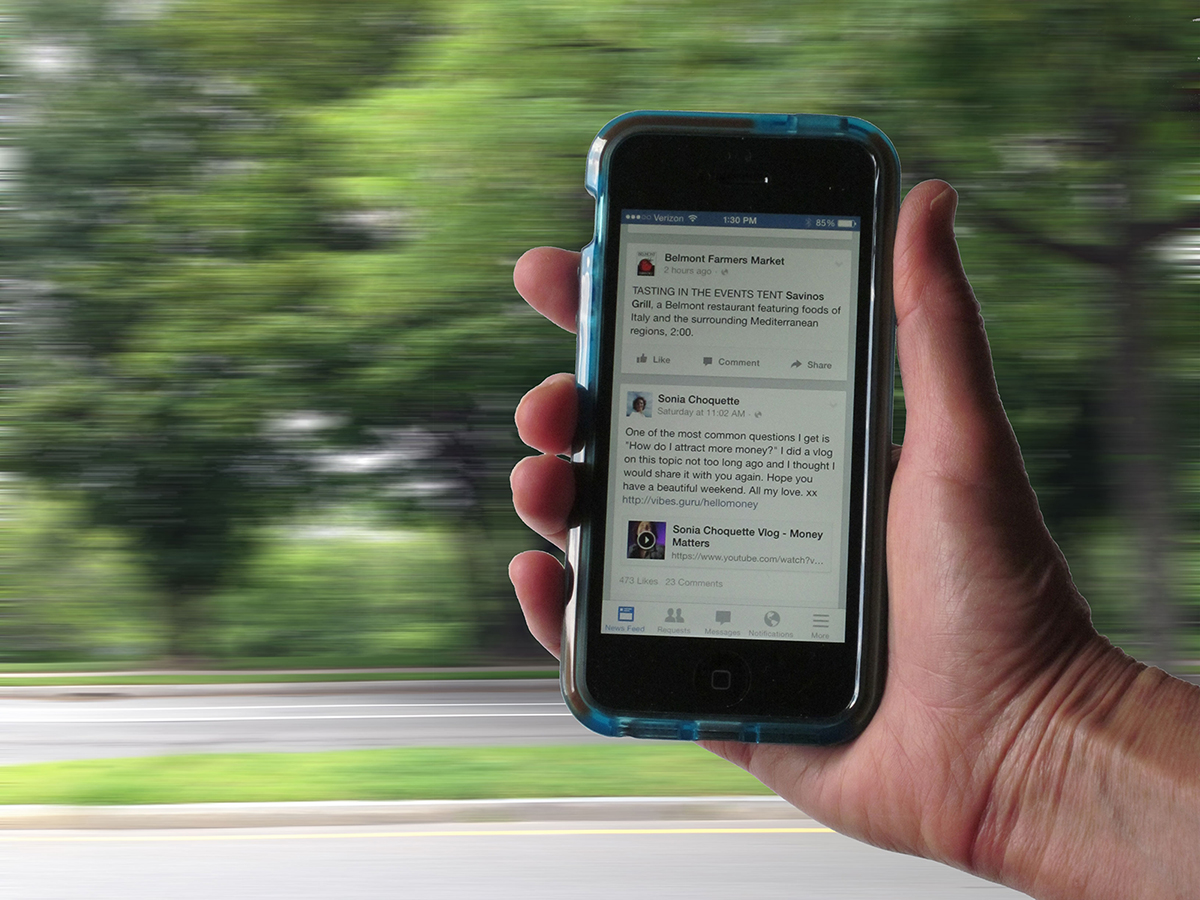
We are connected invisibly all the time, every one of us, through a psychic web of thoughts and emotions. The existence of the Internet has made this web tangible to people around the world. However, we are now in danger of losing our awareness of the power of that connection because of our dependence on technological gadgets that rob us of our intuitive intelligence. Smart phones are dumbing us down by keeping us compulsively plugged in to social media and online information sources.

When I ride the bus and train these days, there are very few riders who are not glued to their smart phones—checking emails, texting, tweeting, posting on Facebook, etc. The world around them goes by in a blur without their noticing. They could be passing urban high-rises or a park with trees and flowering gardens, and they would not look up. Where are they really? Yes, they are interacting with friends or acquaintances, and some of these exchanges are important and worthwhile. But a lot of this constant social back-and-forth is just distraction, avoidance of the present moment. So many of us pass the day in a trance state that blocks natural connections with the people and world right in front of us.

As you might guess, I am not a big fan of cell phones. I have avoided them for years because of the health hazards associated with them and also because I don’t want to be available for phone calls anytime, anywhere. Recently, however, I purchased a cell phone to use when I’m traveling. Because of the almost universal demise of pay phones, it became a necessity. Although my phone is “smart,” I use it only for the occasional call when I’m away. My home iMac is where I read emails and interact with friends via social media. I value these connections greatly, but I know firsthand the addictive attraction of online activity, wherever you are. It seems to have a compelling, magnetic power all its own. The images, posts, and website content draw me in and before I realize it, hours have gone by. I’ve been completely and utterly distracted.

The only way I’ve found to break this pattern is to limit my online activity. I usually check email, Facebook, etc. once a day and only interact for an hour or so. This can be challenging because I’m a writer, so I’m often at my computer anyway. It’s so easy to check in more frequently. I have to be strict with myself in order not to succumb to the sirens’ call to “log in just for a minute.” This is where conscious awareness comes in. Through meditation, yoga, and other spiritual practices, I have come to live more fully in the moment, to be aware of distractions when they ensnare me, if not immediately, then relatively soon. I know that when I spend several hours online, I am less connected to my own internal process and rhythms. The only exceptions are the spiritually related webcasts and communications that I participate in, which do in fact impact me at a deeper level. Other than these, my time offline is the most life-enhancing and soul-enriching: walking, gardening, writing—any quiet activity that centers me in my own peaceful inner core. Actually, spending time doing absolutely nothing except being present to the world around me brings me the deepest soul connection.

So what is the value of online activity? Is it more harmful than helpful? Well, I see it as an interim evolutionary tool to demonstrate to humanity the existence of invisible connections. I think more and more people are starting to become aware of the distractive downside of being perpetually online: smart-phone dependency. I recently read an article by a yoga practitioner whose 9-year-old son asked him, “Daddy, why do you have to check your emails so often?” A wake-up call for him. Perhaps it will be the next generations who show us that we don’t need those phones to be connected. Our own internal intuitive “smarts” that we are born with can handle that just fine, if we learn to access and use them instead of letting them atrophy. Each time we awaken to our own distractions, we take an evolutionary step into that space of awareness and connectivity.

Looking Back Looking Forward

Photo Courtesy of Mike Dubrovich
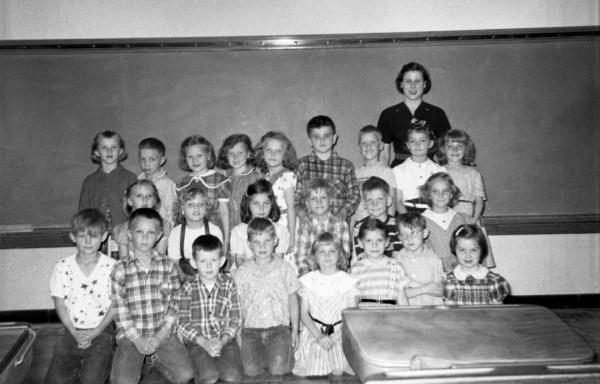
Recently, a childhood friend posted on Facebook a vintage black-and-white photograph of our first grade class. What a strange experience to look at that picture of unfamiliar school children and slowly begin to see familiarity in their faces. Names from the past popped up out of distant memory. I did not, however, recognize myself. I told my friend that I must have been out sick the day the photo was taken. He wrote back, “Isn’t that you on the far left end of the second row?” I peered at the picture more closely and realized in amazement that he was right. Fascinated, I stared at that blondish little girl with big dark eyes, gazing out into her own future. My future. I looked through her eyes and saw myself looking back. Time ceased to exist in that moment of backward-forward perception.

How often do we stumble across those flashes of memory that stop us in our tracks momentarily, lost somewhere between the past and the present? Some say human life is a series of beginnings and endings out of which we fashion our remembered sense of self in the world. Yet we are so much more than our memories, which are really just a long parade of Instagram photographs that we identify as our personal history, our life’s story. Beyond the mental perceptions of time and our place in it, however, is consciousness itself—an awareness that is greater than any one life. In those brief moments of backward/forward memory jumps, we are given an opportunity to see our life from the soul’s point of view, wherein all time is simultaneous, and everything is occurring now. There is no real distinction between a past, present, or future self. The soul sees one being, experiencing time but not defined by it.

Why would we want to see things from the soul’s perspective? Well, if we completely open to soul vision, we see everything is of a piece, whole. We perceive the oneness at the core of all life. Conflicts, comparisons, and judgments fall away. We can never fail our childhood selves and the dreams they had for the future, because we are those children and we are living those dreams now. We are not lost, nor have we taken a wrong path or made a wrong decision. Everything is unfolding in a way that is perfect for our soul’s growth and evolution.

When I looked back at my childhood self in that photo, I wondered, Where is the “I” that is all of me, girl and woman? My soul answered: I am no where. I am now here. I am present. I AM. Taking a long, deep breath, I felt the wholeness of that “I AM,” a timeless soul presence beyond “where.” No separation—the adult and the child are one. If we open our hearts to the soul’s vision of oneness, we can embrace all possibilities and all selves, and life begins to flow in a less fragmented, graceful way. We are able to see the perfection that is at the heart of our own infinitely expansive lives. Within that perfection, there is no backward or forward; there is just fluid, unbroken, loving presence.

A Life Well-Lived

Photograph © 2014 Peggy Kornegger

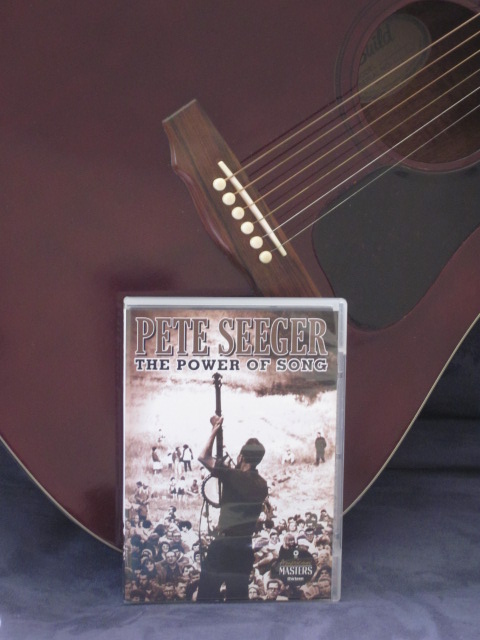
When folk singer and political activist Pete Seeger died recently, at age 94, I was filled with great sadness. His larger-than-life presence and spirit, head thrown back in song, will be missed in this world. I also thought, though, that his was truly “a life well-lived,” as the saying goes. From the 1940s to the last years of his life, he spoke out and sang songs for peace (“Where Have All the Flowers Gone?”), civil rights (“We Shall Overcome”), workers’ rights, saving the environment (the Hudson River), and more recently, the Occupy movement. He was tireless, fearless, dedicated, and his heart and soul were in all he did, for human rights, community, and the Earth.

There are so many others who have lived long full lives: Nelson Mandela, Howard Zinn, Simone de Beauvoir, Adrienne Rich, to name only a few. Of course, not all well-lived lives belong to the famous. My own parents, who passed away at 81 and 94, lived long wonderful lives, deeply connected to the natural world around them and to the friends and family they loved. And age is not necessarily a factor either. My dear friend Michael, actor, poet, and musician, died at 39. His life had been creatively filled to the brim while he was alive.

However long they’re here on Earth, some people seem to embody full-out living, treating each moment as a glorious opportunity to experience all of life’s wonders. They stand out in our minds as vital and vibrantly alive. When Pete died, as I thought about the people I know and know of, it occurred to me that perhaps more and more of us are choosing to live our lives as he did. It is a time of great change on our planet, filled with transformation and evolution of all kinds. Many of us are struggling just to survive, but even within those struggles, there is often a deep desire for more than just the material. Our hearts long for human connection, for spiritual connection, and within community and shared experience, we are finding it. There is so much more to life than we can perceive with our physical eyes. Our souls know this, and as we awaken at that level, we will open up to all the possibilities of life, both imagined and beyond imagination.

So, let us take a page from Pete Seeger’s songbook. However long our life’s transit is, let’s live with our heads thrown back, singing, laughing, celebrating every single moment. No half-lives or shelf lives. No sitting on the sidelines and longing for a chance to dance in the circle of life. Let’s step forward fearlessly, heart open, eyes full of light, and fully embrace this precious gift of life we’ve been given. If time is an illusion, as we’re coming to realize, then it’s the quality not the quantity of the years that matters. Let’s make each moment an entire “life well-lived”—expansive, soaring, and full of sweet appreciation.

In memoriam, Pete Seeger, may your beautiful singing spirit continue to inspire us all:

http://www.youtube.com/watch?v=H4YwKPOgz5o