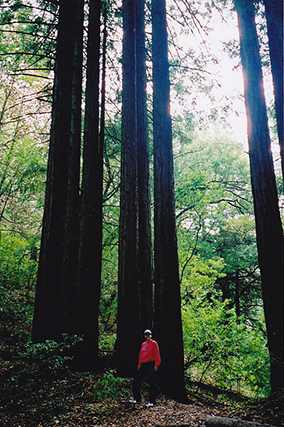
Standing with the Trees

Photograph © 2006 Peggy Kornegger

A few weeks ago, millions of Turkish citizens took to the streets in massive demonstrations throughout the country, protesting an increasingly authoritarian government. The event that triggered public outrage: police use of violence against activists who were sitting in trees in Istanbul’s Gezi Park to prevent their being cut down. Government plans to demolish both the trees and the park—in addition to turning nearby Taksim Square into a shopping mall—pushed people to the breaking point. The trees are some of the only ones remaining in the city, and the square is one of the last places for public gatherings.

Many other issues have been on the rise in Turkey, but it was the threat of forced separation from nature and from one another that was the people’s “last straw.” Trees have once again become a symbolic focal point in human awareness. The crowds gathered in Gezi Park and Taksim Square were standing up, not for an abstract environmental cause, but for the quality of their own daily lives. For the right to see green trees outside their door, for the right to meet with their neighbors in a public space not based in consumerism. Those who joined them in the streets throughout Turkey acted with deep human empathy both for their cause and for the physical suffering they endured. These protests continue.

Nearly 16 years ago, Julia Hill Butterfly took a similar stand—and endured helicopter harassment and repeated attempts to break her resolve—when she lived for two years in a 1500-year-old California redwood to prevent it being killed by a lumber company that was clear-cutting the redwood trees. Julia’s selfless actions have influenced countless others, including those who may not even know her name.

These courageous individuals were standing in the deeper truth of their oneness with all living beings, with all life. They were surrendering to a greater Spirit, or Intelligence, within them, which moved them beyond reason, beyond even personal safety, to live their lives fully aligned with the source of life itself. Nothing else mattered. They were not thinking; they were acting from their hearts. And this is the energy that is rising more and more powerfully in the world, infusing us with hope and possibility.

In many spiritual traditions, the tree of life symbolizes the entire cosmos and our place in it. The Maya of Guatemala consider the ceiba tree sacred, and the day Aaj in the Maya calendar stands for trees and abundance. On this day, the Maya pray for harmony and for the resurgence of nature. Their prayers, from their hearts, connect to each action, each word spoken, in their daily lives. We are being called to live similarly now, aligning our heart’s truth with how we are present in the world moment to moment. We each have countless opportunities to be in harmony with something greater than our own individual lives. Can we humans at long last stand within the circle of life instead of outside it?

Julia Hill Butterfly and the people of Turkey inspire me to believe that it is possible. And the trees themselves inspire me. Each day when I look out the window at the tall maple trees in my back yard, I am filled with reassurance that life continues, that just as the trees stand strong and tall, while at the same time bending with the winds of change, we too can do the same.

The Zen of Bird-Watching

Photograph © 2013 Peggy Kornegger
If you want to develop greater inner patience and be a better listener, become a bird-watcher. If you want to learn how to remain motionless in absolute silence for open-ended periods of time, become a bird-watcher. And, if you long to experience being so centered in present-moment awareness that nothing else exists, become a bird-watcher. Sound kind of Zen-like?

More than 20 years ago, I became a bird-watcher for none of the reasons mentioned above. I loved birds, that’s all. I loved their colors, their songs, their marathon migration flights between South and North America. Everything about them was awe-inspiring. Gradually, however, bird-watching also became a spiritual practice for me. Because my interest in birds developed simultaneously with my interest in meditation, the natural similarities became interwoven in my consciousness. Both meditation and bird-watching involve focus and quiet; they also require awareness and presence. I found that whether I was sitting in meditation at home or walking meditatively outdoors in nature, my inner consciousness and my outer behavior were almost identical.

Over the years, the peace that I feel while meditating or bird-watching has brought with it an underlying joy at being alive. In fact, the distinction between meditation and normal waking consciousness has blurred for me. The practice of centering my awareness in the present moment makes all of life a meditation. And never more so than springtime in Massachusetts, when birds by the thousands fly from the tropics to mate and raise families in North America. Every year, bird-watchers eagerly anticipate the magic of this relatively small window of time when the birds are passing through in a parade of colors and sound. Why the excitement, you may wonder?

Well, to me, their brightly colored spring plumage (reds, oranges, yellows, blues, greens) and their varied spring songs are just plain thrilling to see and hear. One of the first sounds signaling the coming seasonal changes is the ringing-telephone song of the red-winged blackbird (photo above). He lifts and spreads his wings to show off his colorful wing patches when he calls. As migration begins in earnest, the songs of the wood thrush and veery fill the woods with an ethereal flute-like quality that make me feel as if I have been transported to a sacred outdoor chapel. Two of my favorite birds are the orange-and-black Baltimore oriole and the red-and-black scarlet tanager, whose saturated colors often evoke audible gasps from bird-watchers when sunlight hits their feathers. Then there are the tiny warblers, in a class all their own, with an infinite variety of markings, colors, and songs. I especially love the blackburnian warbler, whose throat radiates a deep neon-orange in the sun, and the Canada warbler, whose lemon-yellow chest and throat are accessorized with a delicate black “necklace.”

It’s each bird’s unique beauty that captures my heart and transforms mere watching into something deeper. Meditation, contemplation, Zen peace of mind/spirit—but also more than that. There have been times when a bird has landed on a branch directly in front of me and begun to sing, looking directly at me. A thread of light, of living attention, links bird and human for a moment in time. It is then that I experience that miracle of connection that makes me believe unequivocally in the familial relationship of all beings on Earth.