Because of the current tumultuous political events in this country and worldwide, we need to hold a clear positive vision in our hearts of a more peaceful, compassionate world so that we don’t lose hope. In this week’s blog, which is a video instead of a written article, I talk about the importance of maintaining faith, hope, and clarity in our day-to-day lives. (See other recent videos of mine at Videos on the menu above.)
Category: Global change
Unmaking Enemies, Unraveling Fear
We are living through adversarial times in this country. People want to blame others for whatever they believe is wrong with their own lives. Immigrants, gay people, outspoken women—choose one or all of the above, and you have an instant “enemy.” It’s a behavioral pattern that can be traced back through centuries of human relationships on this planet.
Political groups—whether liberal or conservative; left, right, or center—have historically often based their identity on a perceived common threat or enemy—usually another group of people who epitomizes everything they think is bad or wrong in the world. Within small social groups, sometimes even families, people tend to single out one individual as problematic or unlikable. Religions founded in love often don’t extend it universally. Even heaven has been imagined as a place for some and not others (“sinners” are condemned to hell). Why do we do this? Why do we include some and not others, even in the afterlife? On the face of it, it seems ridiculous, an exercise in absurdity, as if humans could somehow control their own ultimate destiny—and who shares space with us on the journey.
We don’t begin our lives that way. As young children, we model our thoughts, feelings, and behavior after the adults who are close to us. Each of us receives that conditioning to one degree or another, wherever we are in the world. For some of us, mistrust and hatred become a way of life, and it dominates everything we say or do. Surely there must be a way out of this vicious cycle of hostility and aversion, based in fear of the “other,” that we are seeing so much of now.
What if we flip the paradigm and make a conscious effort to create a radical shift in this old conditioned behavior pattern that shows up everywhere, within us as well as outside of us? Awareness and intention can interrupt the toxic cycle of otherness, of “us” versus “them.” Let’s “unmake” enemies in this world by unmaking them in our own minds, our own families, our own social networks, and our own communities. Muslims are currently being targeted, along with a whole long list of others accumulated over the years. It’s time to intervene and make friends with those who the haters tell us to hate. Time to choose love instead of fear. Compassion instead of blame (for the haters as well, whose hatred often stems from their own self-hatred).
Just for a moment, imagine what the world would be like without enemies, without anyone to point a finger at and blame for the world’s ills. What if we were all friends, all family? Actually, anyone visiting from another planet would assume these tall two-legged creatures were all related—we look remarkably alike to an outsider. We’re the ones who make up things to distinguish ourselves from one another: skin color, eye shape, religion, politics. That’s how countries started. Separation, boundaries. Then petty grievances gradually turned to wars, and we forgot who we really are, that we who were born on Earth all came from the same vast energy source or consciousness (God, if you will), and we will return there. When we’re on our deathbeds, it all falls away. Nothing matters but the love we’ve shared.
Can’t we just do that now? Pretend we’re dying (because we are) and just love one another. Just love one another. Until the word enemy falls out of use completely, and universal friendship and cooperation is the only accepted behavior. Let’s agree to live love instead of hate, in every moment, every thought, every action. What else could possibly matter as much? Especially now.
Beyond Roles, Beyond Gender—Who Are You?
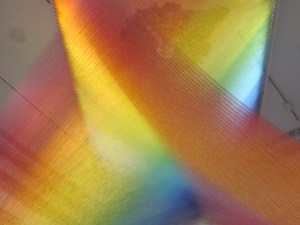
Gabriel Dawe, Plexus A1
We are alive at an amazing time on this planet. In spite of efforts by those desperately trying to patch them up, there are widening cracks in the old paradigms, and everything is shifting. Culturally constructed identities are dissolving, and infinite possibilities are opening up. Within the last few decades, movements for social change have shifted our very assumptions about what it means to be human. We have become aware of gender stereotypes and behavioral polarities that ultimately do not benefit anyone. Relationships between men and women have changed as men embrace their vulnerability and women embrace their strength. Narrow, constrictive definitions of gender roles and of gender itself have been called into question, and consequently we are all evolving into more expansive, more authentic whole human beings.
I grew up in the Midwest in the 1950s and 1960s, a “girl” as it was socially defined then. Yet, there have always been ways in which I did not exactly fit the mold of acceptability. I wore dresses and played with dolls, but I also wore jeans and climbed trees. I had crushes on boys, but girls were my best friends. In college in California, I embraced a flower-child/activist identity, wearing beads, bell-bottoms, and long Indian-print dresses as I took part in peace marches and student sit-ins. Once again, my love relationships were with men, but my closest friends were women. In my mid-20s, I became active in the feminist movement in the Boston area and eventually came out as a lesbian. I cut off my long “hippy” braids and wore colorful T-shirts, jeans, and artsy earrings. As a lesbian, I consciously chose relationships that were not defined by gender roles but by equality, balance, and celebration of each other’s uniqueness.
Today, I have been with my partner Anne for 34 years, married for the last 2. She and I have been able to share our lives and work through individual differences (and “imperfections”!) without the constraints of role expectations. Together we’ve seen the evolution of the LGBTQ community and the greater world around us over time. The wisdom and truth of “Love is love” has gradually entered the collective consciousness, and that has changed all of our lives. None of us are the same as we once were. Yes, homophobia, transphobia, and violence against those considered “different” still exists, but there has also been a shift to more acceptance of difference, of diversity. Minds are opening because of heart connections, because of a deeper recognition that we are all family on this planet. New possibilities for individual expression and equal relationships now exist for all people because of those who continue to shatter the old paradigm, just by being themselves.
To me, those individuals who consider themselves gender-fluid, gender-nonconforming, or non-binary are on the cutting edge of human evolution now. They stretch me the most in my own perceptions. By refusing to accept labels that perpetuate polarity (male, female), they inspire us all to ask: “Who am I beyond roles, beyond gender?” Indeed, who am I, as a human being, as a human soul? Really, the simple sacred truth “I Am” is the most accurate description of each of us on a soul level. The soul is infinite, eternal. Our human identities are temporary and not boxes that we have to fit into. The LGBTQ community has opened the door to life outside the boxes. We as human/divine beings are unboxable, indefinable, and infinitely expansive. And that is exactly why we all incarnated at this time: to embody limitless luminous rainbow consciousness as a species, as a planet. The entire global community of human souls is part of this extraordinary evolution of light within light. Every single shining one of us.
Shining Light in Shadowland

The United States is not united. Nor has it ever been, really. This is a country that has always been made up of people from different countries, cultures, races, religions, and belief systems. The first explorers and colonists—the first “immigrants”—imposed their lives upon the people who already lived here, the Native Americans. The formation of a new country was rooted in exclusion and appropriation.* That shadow has always been there, even as waves of immigrants from countless countries came here seeking freedom and liberation from oppression. Slavery was the most extreme manifestation of the shadow, and racism continues in its wake. The United States has always embodied dual, contradictory aspects: open arms and closed doors; freedom and injustice.
This election has brought to the surface all the fear-based shadows in this country, shadows that exist worldwide as well: intolerance, separation, inability to accept difference. And here is the hard part: As the shadow of humanity is on full display all around us, we have to look at its presence within us as well. Where do we see “other” instead of brother or sister? Where do we judge, condemn, or exclude people from our lives? In what ways do we tell ourselves that the world would be so much better if certain people just didn’t exist? Do we live with an open heart or a closed mind? Do we live in love or in fear?
On the morning after the election, I was traveling to Florida to attend Panache Desai’s annual global gathering. My state of mind was heavy, to say the least. As I found my seat on the plane to Charlotte, where I would change planes, the woman next to me whispered, “Governor Romney is over there.” “Who?” I asked, still in my own thoughts. “Mitt Romney,” she answered, pointing a few rows up, to first class. Finally, it registered, and in exasperation, I replied, “Oh, great, that’s just what I need today.” The woman looked a bit puzzled, and suddenly, it all struck me as very funny, and I began to laugh. (She chuckled a little, but I’m sure she had no idea why I was laughing.) Encountering yet another conservative former presidential candidate seemed to me like a comical cosmic wink or wake-up call. The message: “There will always be someone you disagree with on the plane of life.” In this out-of-the-ordinary occurrence, I was being reminded that from the perspective of global oneness, there is no “other.” No one is excluded.
And that is precisely why we are here on the planet at this time: To break the toxic habit of “otherness.” To find common humanity even when there appears to be none. To love in the face of hate, hope in the face of despair, have courage in the face of fear. You and I are being called to shine our own peaceful light ever more dynamically in the world, no matter what else is going on. To speak out for human rights and universal sister/brotherhood as we hold unconditional love for all in our hearts. (This is the basis of many nonviolent movements for social change.) In seeing every single “other” as another “one” in oneness, we come into greater balance and harmony, both individually and collectively.
Even when it seems unrealistic or emotionally impossible, take a deep breath and express the truth of your soul, which is love, which is kindness. Find the inner strength and compassion to keep expanding your heart until the shadow of separation falls away and you see yourself reflected in every face you encounter. That is the loving connection that holds our very diverse humanity together, in spite of the conflicts that pull us apart. In the wise words of Mahatma Gandhi: “Love is the strongest force the world possesses.”
______________________
*This continues today at Standing Rock Reservation in North Dakota, where Native Americans are protesting a proposed oil pipeline as an environmental hazard and a threat to their sacred lands.
African Dreams
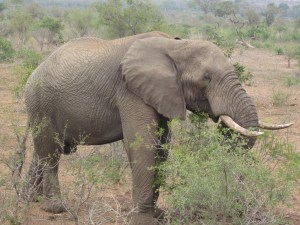
It was one of my life’s greatest blessings to travel to South Africa, where the animals are like nowhere else on Earth. Elephants, giraffes, zebras, impala, kudu, sable, lions, wildebeests, wart hogs, buffalo, nyala, waterbuck, crocodile, hippopotamus, rhinoceros, baboons, monkeys, bush babies, honey badgers, and many more. The birds too are unique: bee-eaters, hornbills, storks, spoonbills, ostriches. The grey go-away bird and the Egyptian goose with bright pink legs and feet. All miraculous beings living in a world that has drastically changed because of human activities and population growth.
The wild animals of Africa can no longer survive outside of reserves, where they are protected, in theory, from game hunters, poachers, and those who see them as a threat to farms and villages. Still, poachers find ways to enter the reserves (by helicopter) to kill elephants for their tusks and rhinoceroses for their horns. There is a high price paid in various countries for them. The animals face food and water shortages because of drought and the fact that fences block them from following their age-old migration routes across Africa. The heartbreaking worldwide dilemma of humans and animals inhabiting the same areas and using the same scarce resources is nowhere as dramatically visible as in Africa. Foreign investors buy up land to raise rhinos for their horns; private game reserves offer hunting for those who can pay for the “pleasure” of killing exotic animals. Colonialism has not disappeared; it has just taken new forms. You can see it in the everywhere-visible electrified wire fences “protecting” houses, land, and supposedly animals.
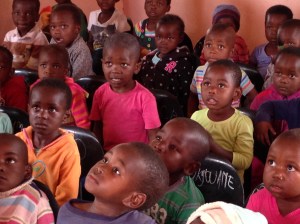
I came to South Africa to volunteer at Moholoholo Wildlife Rehabilitation Center and Daktari Bush School and Wildlife Orphanage and then to see the magnificent animals in the wild. This was not a usual tourist trip, but one where we learned about the enormous challenges faced by the people as well as the animals. Daktari offers an intensive teaching curriculum for 10-11 underprivileged students a week (grade 8) from neighboring schools. They receive class instruction from volunteers (with special focus on the environment and wildlife) and learn firsthand about animals by helping to care for them (they are often afraid of them at first). They also learn about possible future jobs in Africa’s animal reserves.
The students arrive shy and reluctant to speak and usually leave with more self-confidence and a greater ability to express themselves. Still, when we visited the daycare centers and schools that they came from, we saw the uphill battles they face. Schools with hundreds of students and only a handful of teachers; many classrooms with no teachers at all. When they finish school, many encounter either unemployment or jobs that are mostly low income. Racism and poverty have not disappeared with the end of apartheid.* In spite of the odds stacked against them, however, the students we met wanted to make a difference in their communities.
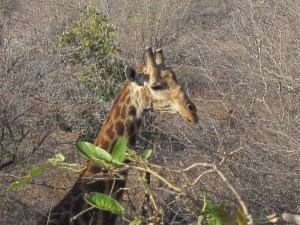
We heard various stories about the animals in the reserves. Some of the staff at Moholoholo and Daktari told us that the two-year drought is drying up both food and water, and animals are dying. That there are far too many of some animals in the reserves (because they are prevented from migrating), and culling operations often kill off the “excess.” Still, many are starving, and some are driven to break through fences to get to food and water, where they are killed by farmers protecting their crops.** A tragic situation. Meanwhile, the rangers at Kruger National Park, one of Africa’s largest animal reserves (7,523 sq. mi.), told us that drought is normal, part of Africa’s savanna climate cycle, and that culling is infrequently necessary. Of course, this is the softer picture presented to tourists, so that they will continue to come to Africa.
So we as visitors who wanted to help, but also tourists in spite of ourselves, did what we could while we were there–offered our love and support to the children and animals and the people we met. A small gesture within a huge continent facing huge conflicts and challenges, within an even bigger world that often sees this unique land only in terms of the money that can be made by exploiting it and the people who live there. We who visit can only know a part of the larger picture, but even so, we can speak about what we have experienced—about the extraordinary beauty of the land, the animals, and the people, and about how precious they are in the greater landscape we all inhabit. Until we can see every part of this world as part of us, we cannot live in oneness. It begins with seeing other people as like ourselves, by seeing every living creature as a sentient being, and by honoring the Earth as sacred ground. To live with good heart upon this planet, wherever we are and whomever we meet. From the African word ubuntu: compassion, humanity, kindness for all. In so many ways, visible and invisible, we are all connected.
_______________
*Just as racism and poverty have not disappeared in the United States in spite of the civil rights laws passed in the 1960s
**Just as wolves are killed by ranchers in the western United States when they leave the protection of national parks


You must be logged in to post a comment.