It’s All About Love, Always

Photograph © 2017 Peggy Kornegger

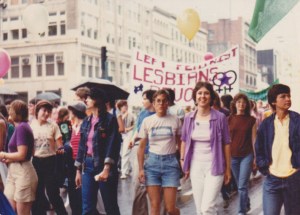
A few weeks ago, I watched the four-part series “When We Rise,” about the recent history of the LGBTQ community in the U.S. and the fight for our basic human rights, including marriage equality. At the end, I felt emotionally exhausted, like I had relived the last 39 years of my life. I lived in San Francisco in 1978 at the time of the California Briggs Initiative to ban gay/lesbian schoolteachers, thankfully defeated, and the shooting death of gay city supervisor Harvey Milk. In 1981, I moved back to Boston, right before the beginning of the AIDS epidemic, which would take the lives of thousands of gay men. Every year I took part in the AIDS Walk to raise money for those with AIDS, and I lost dear friends on both coasts to this terrible disease. In 1987 and 1993, I marched on Washington for LGBTQ rights and freedom, and each year there was a Pride March in Boston (in June, to coincide with the 1969 Stonewall uprising in New York). Those were years of great sadness and loss, and yet the love in our hearts and the hope that together we could bring about change kept us going.

In 2004, Massachusetts became the first state to legalize same sex marriage, and the movement for marriage equality continued to gain momentum. In 2013, the Supreme Court struck down DOMA (the Defense of Marriage Act), and in 2015, it ruled in favor of same sex marriage nationwide. My partner and I, who had been together for 31 years, married in 2014, with family and friends celebrating with us. Suddenly, seemingly out of nowhere, the national consciousness had shifted significantly toward love and inclusiveness over bigotry and hatred. We all had gotten so used to living with secrecy, fear, and the threat of violence that when acceptance appeared, it was almost shocking—extremely emotional and powerful for each of us. But it had not really been sudden; years of activism and private and public “coming out” had brought about the change. The rainbow lights shining across the country on national monuments, as well as the White House, reflected the magical new reality we were all experiencing.

However, today in 2017, a new administration, accompanied by a conservative backlash, is already beginning to whittle away at our hard-won gains, beginning with transgender rights. LGBTQ community members are currently the top target for acts of hatred in the Boston area. We are not done. Freedom, equality, and justice for all people are ideals that must be lived and upheld every single day. We do that by not giving up, by not allowing outrage or depression to overrule the universal compassion and kindness in our hearts. Intolerance still exists, but we are here to live our love, and we won’t stop. Not now, not ever. The music of our hearts and souls will carry us forward.
Photograph © Peggy Kornegger

I have changed in so many ways in the last 39 years, yet the core of me remains the same. I too am here to live love in the world. When I am meditating alone or in spiritual circles, when I am marching in demonstrations, when I am speaking my truth, I am centered in that love. A living prayer for love that includes friends and strangers alike around the world. Our hearts and souls link us together into one family. We are all connected, we very diverse humans on planet Earth, reaching out for freedom, equality, and the right to self-expression. In the deepest part of our being, we are not so different; we all want similar things in this life. Ultimately, it’s all about love. Always.

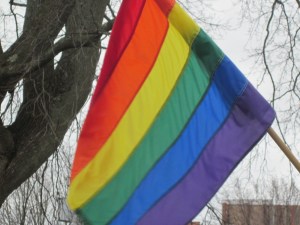
In Memoriam: Gilbert Baker, who in 1978 created the first rainbow flag in San Francisco, died last Friday, March 31, at the age of 65. That first hand-dyed and hand-stitched rainbow flag became the international symbol for LGBTQ pride and freedom.
Faith, Hope, and Clarity

Because of the current tumultuous political events in this country and worldwide, we need to hold a clear positive vision in our hearts of a more peaceful, compassionate world so that we don’t lose hope. In this week’s blog, which is a video instead of a written article, I talk about the importance of maintaining faith, hope, and clarity in our day-to-day lives. (See other recent videos of mine at Videos on the menu above.)

The Deepest Peace

© 2016 Anne S. Katzeff / Artist

I have discovered that the more I want a situation or person to either change or stay the same, the more I suffer. Yet I have also found that there is a peaceful core within me that understands impermanence and nonattachment. These two Buddhist principles have helped me accept the transitory nature of life. When I am deep in meditation, experiencing profound inner peace, I see clearly the truth of impermanence (nothing, good or bad, ever stays the same) and how letting go of attachment to a particular outcome frees me from the mental/emotional habits of the personality self. At the soul level, all is well, unfolding perfectly for my own expansion and evolution.

Embracing impermanence and nonattachment has been a gradual process for me, over many years. They used to be just concepts that I thought sounded good but I couldn’t really connect to experientially. Lately, however, as my spiritual awareness has deepened, those two insights have risen to the forefront of my consciousness. I often repeat them to myself like mantras to access the peace within me, which they are an integral part of. This is the soul’s peace, which does not judge or have opinions; it just witnesses. And from the witness’s point of view, it does not matter if something or someone changes or not. It’s all part of a greater picture that I, as a human being, have a limited ability to see in its entirety. I just have to trust in my soul’s perception (and in God) and surrender to the power of a divine purpose in everything.

Surrender and trust have also been key to letting go within my own life. They, too, accompany the experience of inner peace that I am connecting to more and more. There is a reason why these principles have been around for thousands of years and have been at the core of the teachings of great spiritual masters. They bring us to a place of flow in our lives, accepting “what is” and aligning with the continuous fluctuations of human existence. This is a time on Earth when the voices and energetic imprints of the greatest teachers are becoming more available to everyone. Their wisdom and beingness within the collective consciousness are here to help us as we move into our own wisdom and life mastery.

Events in the world, and particularly within this country, are now making it essential for us to live in connection with our souls, accessing the deeper truths about life and living. In an environment in which people are being persecuted because of bigotry and prejudice, where is justice? How do we live with this? How do we love all of humanity when some are acting in destructive, hateful ways? This is the challenge of our times: to live in such a way that our own souls’ wisdom and light affect the collective consciousness in a positive way. If we believe that love is stronger than hate, and peace more powerful than fear, then we need to live that in every moment. For ourselves and for everyone who crosses our path. When we shift our own energy out of judgment and outrage, then everything begins to shift around us. The peaceful soul brings peace to the world. As I see it, this is how we are evolving as a people and as a planet within a huge constantly changing universe. May we all help each other find our way again and again to deep inner peace.

Unmaking Enemies, Unraveling Fear

Photograph © 2017 Peggy Kornegger

We are living through adversarial times in this country. People want to blame others for whatever they believe is wrong with their own lives. Immigrants, gay people, outspoken women—choose one or all of the above, and you have an instant “enemy.” It’s a behavioral pattern that can be traced back through centuries of human relationships on this planet.

Political groups—whether liberal or conservative; left, right, or center—have historically often based their identity on a perceived common threat or enemy—usually another group of people who epitomizes everything they think is bad or wrong in the world. Within small social groups, sometimes even families, people tend to single out one individual as problematic or unlikable. Religions founded in love often don’t extend it universally. Even heaven has been imagined as a place for some and not others (“sinners” are condemned to hell). Why do we do this? Why do we include some and not others, even in the afterlife? On the face of it, it seems ridiculous, an exercise in absurdity, as if humans could somehow control their own ultimate destiny—and who shares space with us on the journey.

We don’t begin our lives that way. As young children, we model our thoughts, feelings, and behavior after the adults who are close to us. Each of us receives that conditioning to one degree or another, wherever we are in the world. For some of us, mistrust and hatred become a way of life, and it dominates everything we say or do. Surely there must be a way out of this vicious cycle of hostility and aversion, based in fear of the “other,” that we are seeing so much of now.

What if we flip the paradigm and make a conscious effort to create a radical shift in this old conditioned behavior pattern that shows up everywhere, within us as well as outside of us? Awareness and intention can interrupt the toxic cycle of otherness, of “us” versus “them.” Let’s “unmake” enemies in this world by unmaking them in our own minds, our own families, our own social networks, and our own communities. Muslims are currently being targeted, along with a whole long list of others accumulated over the years. It’s time to intervene and make friends with those who the haters tell us to hate. Time to choose love instead of fear. Compassion instead of blame (for the haters as well, whose hatred often stems from their own self-hatred).

Just for a moment, imagine what the world would be like without enemies, without anyone to point a finger at and blame for the world’s ills. What if we were all friends, all family? Actually, anyone visiting from another planet would assume these tall two-legged creatures were all related—we look remarkably alike to an outsider. We’re the ones who make up things to distinguish ourselves from one another: skin color, eye shape, religion, politics. That’s how countries started. Separation, boundaries. Then petty grievances gradually turned to wars, and we forgot who we really are, that we who were born on Earth all came from the same vast energy source or consciousness (God, if you will), and we will return there. When we’re on our deathbeds, it all falls away. Nothing matters but the love we’ve shared.

Can’t we just do that now? Pretend we’re dying (because we are) and just love one another. Just love one another. Until the word enemy falls out of use completely, and universal friendship and cooperation is the only accepted behavior. Let’s agree to live love instead of hate, in every moment, every thought, every action. What else could possibly matter as much? Especially now.


Dog Spelled Backward

Photograph © Peggy Kornegger
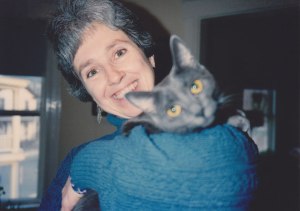
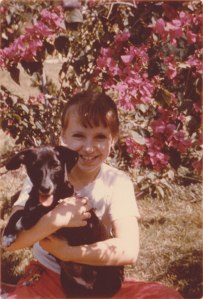
Admittedly, I am a cat person. Even though I grew up with a dog companion (Pepper), whom I loved dearly, cats have been closest to me as an adult: Edward for 8 years and Lily for 22. Of course, animals of all kinds touch my heart, and this has become increasingly true as my own awareness has expanded to be able to perceive the intelligence and sensitivity of all living beings on our planet. In my garden, I have sweet and often funny exchanges with birds, bees, butterflies, squirrels, rabbits, and chipmunks. A connection and communication beyond words frequently passes between us.

Since I am a gardener, I am outdoors a lot of the time in the spring, summer, and early fall. As I plant and take care of my flowers in the yard, I often see neighbors walking their dogs. All kinds of dogs: labs, Scotties, pit bulls, schnauzers, pugs, huskies, terriers. Some are intent on their “appointed rounds” through the neighborhood, sniffing every tree and bush and not that interested in the occasional human gardener. Others, however, are absolutely thrilled to encounter another human besides the one at the other end of their leash.

Two dogs in particular come to mind: a small white terrier named Honus and a large black lab named Maggie. One morning, as I was on my hands and knees pulling weeds in the front border, I heard a kind of whining panting sound immediately behind me. I turned, and there was Honus, straining to get to me, at the absolute end of his leash, as his person tried to keep him contained. He was still a bit of a puppy then, waggling all over, his eyes sparkling with excitement and the overriding desire to get close enough to greet me with licks and touches. Who could resist such intensely focused friendliness? I immediately fell in love with Honus. Every single time I’ve seen him after that initial encounter, he has behaved exactly the same: so excited to see me, this human crawling around on the ground at his level. He is always stretching to get to me before I hear him, turn around, and then reach out to pet and talk to him. It’s a huge gift that makes me happy all day.

Maggie is a much older dog—a large black lab with gray hairs around her mouth. When I first met her, she behaved exactly the same as Honus. As she and the man with her passed by the front yard where I was gardening, I said hello. Maggie turned to look at me, and as soon as my eyes met hers, she began to wag her tail with enthusiasm and excitement, reaching out to me eagerly. Once again, I just had to walk over and pet her. Her eyes were filled with such happiness and love. No other way to describe what I saw there. She emitted a completely uncomplicated and unconditionally loving presence. Something I’ve seen so many times in dogs—and cats, too. Something almost sacred in its purity and spirit. So is it a coincidence that dog spelled backward is god?

Well, let me tell you another story. In recent years, my spiritual practice has opened my eyes to seeing God in everything. Literally everything: human, animal, insect, tree, rock, chair, rug, computer, star, planet. In the midst of this awakening, I watched the world around me transform. Everything I looked at began to take on a special quality of living light. One afternoon, on my usual walk around my neighborhood, I encountered a woman with her pit bull. As I passed them, the dog and I looked into each other’s eyes. I stopped completely. There gazing at me through this pit bull’s eyes was God—life energy shining forth, joyful awareness, pure beingness. Tears filled my eyes. God recognizing God, no separation.

Photograph © Peggy Kornegger

If we could only realize that our entire world is made up of this oneness. Life reflecting life. It is everywhere! God meets God on the street every single day. That innocent, curious, welcoming essence that dogs and cats often show us is within us as well. We had it as children; we just need to allow it to come to life again. Years ago, my father, in his aging wisdom, once said, “If only I could be more like a dog.” Meaning, more forgiving, more loving. He could see that our companion animals are living examples of unselfish sweetness and love. Time to pay attention. Time to see the God in Dog. And in ourselves.