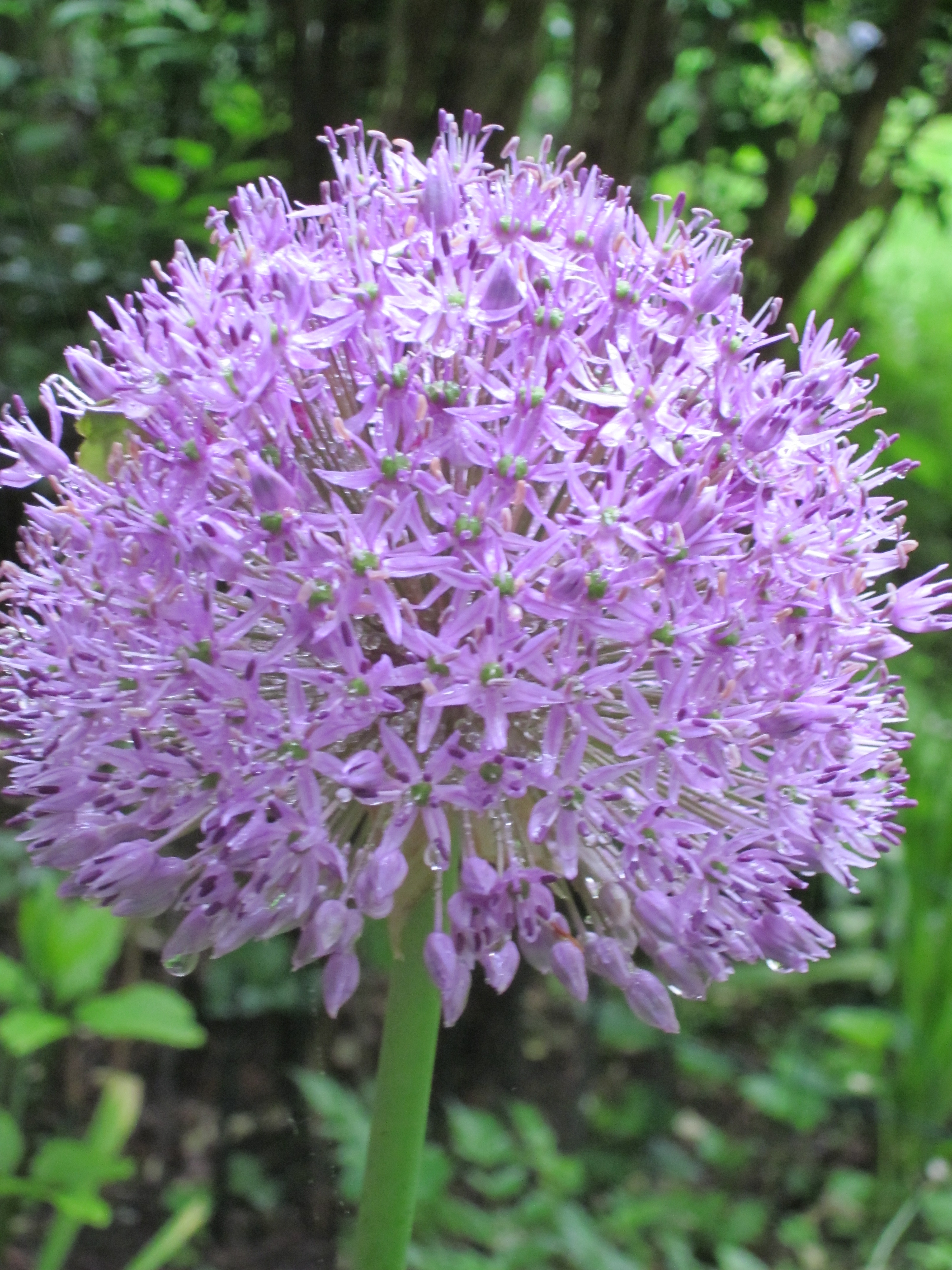
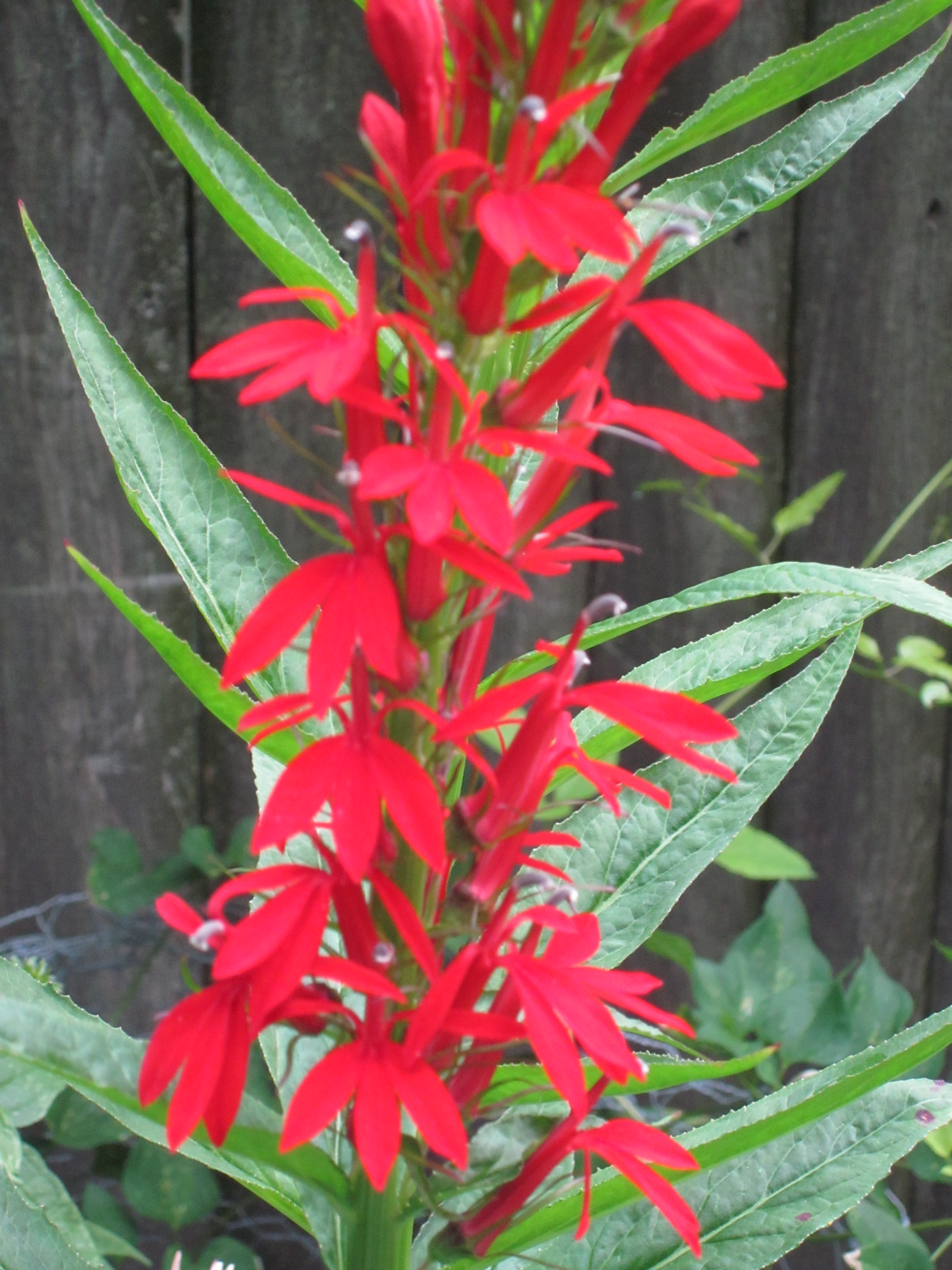
My own backyard and flower garden are full of nature’s fractals. Perhaps that’s one reason why I love being in nature. I am continually in awe of the colorful patterns I see there, whether bird feather, butterfly wing, flower, or leaf. When I sit and gaze at the beauty with patterning in mind, I begin to see the connectedness of everything on Earth. The tiger swallowtail butterflies that visit my butterfly bush in summer call to mind their namesake, the tiger. An allium flower is made up of tiny flowerettes, forming a larger ball that looks like a small lavender planet. Sunflowers, of course, resemble the sun itself, with rays of golden light shining out. Many other flowers are named for what they remind us of. Cleome, or spider flowers, have long thin stamens that resemble the legs of a spider. Cardinal flowers look like smaller versions of the brilliant red feathers of the male cardinal. And pastel-pink bleeding hearts, which hang by the dozen from the branches of the plant, are indeed just like tiny hearts.
When I work outside in the garden, I am reminded again and again of the extraordinary complexity of the living world. Every plant, flower, insect, bird, stone, and piece of dirt is an integral part of something much greater, of which I too am a part. I look at the sunlight filtering down through the trees, the clouds floating by overhead, the hummingbird darting between the honeysuckle and bee balm flowers, and I feel the oneness that connects every small fragment of life everywhere: I am the leaf and I am the tree. I am the wave and I am the ocean. I am the spiral shell and I am the galaxy. We are all fractals in an infinite, perfectly designed and geometrically sacred multiverse. We are all fractals of God.
Every year in early May, I spend three to six hours each morning at nearby Mt. Auburn Cemetery. Why? you may wonder. Well, Mt. Auburn, with its woodlands, lakes, and gardens, is a magnet for songbirds during their annual spring migration. They fly in by the hundreds on the way north from South and Central America. Some of them nest in the cemetery; others continue further to northern New England and Canada. But during the small window of time that they grace our local flowering trees and bushes, birdwatchers are blessed with up-close views of the colorful and musical birds of the tropics. Each year, I see or hear something new: a chestnut-sided warbler and a ruby-throated hummingbird having a territorial faceoff; a flycatcher singing next to a kinglet displaying its usually hidden ruby crown; a Baltimore oriole weaving a hanging nest in a tall maple tree; a wood thrush singing its fluted song on the path a few feet in front of me. These moments are magical—a fleeting glimpse into nature’s secret world.
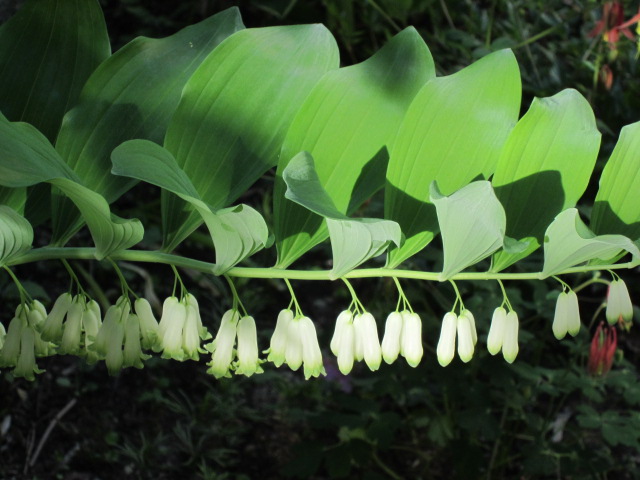
Equally as exciting at this time of year are the perennial plants and flowers that break through the soil reaching to the light. How do they know when to move upward, when to grow stems, leaves, and flowers from their buried roots? It’s a yearly miracle that I witness both at Mt. Auburn and in my own backyard garden. Tightly furled leaves and flower buds appear first, gradually opening to the sun’s warmth and the longer light-filled days. A plant like Solomon’s Seal begins as a blunt grey/green finger pointing up out of the ground. Day by day, the finger slowly becomes a tall thick stem that bends and arches with opening leaves of fernlike delicacy. Beneath the leaves, along the arching stem, small white buds form and eventually open into a line of belled flowers. Swaying in the wind, Solomon’s Seal is one of the special visual gifts of spring, along with lilies of the valley, violets, grape hyacinth, columbine, and so many others.
Year after year, spring flowers and nesting birds remind me of life’s cycles of rebirth and renewal. After a long icy-cold Massachusetts winter like the one we have just experienced, this is a welcome message. Even in the freezing temperatures, even in the dark, life continues. The birds migrate south and return to raise their families; the plants withdraw into the earth to rest before emerging to bloom again in spring. Humans, too, have their cycles, though many of us have forgotten how to align ourselves with life’s rhythms of rest and renewal. If we look to the natural world, we can see that each living being has its own cycle of birth/flowering, rest/renewal, rebirth. In our over-scheduled, busy lives, we often careen out of control and crash in exhaustion. Yet, if we let go of so much trying and effort and allow life to unfold in cycles of activity, rest, renewal, and rebirth, we will feel so much more in tune with ourselves and all of life.
In spring’s wonders, there is great beauty, but there is also great wisdom, showing us firsthand the ever-turning circle of life/rest/rebirth that we too are part of. Something more powerful than our own attempts to control daily life is at play here. If we surrender to the flow of life that is so stunningly visible in springtime, we open ourselves to both inner peace and connection to spirit.
We learn to talk when we are babies, expressing ourselves in sounds and eventually words that make sense to those around us. Speech and verbal communication are encouraged and celebrated. What an achievement that first word is—a rite of passage in the human journey! Listening, however, is not given quite the same emphasis or encouragement. In school, we take classes in speech but not in listening. Within the context of polite behavior, we are told to listen and not interrupt, but learning to be silently present with focused attention in a variety of situations is not part of the curriculum. Neither is quiet time spent in meditation or contemplation. Western society is noisy and wordy and very distracting, and we learn to live with it in whatever way we can, often to the detriment of our inner spirit.
As an only child, I played quietly by myself as much as with friends, but I didn’t begin to learn the true value of silence and of listening until I was well into adulthood. Although from a rural background, I acclimated easily to the novelty of living in cities and thought little of urban noise for years. At some point, however, I began to notice, and then couldn’t stop noticing, the lack of quiet everywhere. I sought out silence—in meditation classes, in parks, on vacations to natural settings away from the city. I took up bird watching as a way of immersing myself in nature, and it was then that I really began to learn how to listen.
In order to observe birds closely, you have to be willing to stand or walk in absolute silence, your senses of sight and hearing keenly attuned. When you are silent and motionless, the natural world gradually resumes its normal activity, which it had ceased at the appearance of a noisy human. What a miracle this was to me when I first experienced it. The more I listened, the more I heard: birdsong, bees buzzing, squirrels chattering, chipmunks scampering through the bushes, the wind rustling tree leaves and creaking branches. My soul was in silent communion with everything around me. Over the years, my listening deepened to the point where I felt I could actually hear flowers growing in my garden in the early morning stillness. Sounds fantastic, I know, but when you quiet yourself enough and truly listen, the world opens up its secrets to you.
Birds and flowers weren’t the only ones to teach me about listening. The elder parents in my life also taught me this sacred life lesson. Both my father and my partner’s mother experienced memory loss and related dementia in their later years. What you learn first in that situation is not to rush or finish the other person’s sentences, but to allow them time/space/silence to find the words they want to say. And if they don’t find the words, so what? Really the words themselves are unimportant. You learn to listen to the spaces between the words to hear what is really being communicated. I listened with my heart, with my soul. The last time I saw him, my father and I shared a lifetime of love just by looking in each other’s eyes. When he spoke, I heard his heart’s voice beneath the words. And during the afternoons when my partner and I sat quietly with her mother listening to 1940s tunes, we experienced together the beauty of the songs as well as the silence between the songs. Our spirits were connected in that peaceful space.
Perhaps what I am describing can’t really be taught in school, but only in life. We learn to listen as we learn that there is more to this world than the physical dimension. The longer we live, the wider our perception and awareness grows (if we are fortunate), and the closer we come to the essential stillness that is at the core of being and at the center of the cosmos. Out of silence, sound is born, life is born. When we listen deeply enough, we hear the sound of silence itself. And that is the place where our souls speak to one another, without words.
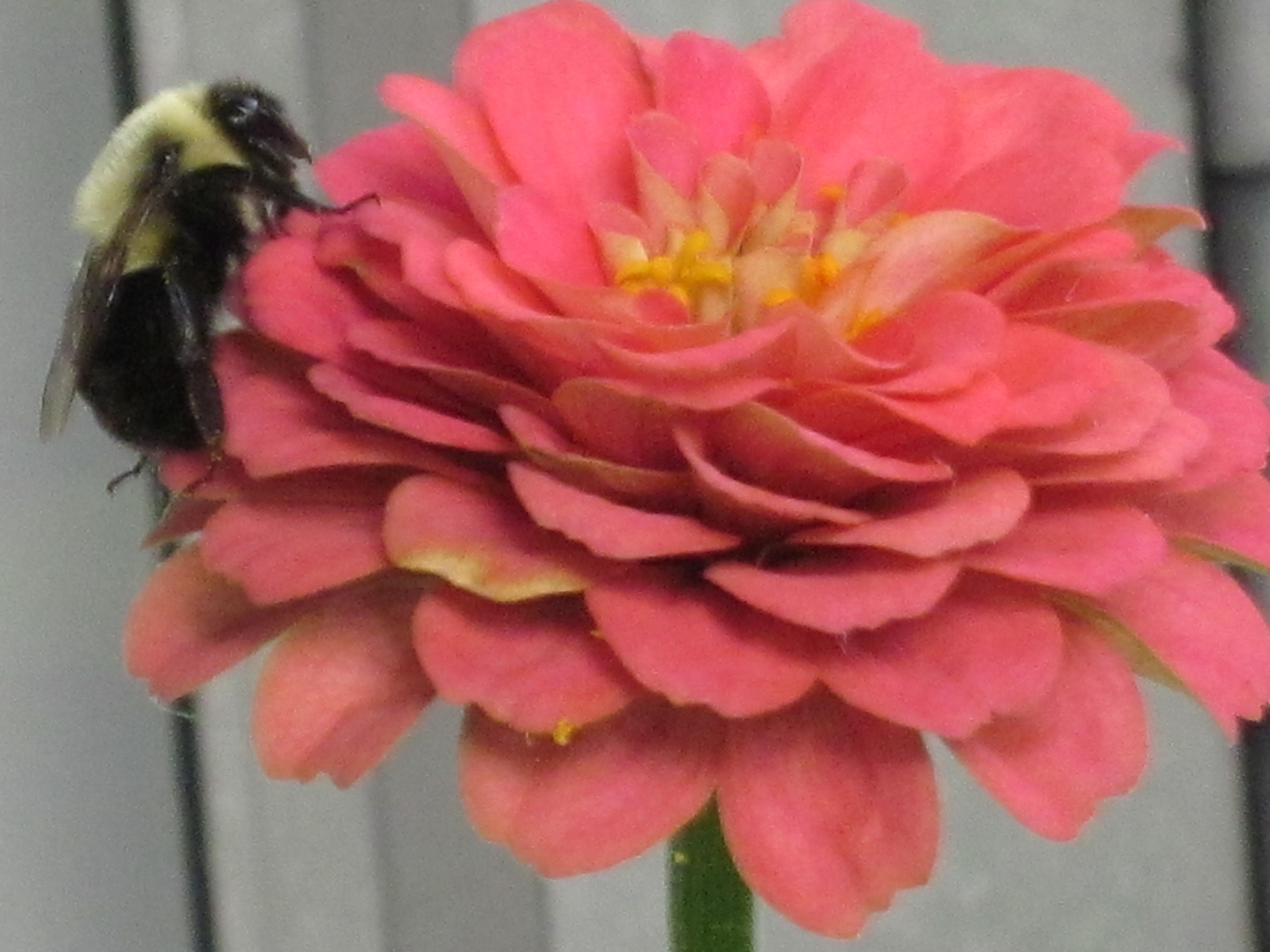
Soon, butterflies and birds did indeed begin to frequent the flowers and bushes in my yard. Unexpectedly, though, it was the bees that completely stole my heart. I discovered that there were at least 5 or 6 different kinds that visited the flowers, including honeybees and bumblebees. I watched them all and learned more all the time, just by observing their behavior. The evening that I discovered a bumblebee curled up for the night on the petals of one of my zinnias, I fell in love. I felt such tenderness, as if it were my own child.
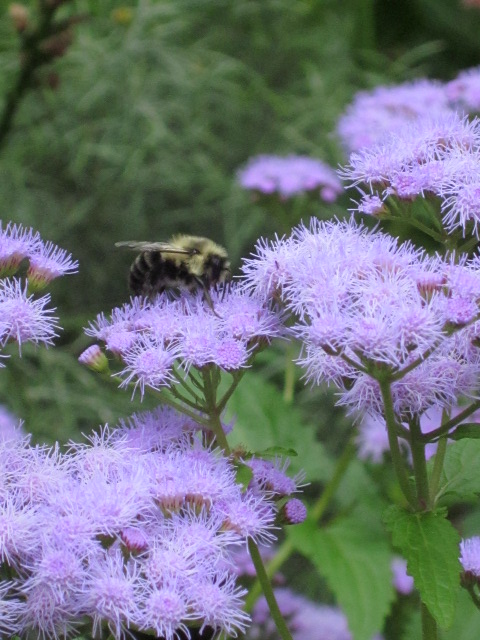
Over the weeks and months, I found that bumblebees also “slept” on blanket flowers, bachelor buttons, pincushion flowers, sedum, cosmos, and the butterfly bush. Their most interesting bed, however, was the 6-foot-tall Joe Pye weed, which has large clustered fluffy pink blossoms. In the late evening, I would often find 8 or 9 bees on the different levels of flower clusters, snuggled into their own down comforters. When it rained, they would hang beneath the flower clusters, using them as umbrellas while they rested.
In the mornings, if it was cool or damp, the bees would often “sleep in” until the sun warmed the air. Sometimes I would see a bumblebee slowly stretching its legs, one by one, as if limbering up after its night’s immobility. I always wished them good morning and good night, and I believe they were aware of my presence as a “friend,” occasionally buzzing up to my face in greeting. I’ve had butterflies behave in a similar fashion, sometimes even landing on my chest or arm to sit in the sun. It was a beautiful life lesson about the conscious intelligence of all beings.
Bees, which many people hardly notice, provide irreplaceable support to the cycles of life on Earth by pollinating the flowers. The massive deaths of honeybees and bumblebees in recent years have been heartbreaking. The probable cause: pesticides and herbicides used by agribusiness, landscapers, and often homeowners as well. It is my hope that people will begin to understand the wisdom and urgent necessity of gardening and eating organically, for the health of our bodies, our planet, and all the creatures that inhabit it. You only have to fall in love with one flower, one tree, one animal, or one bee to feel the interconnectedness of all life. In one(ness) is the survival of all.
Note: A reader has reminded me that GMOs are another likely culprit in the collapse of bee colonies. Thus the key importance of the current consumer campaign against GMOs in the U.S. For more information, visit: http://www.organicconsumers.org/bees.cfm.
Not long ago, I decided to unplug myself from technology for a month. I took a mini-sabbatical from computers (including all email and editorial work), TV, and radio (I don’t own a cell phone). It was with a huge sigh of relief that I did this. My days had begun to be filled with such constant busyness that even finding time to meditate or take long walks seemed difficult. When I stopped sitting for hours in front of the computer, my life opened up all around me.
At the same time that I closed the technology door, I opened another door—to the natural world outdoors and the world of spirit present everywhere. Outside in my backyard, I gardened, read, meditated, or just gazed at passing clouds in the sky or the sun on the flowers in my garden. I often felt transported to another dimension where only infinite variations of light were real. Life seemed as fragile and precious as a flower petal or an inhaled breath. There were moments when all I felt was gratitude for the gift of being alive.
In my journal I wrote: “We have this one lifetime to live in a human body, to look through human eyes and see the beauty of the world. I just want to drink in the wonders all around me, to feel in my heart each exquisite detail of flower, leaf, and cloud. I could look at the sky forever and never come to the end of its magnificence. Every bird and butterfly and bee is a tiny miracle. In the swirling center of each flower is a sacred universe. I am so blessed to have this life on Earth. I don’t want to miss a thing. I don’t want to lose a second looking at a computer or TV when the world and all its breathtaking beauty is just outside the door.”
Along with the wonder and awe came a deep connection to the living spirit that existed in the natural world all around me. The spirit within me embraced the spirit everywhere outside of me, and I stepped into a profound experience of oneness that expanded with each passing day. I found that within each exquisite detail of the universe that I perceived with my physical eyes was an invisible thread that led to the infinite Source of all things. William Blake described this perfectly: “To See a World in a Grain of Sand/And a Heaven in a Wildflower/Hold Infinity in the palm of your hand/And Eternity in an hour.”
So did I renounce all technology for the rest of my life after discovering “God in the details”? No, of course not. We live in a human world that has manifested global communication via the Internet. If it doesn’t overtake your life, it can be a wonderful vehicle for experiencing worldwide interconnections. The key is balance, as in all things. I still check my email, visit favorite websites, and even listen to spiritual webcasts, but I’m now more in touch with when it’s time to turn off the computer and walk out the door into nature’s paradise.
 Spiritflower
You must be logged in to post a comment.