The Magic of Springtime

Photograph © 2014 Peggy Kornegger

Every year in early May, I spend three to six hours each morning at nearby Mt. Auburn Cemetery. Why? you may wonder. Well, Mt. Auburn, with its woodlands, lakes, and gardens, is a magnet for songbirds during their annual spring migration. They fly in by the hundreds on the way north from South and Central America. Some of them nest in the cemetery; others continue further to northern New England and Canada. But during the small window of time that they grace our local flowering trees and bushes, birdwatchers are blessed with up-close views of the colorful and musical birds of the tropics. Each year, I see or hear something new: a chestnut-sided warbler and a ruby-throated hummingbird having a territorial faceoff; a flycatcher singing next to a kinglet displaying its usually hidden ruby crown; a Baltimore oriole weaving a hanging nest in a tall maple tree; a wood thrush singing its fluted song on the path a few feet in front of me. These moments are magical—a fleeting glimpse into nature’s secret world.

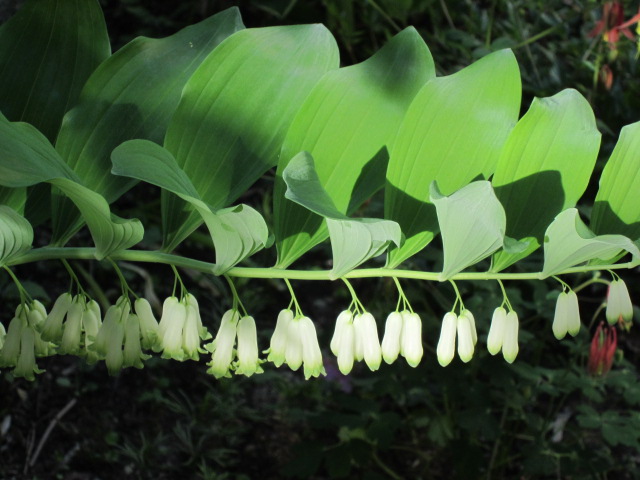
Equally as exciting at this time of year are the perennial plants and flowers that break through the soil reaching to the light. How do they know when to move upward, when to grow stems, leaves, and flowers from their buried roots? It’s a yearly miracle that I witness both at Mt. Auburn and in my own backyard garden. Tightly furled leaves and flower buds appear first, gradually opening to the sun’s warmth and the longer light-filled days. A plant like Solomon’s Seal begins as a blunt grey/green finger pointing up out of the ground. Day by day, the finger slowly becomes a tall thick stem that bends and arches with opening leaves of fernlike delicacy. Beneath the leaves, along the arching stem, small white buds form and eventually open into a line of belled flowers. Swaying in the wind, Solomon’s Seal is one of the special visual gifts of spring, along with lilies of the valley, violets, grape hyacinth, columbine, and so many others.

Year after year, spring flowers and nesting birds remind me of life’s cycles of rebirth and renewal. After a long icy-cold Massachusetts winter like the one we have just experienced, this is a welcome message. Even in the freezing temperatures, even in the dark, life continues. The birds migrate south and return to raise their families; the plants withdraw into the earth to rest before emerging to bloom again in spring. Humans, too, have their cycles, though many of us have forgotten how to align ourselves with life’s rhythms of rest and renewal. If we look to the natural world, we can see that each living being has its own cycle of birth/flowering, rest/renewal, rebirth. In our over-scheduled, busy lives, we often careen out of control and crash in exhaustion. Yet, if we let go of so much trying and effort and allow life to unfold in cycles of activity, rest, renewal, and rebirth, we will feel so much more in tune with ourselves and all of life.

In spring’s wonders, there is great beauty, but there is also great wisdom, showing us firsthand the ever-turning circle of life/rest/rebirth that we too are part of. Something more powerful than our own attempts to control daily life is at play here. If we surrender to the flow of life that is so stunningly visible in springtime, we open ourselves to both inner peace and connection to spirit.
 

Learning to Listen

Copyright © 2013 Peggy Kornegger

We learn to talk when we are babies, expressing ourselves in sounds and eventually words that make sense to those around us. Speech and verbal communication are encouraged and celebrated. What an achievement that first word is—a rite of passage in the human journey! Listening, however, is not given quite the same emphasis or encouragement. In school, we take classes in speech but not in listening. Within the context of polite behavior, we are told to listen and not interrupt, but learning to be silently present with focused attention in a variety of situations is not part of the curriculum. Neither is quiet time spent in meditation or contemplation. Western society is noisy and wordy and very distracting, and we learn to live with it in whatever way we can, often to the detriment of our inner spirit.

As an only child, I played quietly by myself as much as with friends, but I didn’t begin to learn the true value of silence and of listening until I was well into adulthood. Although from a rural background, I acclimated easily to the novelty of living in cities and thought little of urban noise for years. At some point, however, I began to notice, and then couldn’t stop noticing, the lack of quiet everywhere. I sought out silence—in meditation classes, in parks, on vacations to natural settings away from the city. I took up bird watching as a way of immersing myself in nature, and it was then that I really began to learn how to listen.

In order to observe birds closely, you have to be willing to stand or walk in absolute silence, your senses of sight and hearing keenly attuned. When you are silent and motionless, the natural world gradually resumes its normal activity, which it had ceased at the appearance of a noisy human. What a miracle this was to me when I first experienced it. The more I listened, the more I heard: birdsong, bees buzzing, squirrels chattering, chipmunks scampering through the bushes, the wind rustling tree leaves and creaking branches. My soul was in silent communion with everything around me. Over the years, my listening deepened to the point where I felt I could actually hear flowers growing in my garden in the early morning stillness. Sounds fantastic, I know, but when you quiet yourself enough and truly listen, the world opens up its secrets to you.

Birds and flowers weren’t the only ones to teach me about listening. The elder parents in my life also taught me this sacred life lesson. Both my father and my partner’s mother experienced memory loss and related dementia in their later years. What you learn first in that situation is not to rush or finish the other person’s sentences, but to allow them time/space/silence to find the words they want to say. And if they don’t find the words, so what? Really the words themselves are unimportant. You learn to listen to the spaces between the words to hear what is really being communicated. I listened with my heart, with my soul. The last time I saw him, my father and I shared a lifetime of love just by looking in each other’s eyes. When he spoke, I heard his heart’s voice beneath the words. And during the afternoons when my partner and I sat quietly with her mother listening to 1940s tunes, we experienced together the beauty of the songs as well as the silence between the songs. Our spirits were connected in that peaceful space.

Perhaps what I am describing can’t really be taught in school, but only in life. We learn to listen as we learn that there is more to this world than the physical dimension. The longer we live, the wider our perception and awareness grows (if we are fortunate), and the closer we come to the essential stillness that is at the core of being and at the center of the cosmos. Out of silence, sound is born, life is born. When we listen deeply enough, we hear the sound of silence itself. And that is the place where our souls speak to one another, without words.


Winter’s Spring Song

Photograph © 2014 Peggy Kornegger

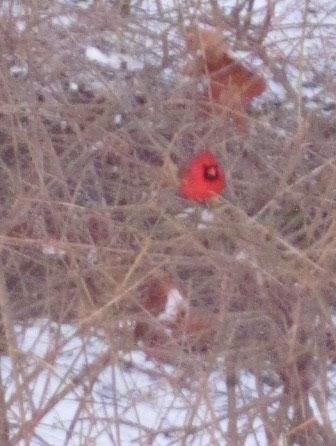
The cardinal is a favorite bird on Christmas cards—that startling red presence against the white snow. But for me, cardinals are always linked in my heart to the first sign of spring in a frozen winter world. On some random day in mid- to late February, the male can be heard heralding the coming seasonal change with his “cheer, cheer, cheer” spring song. Sitting on a branch at the very top of a leafless tree in the bright winter sunshine, he sings of the coming of warmer, light-filled days, of flower bulbs pushing up out of the ground, of grass turning green. And of the spring migration of birds who have wintered in Central and South America.

House finches and chickadees begin singing their spring songs in February too. Soon, over-wintering robins and returning red-winged blackbirds, goldfinches, and phoebes are part of the morning chorus. By late April and early May, migrating birds are passing through New England in large numbers. This is what we in Massachusetts dream of and look forward to during winter’s months of snow, ice, and freezing rain. Especially those of us who will soon spend countless hours with binoculars pressed to our eyes, craning our necks upward in order to catch a glimpse of migrating warblers, orioles, tanagers, and thrushes.

This has been a challenging winter. The frigid temperatures and seemingly endless snowstorms, coupled with heavy layered clothing indoors and out, have made me daydream longingly of California and Florida. Better yet, Costa Rica, where many of our migrating birds spend the winter, and others live year-round. Still, here I am in the Northeast, and I am reminded that loving “what is” is part of living each moment to the fullest on planet Earth, wherever you happen to be. The sun rises and sets in an extraordinary display of color and light in any given month, no matter the weather. The cardinals brighten our days all winter long. Their very existence holds the promise of spring.

And, on that February day when the male cardinal begins to announce his territorial presence with song, all other thoughts recede into the background. Spring is coming, no doubt about it. The earth is giving birth to life one more time. How can you not celebrate with such a steadfast harbinger of hope and wonder—the bright-red, cheer-full cardinal?


Present-Time Paradise

Photograph © 2012 Peggy Kornegger
Years ago, Stevie Wonder wrote a song called “Pastime Paradise,” which described people who lived their lives glorifying the past or longing for a different future. We all have that tendency because our society fosters dissatisfaction and discontent. The advertising industry feeds on it, as do our social and political institutions. Yet, the quieter voices that whisper “live in the moment” and “count your blessings” are growing stronger and more widespread. If we shift our focus to the present and look at what we do have instead of what we don’t, life is suddenly full and abundant beyond measure.

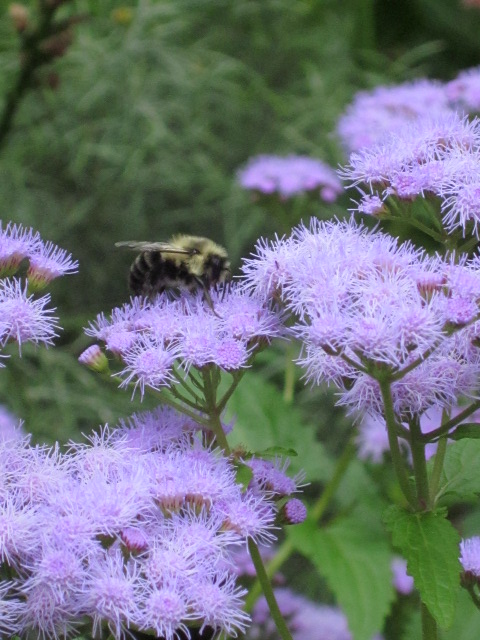
Personally, I have no doubt that I live in paradise. I love my life. My partner and I live in an apartment in a two-family home with a yard, front and back. Our small-town neighborhood is friendly and quiet. We like our neighbors, and our landlord is kind and responsive. I have freedom to grow flowers, plants, and bushes in the yard, and this is my greatest joy. I spend hours in my garden every day, sometimes working, sometimes just drinking in the colors and light. Hummingbirds visit the red tubular flowers of the native honeysuckle, goldfinches cluster about the hanging thistle feeder, and butterflies and bees fill the air around the large purple flowers of the butterfly bush. What more could one ask of life than moments like these?

Don’t get me wrong. I have experienced my share of life’s heartaches too—the death of loved ones, the end of relationships, loss of jobs, physical pain, etc. But all of it has been part of life and has brought me to where I am today. If I step back and look at my life as a whole, the miracles outnumber the tragedies, and even the tragedies had hidden miracles within them. Events that I feared all my life such as my parents’ deaths ended up being extraordinary spiritual experiences because I was fully present with them as they transitioned. Losing my job late in my editorial career allowed me to step into the freelance world for a couple of years and then gradually move into full retirement. I now have the time and freedom to write and garden whenever I want instead of squeezing it in on the side.

What I have discovered is that paradise is a state of presence, not an aspiration. I truly believe that I came to this planet to have all the experiences I could possibly pack in and that each one allows me to expand more and more as both a spiritual and a human being. Everything that has occurred has enabled me to become more fully myself, my soul self. And I am grateful for every single bit of it, the tears as well as the laughter. It’s a miracle to just be alive. Really. Look at your physical body—how did that happen? You can’t help but be in awe of the infinite complexity of the tiniest aspect of every part of life. Or at least I am. And I think that’s where we’re all heading. Collectively, we are shifting from suffering to celebration, from dismay to full-hearted appreciation for the gifts each day brings. Paradise is with us, within us—now. It really is.

Standing with the Trees

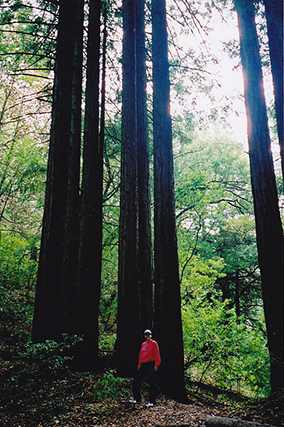
Photograph © 2006 Peggy Kornegger

A few weeks ago, millions of Turkish citizens took to the streets in massive demonstrations throughout the country, protesting an increasingly authoritarian government. The event that triggered public outrage: police use of violence against activists who were sitting in trees in Istanbul’s Gezi Park to prevent their being cut down. Government plans to demolish both the trees and the park—in addition to turning nearby Taksim Square into a shopping mall—pushed people to the breaking point. The trees are some of the only ones remaining in the city, and the square is one of the last places for public gatherings.

Many other issues have been on the rise in Turkey, but it was the threat of forced separation from nature and from one another that was the people’s “last straw.” Trees have once again become a symbolic focal point in human awareness. The crowds gathered in Gezi Park and Taksim Square were standing up, not for an abstract environmental cause, but for the quality of their own daily lives. For the right to see green trees outside their door, for the right to meet with their neighbors in a public space not based in consumerism. Those who joined them in the streets throughout Turkey acted with deep human empathy both for their cause and for the physical suffering they endured. These protests continue.

Nearly 16 years ago, Julia Hill Butterfly took a similar stand—and endured helicopter harassment and repeated attempts to break her resolve—when she lived for two years in a 1500-year-old California redwood to prevent it being killed by a lumber company that was clear-cutting the redwood trees. Julia’s selfless actions have influenced countless others, including those who may not even know her name.

These courageous individuals were standing in the deeper truth of their oneness with all living beings, with all life. They were surrendering to a greater Spirit, or Intelligence, within them, which moved them beyond reason, beyond even personal safety, to live their lives fully aligned with the source of life itself. Nothing else mattered. They were not thinking; they were acting from their hearts. And this is the energy that is rising more and more powerfully in the world, infusing us with hope and possibility.

In many spiritual traditions, the tree of life symbolizes the entire cosmos and our place in it. The Maya of Guatemala consider the ceiba tree sacred, and the day Aaj in the Maya calendar stands for trees and abundance. On this day, the Maya pray for harmony and for the resurgence of nature. Their prayers, from their hearts, connect to each action, each word spoken, in their daily lives. We are being called to live similarly now, aligning our heart’s truth with how we are present in the world moment to moment. We each have countless opportunities to be in harmony with something greater than our own individual lives. Can we humans at long last stand within the circle of life instead of outside it?

Julia Hill Butterfly and the people of Turkey inspire me to believe that it is possible. And the trees themselves inspire me. Each day when I look out the window at the tall maple trees in my back yard, I am filled with reassurance that life continues, that just as the trees stand strong and tall, while at the same time bending with the winds of change, we too can do the same.