The Zen of Bird-Watching

Photograph © 2013 Peggy Kornegger
If you want to develop greater inner patience and be a better listener, become a bird-watcher. If you want to learn how to remain motionless in absolute silence for open-ended periods of time, become a bird-watcher. And, if you long to experience being so centered in present-moment awareness that nothing else exists, become a bird-watcher. Sound kind of Zen-like?

More than 20 years ago, I became a bird-watcher for none of the reasons mentioned above. I loved birds, that’s all. I loved their colors, their songs, their marathon migration flights between South and North America. Everything about them was awe-inspiring. Gradually, however, bird-watching also became a spiritual practice for me. Because my interest in birds developed simultaneously with my interest in meditation, the natural similarities became interwoven in my consciousness. Both meditation and bird-watching involve focus and quiet; they also require awareness and presence. I found that whether I was sitting in meditation at home or walking meditatively outdoors in nature, my inner consciousness and my outer behavior were almost identical.

Over the years, the peace that I feel while meditating or bird-watching has brought with it an underlying joy at being alive. In fact, the distinction between meditation and normal waking consciousness has blurred for me. The practice of centering my awareness in the present moment makes all of life a meditation. And never more so than springtime in Massachusetts, when birds by the thousands fly from the tropics to mate and raise families in North America. Every year, bird-watchers eagerly anticipate the magic of this relatively small window of time when the birds are passing through in a parade of colors and sound. Why the excitement, you may wonder?

Well, to me, their brightly colored spring plumage (reds, oranges, yellows, blues, greens) and their varied spring songs are just plain thrilling to see and hear. One of the first sounds signaling the coming seasonal changes is the ringing-telephone song of the red-winged blackbird (photo above). He lifts and spreads his wings to show off his colorful wing patches when he calls. As migration begins in earnest, the songs of the wood thrush and veery fill the woods with an ethereal flute-like quality that make me feel as if I have been transported to a sacred outdoor chapel. Two of my favorite birds are the orange-and-black Baltimore oriole and the red-and-black scarlet tanager, whose saturated colors often evoke audible gasps from bird-watchers when sunlight hits their feathers. Then there are the tiny warblers, in a class all their own, with an infinite variety of markings, colors, and songs. I especially love the blackburnian warbler, whose throat radiates a deep neon-orange in the sun, and the Canada warbler, whose lemon-yellow chest and throat are accessorized with a delicate black “necklace.”

It’s each bird’s unique beauty that captures my heart and transforms mere watching into something deeper. Meditation, contemplation, Zen peace of mind/spirit—but also more than that. There have been times when a bird has landed on a branch directly in front of me and begun to sing, looking directly at me. A thread of light, of living attention, links bird and human for a moment in time. It is then that I experience that miracle of connection that makes me believe unequivocally in the familial relationship of all beings on Earth.
For the Love of Bees

Photograph © 2012 Peggy Kornegger
Now that winter is over in New England, and spring bulbs are blooming in my garden, I am filled with sweet anticipation for the coming months of summer flower abundance. My life has increasingly revolved around the change of seasons since I moved to a house with a yard a few years ago. Although I have always filled my apartments with houseplants, I had never really gardened outdoors before. I read up on which flowers and bushes would bring butterflies and birds to the garden and slowly began to learn how to become a “midwife” to plant life.

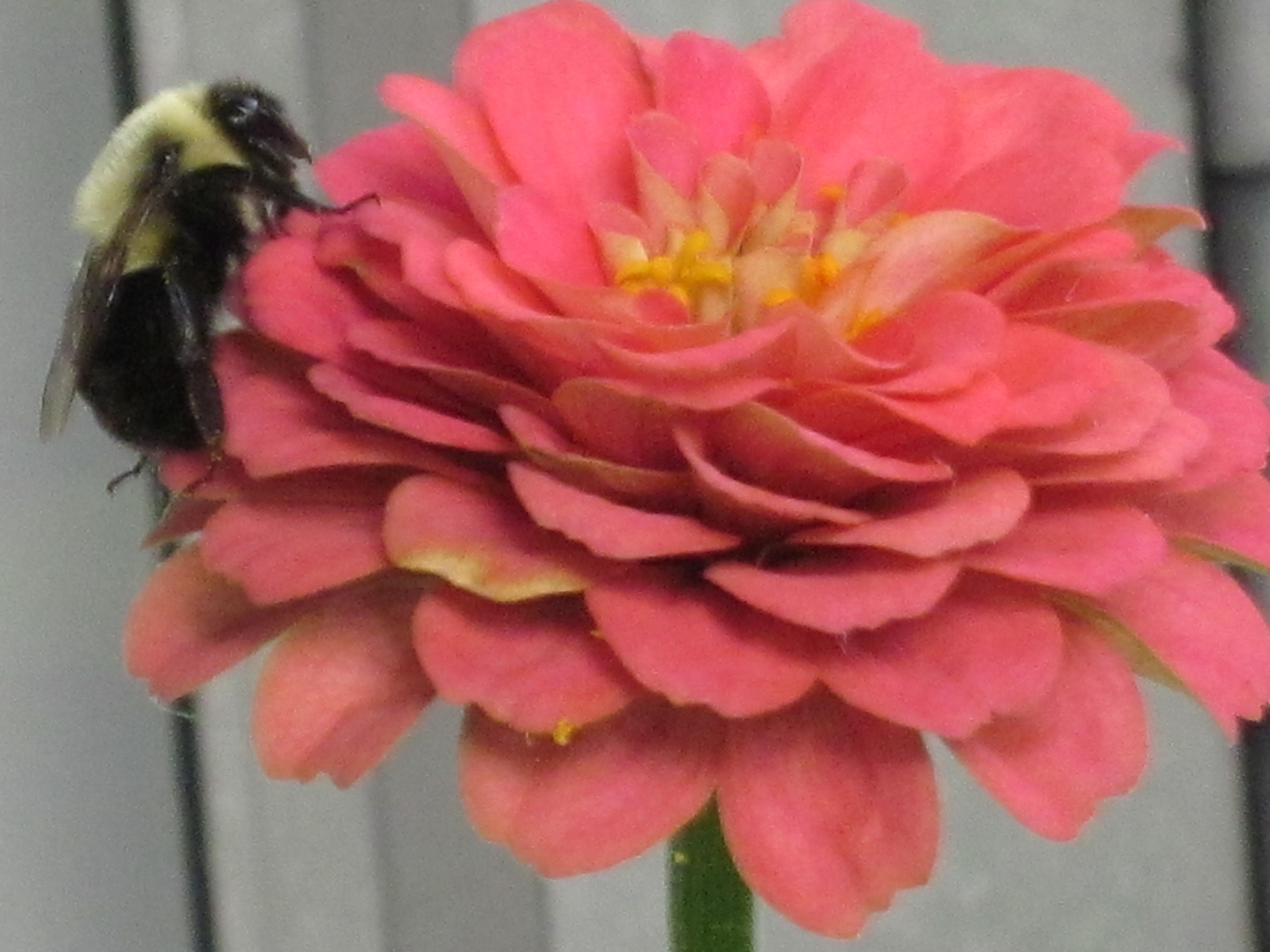
Soon, butterflies and birds did indeed begin to frequent the flowers and bushes in my yard. Unexpectedly, though, it was the bees that completely stole my heart. I discovered that there were at least 5 or 6 different kinds that visited the flowers, including honeybees and bumblebees. I watched them all and learned more all the time, just by observing their behavior. The evening that I discovered a bumblebee curled up for the night on the petals of one of my zinnias, I fell in love. I felt such tenderness, as if it were my own child.

Over the weeks and months, I found that bumblebees also “slept” on blanket flowers, bachelor buttons, pincushion flowers, sedum, cosmos, and the butterfly bush. Their most interesting bed, however, was the 6-foot-tall Joe Pye weed, which has large clustered fluffy pink blossoms. In the late evening, I would often find 8 or 9 bees on the different levels of flower clusters, snuggled into their own down comforters. When it rained, they would hang beneath the flower clusters, using them as umbrellas while they rested.

In the mornings, if it was cool or damp, the bees would often “sleep in” until the sun warmed the air. Sometimes I would see a bumblebee slowly stretching its legs, one by one, as if limbering up after its night’s immobility. I always wished them good morning and good night, and I believe they were aware of my presence as a “friend,” occasionally buzzing up to my face in greeting. I’ve had butterflies behave in a similar fashion, sometimes even landing on my chest or arm to sit in the sun. It was a beautiful life lesson about the conscious intelligence of all beings.

Bees, which many people hardly notice, provide irreplaceable support to the cycles of life on Earth by pollinating the flowers. The massive deaths of honeybees and bumblebees in recent years have been heartbreaking. The probable cause: pesticides and herbicides used by agribusiness, landscapers, and often homeowners as well. It is my hope that people will begin to understand the wisdom and urgent necessity of gardening and eating organically, for the health of our bodies, our planet, and all the creatures that inhabit it. You only have to fall in love with one flower, one tree, one animal, or one bee to feel the interconnectedness of all life. In one(ness) is the survival of all.

Note: A reader has reminded me that GMOs are another likely culprit in the collapse of bee colonies. Thus the key importance of the current consumer campaign against GMOs in the U.S. For more information, visit: http://www.organicconsumers.org/bees.cfm.

Don’t Miss the Miracle

Photograph © 2012 Peggy Kornegger

Sometimes we are so submerged in the day-to-day details of our lives that we forget to look up and see the bigger picture. Literally. With our heads down, focused on our endless to-do lists, we lose sight of what is really important in life. It’s not the errands, tasks, or dollar signs that will pass before our inner eyes at the end of our lives. It’s the people we’ve loved and the moments of wonder and joy that we’ve experienced we will remember as we leave this lifetime. As we navigate this time of global awakening, we are being continually reminded to see the miracles in every moment. And we need those reminders. At least I do.

It is so easy to forget, to lose yourself in thoughts or distractions. Yet, if you just remember to take a breath and look around, there is extraordinary beauty everywhere. The other day, as I waited for the bus, I watched towering cumulus clouds forming huge white cotton balls against the bluest of skies. Then, slowly charcoal-gray rain clouds moved in, creating a dramatic play of darkness and light. The entire sky was filled with an infinite variety of cloud formations, and I felt blessed to be standing there at that particular time, witnessing Nature’s pageantry. The rest of my day was uplifted by the experience.

Such moments are not infrequent if we just pay attention. Often it’s as simple as walking to a window in the early morning or evening. Daily, the sun puts on a radiant multicolored light show as it rises or sets. Each day is different. Like snowflakes, no two sunsets are the same. And the colors frequently linger well after the sun has disappeared below the horizon—mauves, lavenders, and pinks against an indigo sky, as the stars begin to appear faintly. What more could any human ask of a day on Earth?

Of course, equally important as connections to the natural world are connections to other human beings. Those we love, friends and family as well as those we may just meet in passing, bring us warmth and happiness if we have ongoing appreciation for each person’s uniqueness. There is a cashier in the store where I buy my groceries who is a true master in the art of appreciating people and lifting their spirits. He always has a smile and friendly word for everyone who passes through his line. I learn from him each week how simple it is to be kind, and what a difference it makes.

At times, life’s passing irritations or problems cause us to forget how special the people and experiences in our lives are. Yet, each one is a miracle—each passing cloud or ray of sun, each spring flower, and each extraordinary person. Every single moment is a miracle, even the challenges. Don’t miss your life as it unfolds before you in glorious living color.


Growing Up Godless

I grew up outside of organized religion. In a small Midwestern town, this was unheard of. I knew no one else like me; all my friends dutifully went to church every Sunday. My parents didn’t want to impose any one set of religious beliefs on me, so they basically left the door open. They told me that God might exist or might not; it was not provable, all based on belief—the agnostic’s view. So I was left with a question mark and a feeling of “differentness” among my peers. I can remember feeling very uncomfortable whenever the topic of church or God came up at school, fearful that I would be “found out.”

When I was about 9 years old, my parents took me to a Unitarian church service in a nearby town, after which I commented, “I’m glad that’s over!” Clearly I wasn’t longing to go to church as much as I was longing not to be different. When I reached college age, all my new friends were rejecting their religious upbringing, and I found myself ahead of the game since I didn’t have a religion to reject. But still I was searching for something, as were so many others of my generation. The meaning of life perhaps, or the secrets of the cosmos. At any rate, I gradually began to look for answers in diverse spiritual books and teachers, not really wanting a guru or one answer, but rather a tapestry of truths that resonated with me.

My search for meaning was partially driven by a deep-seated fear of eternity/infinity, which I had carried within me since childhood, possibly because I had no superimposed God image to block the fear. The void, or an endless universe in which “the world went on forever and ever,” was very real to me. Eternal life and eternal death seemed equally frightening. Still, in spite of this, I was a happy child for the most part, nurtured and supported both by my parents’ unconditional love and by the natural world outside our rural home. It was only at night that my fears about the infinite universe arose.

These night fears continued throughout adulthood, even after I came to believe in Spirit, or a greater sacred presence in the universe. After many years of spiritual exploration and growth, it was in an individual session with Panache Desai that I had my first tangible experience of infinity as an expanse that was both peaceful and comforting (see previous blog post “Infinity). Months later, during Panache’s webcast series “Mother, Father, God,” I faced my long-ago religionless past. As he instructed listeners to embrace the image of God they had grown up with, until it disappeared and became one with them, I felt disconnected, alone, different, stuck in my Godless childhood. But when he said, “The Divine in essence is formless and nameless and is in fact love,” I suddenly realized that I was already at “disappeared,” and God/Spirit had always been a part of my life, as love. I felt old fears dissolving as I also realized that I had never really been alone. God, or the Divine, was always there, at my very core.

Looking back, I see how what seemed my greatest challenge as a child was in fact my greatest blessing. What I experienced then, through my parents, through nature, and within my own heart, was Divine love in its purest form, undiluted by human concepts of an external God. Now, in my present life, as I continue to have extraordinary experiences of Spirit and infinity, I am so very grateful for my parents’ openhearted love and wisdom which allowed me to follow my own path when it came to matters of the spirit.

“Look in your heart for God, for truth, for the answer. Feel that heart space—that is where you and infinity can meet, because your heart is not limited, but ever expansive.”—Panache Desai


Fear Less

In Jan Frazier’s book When Fear Falls Away, she describes a sudden falling away of fear, just before having a repeat mammogram. The subsequent awakening she experienced changed her life. It is something we all dream of: to live with unshakable trust in the universe. I believe that we are now entering a period in the Earth’s evolution in which that is possible, not just for yogis or shamans, but for every person on the planet. Individual processes may not be as instantaneous as Jan Frazier’s, but I think the ultimate experience of trust in something greater will be very similar. I believe this because I feel it happening to me.

Recently, after intentionally stepping away from external busyness in the “real” world (see blog post “Unplugged and Reconnected”), I found that a door opened within me through which life poured through in boundless exuberance. The perfect books and spiritual workshops presented themselves to me with free-flowing synchronicity. In addition to these, the time that I sat alone in silent meditation and contemplation in my backyard was deeply transformative. I spent hours there each day, sometimes working in my garden, sometimes meditating, sometimes just breathing in the beauty all around me—the flowers, the trees, the sky, the clouds, the birds. A tiger swallowtail butterfly floating into the yard would make my heart catch in my throat at the miracle of its very existence. A single ray of sun penetrating the dense green shrubbery to form a patch of shimmering golden light on the grass would fill my eyes with tears. It was if I were absorbing the magnificence of the world through my very pores.

Gradually, as these magic moments continued, a deep loving connection to something larger than my own life became my prevailing experience. I have had such moments frequently in recent years, but something new was beginning to shift within me now. The connection to Source or Spirit was less fleeting, more a part of me. As the external world continued to be rocked by the changes inherent in 2012 and the Great Shift, I found that, within me, everything that was not trust in the presence of Spirit in all things began to dissolve. Old rigid ways of perceiving the world fell away. As did fear. I was not completely fearless (impossible—I am human), but I feared less.

Months later, after continued inner journeying on my own and at various spiritual gatherings, I find that this opening/shedding process has continued. I am no longer run by fear. Instead, at any given moment, I can connect to a spacious silent place within where peace and a trusting calm exist (see previous post “Infinity”). And I truly believe that now is the time when we all can find that inner space and open our hearts to a greater trust, a greater love.