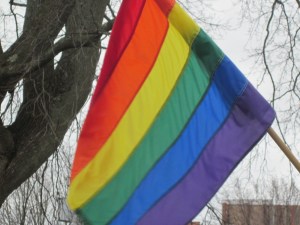
It’s All About Love, Always

Photograph © 2017 Peggy Kornegger

A few weeks ago, I watched the four-part series “When We Rise,” about the recent history of the LGBTQ community in the U.S. and the fight for our basic human rights, including marriage equality. At the end, I felt emotionally exhausted, like I had relived the last 39 years of my life. I lived in San Francisco in 1978 at the time of the California Briggs Initiative to ban gay/lesbian schoolteachers, thankfully defeated, and the shooting death of gay city supervisor Harvey Milk. In 1981, I moved back to Boston, right before the beginning of the AIDS epidemic, which would take the lives of thousands of gay men. Every year I took part in the AIDS Walk to raise money for those with AIDS, and I lost dear friends on both coasts to this terrible disease. In 1987 and 1993, I marched on Washington for LGBTQ rights and freedom, and each year there was a Pride March in Boston (in June, to coincide with the 1969 Stonewall uprising in New York). Those were years of great sadness and loss, and yet the love in our hearts and the hope that together we could bring about change kept us going.

In 2004, Massachusetts became the first state to legalize same sex marriage, and the movement for marriage equality continued to gain momentum. In 2013, the Supreme Court struck down DOMA (the Defense of Marriage Act), and in 2015, it ruled in favor of same sex marriage nationwide. My partner and I, who had been together for 31 years, married in 2014, with family and friends celebrating with us. Suddenly, seemingly out of nowhere, the national consciousness had shifted significantly toward love and inclusiveness over bigotry and hatred. We all had gotten so used to living with secrecy, fear, and the threat of violence that when acceptance appeared, it was almost shocking—extremely emotional and powerful for each of us. But it had not really been sudden; years of activism and private and public “coming out” had brought about the change. The rainbow lights shining across the country on national monuments, as well as the White House, reflected the magical new reality we were all experiencing.

However, today in 2017, a new administration, accompanied by a conservative backlash, is already beginning to whittle away at our hard-won gains, beginning with transgender rights. LGBTQ community members are currently the top target for acts of hatred in the Boston area. We are not done. Freedom, equality, and justice for all people are ideals that must be lived and upheld every single day. We do that by not giving up, by not allowing outrage or depression to overrule the universal compassion and kindness in our hearts. Intolerance still exists, but we are here to live our love, and we won’t stop. Not now, not ever. The music of our hearts and souls will carry us forward.

Photograph © Peggy Kornegger

I have changed in so many ways in the last 39 years, yet the core of me remains the same. I too am here to live love in the world. When I am meditating alone or in spiritual circles, when I am marching in demonstrations, when I am speaking my truth, I am centered in that love. A living prayer for love that includes friends and strangers alike around the world. Our hearts and souls link us together into one family. We are all connected, we very diverse humans on planet Earth, reaching out for freedom, equality, and the right to self-expression. In the deepest part of our being, we are not so different; we all want similar things in this life. Ultimately, it’s all about love. Always.

In Memoriam: Gilbert Baker, who in 1978 created the first rainbow flag in San Francisco, died last Friday, March 31, at the age of 65. That first hand-dyed and hand-stitched rainbow flag became the international symbol for LGBTQ pride and freedom.

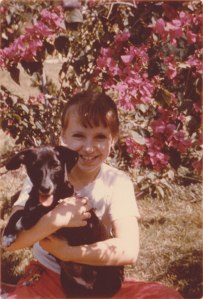
Dog Spelled Backward

Photograph © Peggy Kornegger
Admittedly, I am a cat person. Even though I grew up with a dog companion (Pepper), whom I loved dearly, cats have been closest to me as an adult: Edward for 8 years and Lily for 22. Of course, animals of all kinds touch my heart, and this has become increasingly true as my own awareness has expanded to be able to perceive the intelligence and sensitivity of all living beings on our planet. In my garden, I have sweet and often funny exchanges with birds, bees, butterflies, squirrels, rabbits, and chipmunks. A connection and communication beyond words frequently passes between us.

Since I am a gardener, I am outdoors a lot of the time in the spring, summer, and early fall. As I plant and take care of my flowers in the yard, I often see neighbors walking their dogs. All kinds of dogs: labs, Scotties, pit bulls, schnauzers, pugs, huskies, terriers. Some are intent on their “appointed rounds” through the neighborhood, sniffing every tree and bush and not that interested in the occasional human gardener. Others, however, are absolutely thrilled to encounter another human besides the one at the other end of their leash.

Two dogs in particular come to mind: a small white terrier named Honus and a large black lab named Maggie. One morning, as I was on my hands and knees pulling weeds in the front border, I heard a kind of whining panting sound immediately behind me. I turned, and there was Honus, straining to get to me, at the absolute end of his leash, as his person tried to keep him contained. He was still a bit of a puppy then, waggling all over, his eyes sparkling with excitement and the overriding desire to get close enough to greet me with licks and touches. Who could resist such intensely focused friendliness? I immediately fell in love with Honus. Every single time I’ve seen him after that initial encounter, he has behaved exactly the same: so excited to see me, this human crawling around on the ground at his level. He is always stretching to get to me before I hear him, turn around, and then reach out to pet and talk to him. It’s a huge gift that makes me happy all day.

Maggie is a much older dog—a large black lab with gray hairs around her mouth. When I first met her, she behaved exactly the same as Honus. As she and the man with her passed by the front yard where I was gardening, I said hello. Maggie turned to look at me, and as soon as my eyes met hers, she began to wag her tail with enthusiasm and excitement, reaching out to me eagerly. Once again, I just had to walk over and pet her. Her eyes were filled with such happiness and love. No other way to describe what I saw there. She emitted a completely uncomplicated and unconditionally loving presence. Something I’ve seen so many times in dogs—and cats, too. Something almost sacred in its purity and spirit. So is it a coincidence that dog spelled backward is god?

Well, let me tell you another story. In recent years, my spiritual practice has opened my eyes to seeing God in everything. Literally everything: human, animal, insect, tree, rock, chair, rug, computer, star, planet. In the midst of this awakening, I watched the world around me transform. Everything I looked at began to take on a special quality of living light. One afternoon, on my usual walk around my neighborhood, I encountered a woman with her pit bull. As I passed them, the dog and I looked into each other’s eyes. I stopped completely. There gazing at me through this pit bull’s eyes was God—life energy shining forth, joyful awareness, pure beingness. Tears filled my eyes. God recognizing God, no separation.

Photograph © Peggy Kornegger

If we could only realize that our entire world is made up of this oneness. Life reflecting life. It is everywhere! God meets God on the street every single day. That innocent, curious, welcoming essence that dogs and cats often show us is within us as well. We had it as children; we just need to allow it to come to life again. Years ago, my father, in his aging wisdom, once said, “If only I could be more like a dog.” Meaning, more forgiving, more loving. He could see that our companion animals are living examples of unselfish sweetness and love. Time to pay attention. Time to see the God in Dog. And in ourselves.


Shining Light in Shadowland

Photograph © 2016 Peggy Kornegger
Ever since the election, in spite of attempts to stay centered in a positive outlook, I often wake up in the morning with sadness and apprehension. As much as I try to avoid it, I find that I have to come to terms with a new presidential administration that is displaying the underside of human thought and behavior: racism, sexism, anti-Semitism, homophobia, elitism. Exclusion that sees “them” instead of “we.” This is the shadow of humanity that has existed for thousands of years as hatred of “otherness.” Yet, now it is in our faces, even more so than in past administrations, which were not exactly stellar either. Electing Barack Obama seemed a step toward inclusiveness and diversity, yet even then, the country was almost evenly split, as it has been for many years now. True, the electoral college is not a fair instrument for representing the will of the people, but changing that will not erase the shadow. We have to face the huge division that exists in this country.

The United States is not united. Nor has it ever been, really. This is a country that has always been made up of people from different countries, cultures, races, religions, and belief systems. The first explorers and colonists—the first “immigrants”—imposed their lives upon the people who already lived here, the Native Americans. The formation of a new country was rooted in exclusion and appropriation.* That shadow has always been there, even as waves of immigrants from countless countries came here seeking freedom and liberation from oppression. Slavery was the most extreme manifestation of the shadow, and racism continues in its wake. The United States has always embodied dual, contradictory aspects: open arms and closed doors; freedom and injustice.

This election has brought to the surface all the fear-based shadows in this country, shadows that exist worldwide as well: intolerance, separation, inability to accept difference. And here is the hard part: As the shadow of humanity is on full display all around us, we have to look at its presence within us as well. Where do we see “other” instead of brother or sister? Where do we judge, condemn, or exclude people from our lives? In what ways do we tell ourselves that the world would be so much better if certain people just didn’t exist? Do we live with an open heart or a closed mind? Do we live in love or in fear?

On the morning after the election, I was traveling to Florida to attend Panache Desai’s annual global gathering. My state of mind was heavy, to say the least. As I found my seat on the plane to Charlotte, where I would change planes, the woman next to me whispered, “Governor Romney is over there.” “Who?” I asked, still in my own thoughts. “Mitt Romney,” she answered, pointing a few rows up, to first class. Finally, it registered, and in exasperation, I replied, “Oh, great, that’s just what I need today.” The woman looked a bit puzzled, and suddenly, it all struck me as very funny, and I began to laugh. (She chuckled a little, but I’m sure she had no idea why I was laughing.) Encountering yet another conservative former presidential candidate seemed to me like a comical cosmic wink or wake-up call. The message: “There will always be someone you disagree with on the plane of life.” In this out-of-the-ordinary occurrence, I was being reminded that from the perspective of global oneness, there is no “other.” No one is excluded.

And that is precisely why we are here on the planet at this time: To break the toxic habit of “otherness.” To find common humanity even when there appears to be none. To love in the face of hate, hope in the face of despair, have courage in the face of fear. You and I are being called to shine our own peaceful light ever more dynamically in the world, no matter what else is going on. To speak out for human rights and universal sister/brotherhood as we hold unconditional love for all in our hearts. (This is the basis of many nonviolent movements for social change.) In seeing every single “other” as another “one” in oneness, we come into greater balance and harmony, both individually and collectively.

Even when it seems unrealistic or emotionally impossible, take a deep breath and express the truth of your soul, which is love, which is kindness. Find the inner strength and compassion to keep expanding your heart until the shadow of separation falls away and you see yourself reflected in every face you encounter. That is the loving connection that holds our very diverse humanity together, in spite of the conflicts that pull us apart. In the wise words of Mahatma Gandhi: “Love is the strongest force the world possesses.”

______________________

*This continues today at Standing Rock Reservation in North Dakota, where Native Americans are protesting a proposed oil pipeline as an environmental hazard and a threat to their sacred lands.

African Dreams

Photograph © 2016 Peggy Kornegger
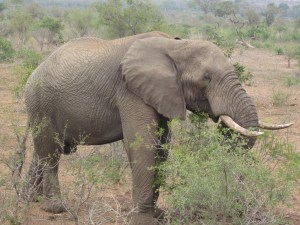
In October, I spent two weeks in South Africa. After I returned, I woke each morning disoriented, thinking I was still there—bird calls and animal sounds filling the air. My own bedroom seemed unfamiliar, and as I lay in a half-awake/half-asleep state, I dreamed of elephants walking slowly with majestic, graceful intent, just as they did when I saw them in the hot, dry African savanna. Gradually, when I awoke fully, I realized I was back home in Massachusetts, where it was cold and rainy, and autumn leaves covered the ground. Yet the elephants are still with me. Africa inhabits my consciousness now, never far way in memory or awareness. I close my eyes, and I see again the enduring, yet somehow fragile beauty of the land and the people and animals who live there.

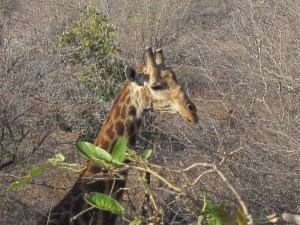
It was one of my life’s greatest blessings to travel to South Africa, where the animals are like nowhere else on Earth. Elephants, giraffes, zebras, impala, kudu, sable, lions, wildebeests, wart hogs, buffalo, nyala, waterbuck, crocodile, hippopotamus, rhinoceros, baboons, monkeys, bush babies, honey badgers, and many more. The birds too are unique: bee-eaters, hornbills, storks, spoonbills, ostriches. The grey go-away bird and the Egyptian goose with bright pink legs and feet. All miraculous beings living in a world that has drastically changed because of human activities and population growth.

The wild animals of Africa can no longer survive outside of reserves, where they are protected, in theory, from game hunters, poachers, and those who see them as a threat to farms and villages. Still, poachers find ways to enter the reserves (by helicopter) to kill elephants for their tusks and rhinoceroses for their horns. There is a high price paid in various countries for them. The animals face food and water shortages because of drought and the fact that fences block them from following their age-old migration routes across Africa. The heartbreaking worldwide dilemma of humans and animals inhabiting the same areas and using the same scarce resources is nowhere as dramatically visible as in Africa. Foreign investors buy up land to raise rhinos for their horns; private game reserves offer hunting for those who can pay for the “pleasure” of killing exotic animals. Colonialism has not disappeared; it has just taken new forms. You can see it in the everywhere-visible electrified wire fences “protecting” houses, land, and supposedly animals.

Photograph © 2016 Anne Katzeff

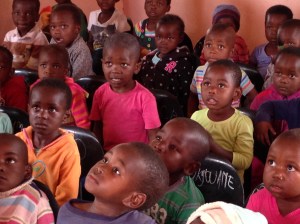
I came to South Africa to volunteer at Moholoholo Wildlife Rehabilitation Center and Daktari Bush School and Wildlife Orphanage and then to see the magnificent animals in the wild. This was not a usual tourist trip, but one where we learned about the enormous challenges faced by the people as well as the animals. Daktari offers an intensive teaching curriculum for 10-11 underprivileged students a week (grade 8) from neighboring schools. They receive class instruction from volunteers (with special focus on the environment and wildlife) and learn firsthand about animals by helping to care for them (they are often afraid of them at first). They also learn about possible future jobs in Africa’s animal reserves.

The students arrive shy and reluctant to speak and usually leave with more self-confidence and a greater ability to express themselves. Still, when we visited the daycare centers and schools that they came from, we saw the uphill battles they face. Schools with hundreds of students and only a handful of teachers; many classrooms with no teachers at all. When they finish school, many encounter either unemployment or jobs that are mostly low income. Racism and poverty have not disappeared with the end of apartheid.* In spite of the odds stacked against them, however, the students we met wanted to make a difference in their communities.

Photograph © 2016 Peggy Kornegger

We heard various stories about the animals in the reserves. Some of the staff at Moholoholo and Daktari told us that the two-year drought is drying up both food and water, and animals are dying. That there are far too many of some animals in the reserves (because they are prevented from migrating), and culling operations often kill off the “excess.” Still, many are starving, and some are driven to break through fences to get to food and water, where they are killed by farmers protecting their crops.** A tragic situation. Meanwhile, the rangers at Kruger National Park, one of Africa’s largest animal reserves (7,523 sq. mi.), told us that drought is normal, part of Africa’s savanna climate cycle, and that culling is infrequently necessary. Of course, this is the softer picture presented to tourists, so that they will continue to come to Africa.

So we as visitors who wanted to help, but also tourists in spite of ourselves, did what we could while we were there–offered our love and support to the children and animals and the people we met. A small gesture within a huge continent facing huge conflicts and challenges, within an even bigger world that often sees this unique land only in terms of the money that can be made by exploiting it and the people who live there. We who visit can only know a part of the larger picture, but even so, we can speak about what we have experienced—about the extraordinary beauty of the land, the animals, and the people, and about how precious they are in the greater landscape we all inhabit. Until we can see every part of this world as part of us, we cannot live in oneness. It begins with seeing other people as like ourselves, by seeing every living creature as a sentient being, and by honoring the Earth as sacred ground. To live with good heart upon this planet, wherever we are and whomever we meet. From the African word ubuntu: compassion, humanity, kindness for all. In so many ways, visible and invisible, we are all connected.

_______________

*Just as racism and poverty have not disappeared in the United States in spite of the civil rights laws passed in the 1960s

**Just as wolves are killed by ranchers in the western United States when they leave the protection of national parks


Fear and Its Disguises

Photograph © 2012 Peggy Kornegger
The presence of fear is not always recognizable as such. Yes, it can be the jolt to the gut, adrenaline coursing through your body, at a near-miss in traffic or sudden turbulence mid-flight. Obvious. Unmistakable. But most fear is more subtle than that, more hidden. It lurks in your subconscious and disguises itself as other things when it emerges. Anger, sadness, negativity, shyness, humility, resentment—all these are perfect covers for fear.

A friend of mine feels angry when she’s in a situation that frightens her, such as running out of gas on the highway in the middle of nowhere. Anger comes up first; irritation. Next could be self-blame or regret. But really the root feeling is fear. Another friend experiences depression or sadness instead of active fear when facing a potentially difficult turn of events or future circumstances. Yet another friend recently wrote about how he now realizes that his spiritual “humility” has concealed a fear of standing out, of being fully himself in the world. I can relate to all of these experiences.

I’ve also had disguised fear directed at me in the form of well-meaning, but basically negative advice or warnings about something I plan to do. Naysaying. Actually, we live in a naysaying world dominated by fear and a mainstream media that promulgates it. We learn to internalize it and then pass it on to others. Our news sources rely on sensationalism to attract an audience with frightening new dramas every day: murder, disease, abuse, scams. Those who financially sponsor the media use fear to control people, to keep them distracted, apprehensive, and unquestioning.

Conscious awareness can shift everything, however. Once we recognize the sources of external fear in our lives, we begin to recognize it within ourselves. Some fear may come from past experiences, which needs to surface and be released, and some may come from present events and how they are perceived. When we become more aware, we realize that the world is not all mayhem and catastrophe. Positive solutions also exist, and we can become part of that wave of positivity on this planet. When we are not stopped by internalized fear, so much becomes possible. We can step into our own greatness: the fully realized humans we came here to be.

My own fear of “being great” has hidden behind childhood shyness and then adult political and spiritual beliefs about equality and humility. I’ve never liked the existing hierarchical paradigm in which individuals battle for top-dog status at the expense of others. I envision a world in which self-actualization is possible for all. To be humble is to know we are connected to everyone else, and what each of us does affects the whole. As I evolve spiritually, I have come to see that becoming my own greatest self does not negate humility but can actually enhance it when I align with my connection to all beings everywhere. That’s the magic; that’s the miracle.

Becoming your full-out magnificent self and also being aware you are part of a whole involves a delicate balancing. But that’s the humility of oneness. No self-abnegation or belittling of self, but instead, expansive creativity within a framework of collective brilliance. We can be fabulous with inclusivity, not exclusivity. We can inspire others without causing them to feel small. Because we are all inspiring when we allow our souls to step to the fore. So don’t let fear stop you, no matter what disguise it wears. See through the masquerade to the soaring spirit at the core of everything and everyone.