Growing Up Walden

One of my father’s favorite books was Walden by Henry David Thoreau. He loved Thoreau’s immersion in the natural world and his emphasis on a simple life. Recently, when I was watching a PBS documentary on Thoreau and his time living alone in the woods at Walden Pond, I remembered my childhood in Illinois and how my dad had created his own version of Walden on the five acres where my parents built a house nine years before I was born. The land had a number of old oak trees and a couple of streams running through it but was otherwise mainly open fields. By the time I was a young child playing there, my dad and mom had planted shade trees, evergreens, bushes, vegetable and flower gardens, a fruit orchard, and berry patches. The vibrant beauty of Nature surrounded me every day. Without realizing it, I was growing up immersed in Walden consciousness.

“Simplify, simplify, simplify,” my dad would often quote Thoreau. No wonder I inherited an aversion to complications and clutter—and a love of Nature’s beautiful simplicity. When I read Walden in college, it all came together for me. Thoreau’s writing, as well as that of other Transcendentalists like Emerson, aligned with my heart and soul. Thoreau’s small wooden cabin in the forest by Walden Pond seemed to call to me. A number of years later, I moved to Massachusetts, and Walden became a special sanctuary for me where I often walked the trails and gazed at the trees, water, and sky. In any season, it radiated peace and tranquility. It was as if Thoreau’s solitary spirit watched over and protected it.
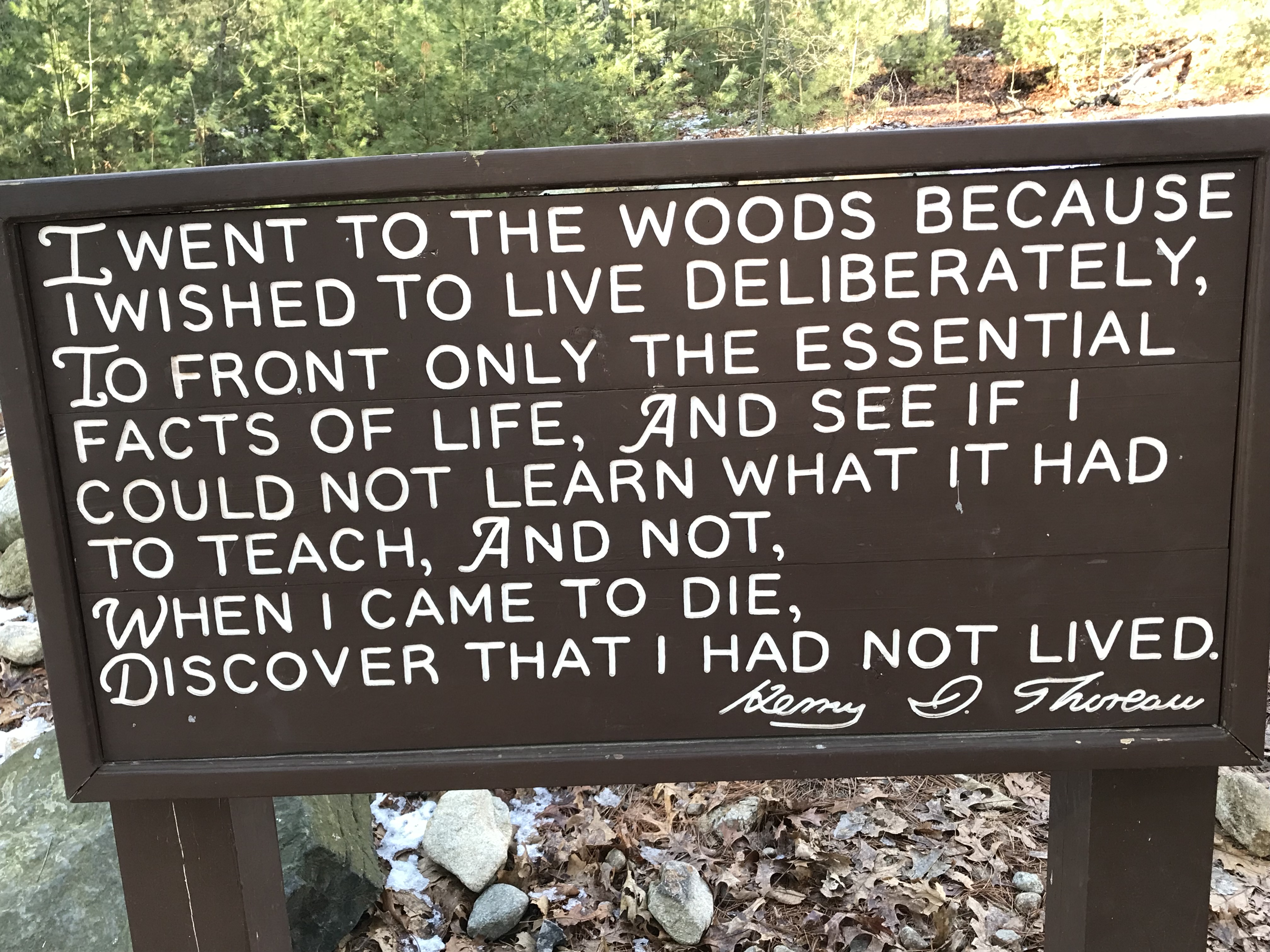
When my parents flew from Chicago to Boston to visit me, two dear friends drove us out to Walden so that my dad could see it in person. It was a special moment for all of us because we knew how greatly he admired Thoreau and his philosophy. My father continued to plant mini-Waldens in other Illinois locations where my parents lived in later years. And I too have created “Waldens” in the various backyards (or porches) of houses where I have had an apartment.

Currently, my partner Anne and I live in a condo which faces a woods thick with deciduous trees and evergreens. Bird song fills the air when I open our deck doors at sunrise, and we hear spring peepers or summer crickets trilling after dark. Walden once again synchronistically surrounds me, the perfect circle of a lifetime. Early in my life, I learned that the wonders of the Earth are ever-present; every day I see them wherever I live. I am deeply grateful to Thoreau, my dad, and all those magical years of “growing up Walden.”
————
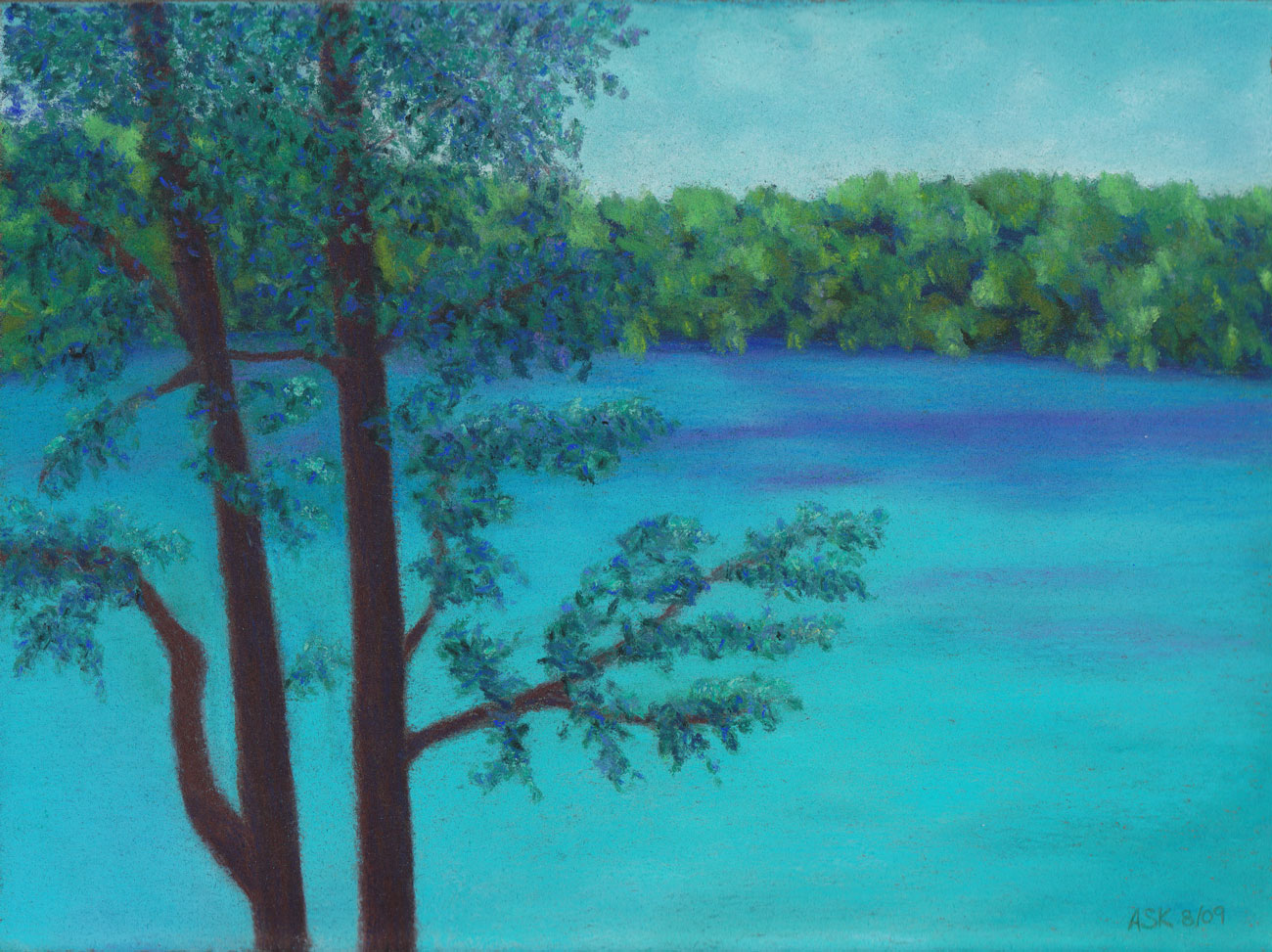
Artwork above: “Thoreau’s View,” by Anne Katzeff

Simplify

I grew up hearing my father repeatedly quoting Thoreau: “Simplify, simplify, simplify.” A life without possessions and attachments. Of course, he was counseling himself because he never threw anything away. Like many of his generation who lived through the Depression era, he acquired a lifelong habit of saving things because “they might come in handy someday.” A philosophy born out of necessity, yet hard to shake decades later when it wasn’t as necessary, and accumulation could become burdensome. Thus, periodically he would announce his intention of moving to a one-room cabin in the woods, as Thoreau had done at Walden Pond. Simplify…

My mother just smiled and continued living her own simplified life. Although also living through the Depression, she had acquired a “clear the clutter” approach to daily living. She threw things away, or donated them, if they were no longer needed. She would get rid of any old, damaged, or extraneous objects lying around the house. My dad would retrieve them from the trash. She had her secret ways of working around his saving reflex. My favorite story about their dynamic took place when she wanted to discard an old braided rug on the back porch which was showing signs of mildew. Every few weeks she removed a braided circle from the outside edge of the rug and surreptitiously threw it away. The rug grew gradually smaller and smaller until she was able to dispose of it completely. When my dad eventually noticed, it then became a family joke. Because even with their differences, they did appreciate and love each other. As did I.

I learned to love both Thoreau and “clearing the clutter” because of my father and mother. In essence, they did live a perfectly simple life together. Neither believed in consumerism or buying unnecessary things. We had all that was needed for a happy life: food, shelter, each other, and gratitude for the small wonders of life, like Nature right outside the door. I grew up in my own version of Walden: five acres in the Illinois countryside. Toys were never as important to me as the trees I climbed (and picked fruit from), the creek I waded in, and the fields I ran across with my dog. When I think of a “simple life,” this is what I see. And, even though I have resided in or near cities for most of my adult life, it is how I live: trees nearby, yards and parks, rivers or ocean.

The natural world, and the simple life, can be found in an urban environment as well as anywhere else. You just have to look for it, and then choose it, consistently. We don’t all have the opportunity to move to a cabin in the woods as Thoreau did, but we can always simplify. To me, that means focusing on Nature’s ever-present miracles and not the passing distractions of the overcomplicated material world. We can build a peaceful, inspirited life based in simplicity. The entire universe lives in those wondrously simple details. That is what Thoreau (and my parents) believed. And the more years I live, the more this essential wisdom guides my life. “Simplify” says it all.