Growing Up Walden

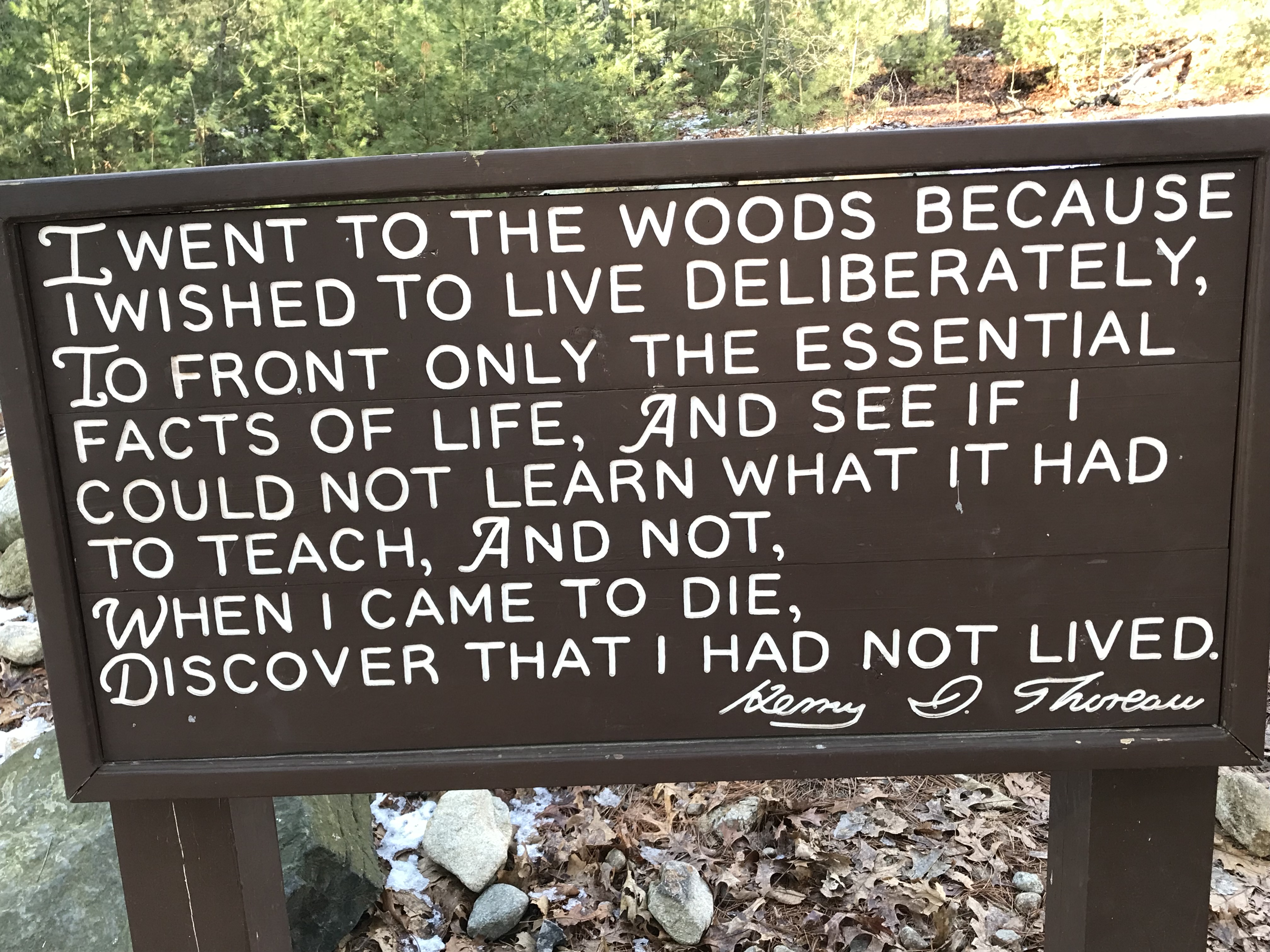
One of my father’s favorite books was Walden by Henry David Thoreau. He loved Thoreau’s immersion in the natural world and his emphasis on a simple life. Recently, when I was watching a PBS documentary on Thoreau and his time living alone in the woods at Walden Pond, I remembered my childhood in Illinois and how my dad had created his own version of Walden on the five acres where my parents built a house nine years before I was born. The land had a number of old oak trees and a couple of streams running through it but was otherwise mainly open fields. By the time I was a young child playing there, my dad and mom had planted shade trees, evergreens, bushes, vegetable and flower gardens, a fruit orchard, and berry patches. The vibrant beauty of Nature surrounded me every day. Without realizing it, I was growing up immersed in Walden consciousness.

“Simplify, simplify, simplify,” my dad would often quote Thoreau. No wonder I inherited an aversion to complications and clutter—and a love of Nature’s beautiful simplicity. When I read Walden in college, it all came together for me. Thoreau’s writing, as well as that of other Transcendentalists like Emerson, aligned with my heart and soul. Thoreau’s small wooden cabin in the forest by Walden Pond seemed to call to me. A number of years later, I moved to Massachusetts, and Walden became a special sanctuary for me where I often walked the trails and gazed at the trees, water, and sky. In any season, it radiated peace and tranquility. It was as if Thoreau’s solitary spirit watched over and protected it.

When my parents flew from Chicago to Boston to visit me, two dear friends drove us out to Walden so that my dad could see it in person. It was a special moment for all of us because we knew how greatly he admired Thoreau and his philosophy. My father continued to plant mini-Waldens in other Illinois locations where my parents lived in later years. And I too have created “Waldens” in the various backyards (or porches) of houses where I have had an apartment.

Currently, my partner Anne and I live in a condo which faces a woods thick with deciduous trees and evergreens. Bird song fills the air when I open our deck doors at sunrise, and we hear spring peepers or summer crickets trilling after dark. Walden once again synchronistically surrounds me, the perfect circle of a lifetime. Early in my life, I learned that the wonders of the Earth are ever-present; every day I see them wherever I live. I am deeply grateful to Thoreau, my dad, and all those magical years of “growing up Walden.”
————
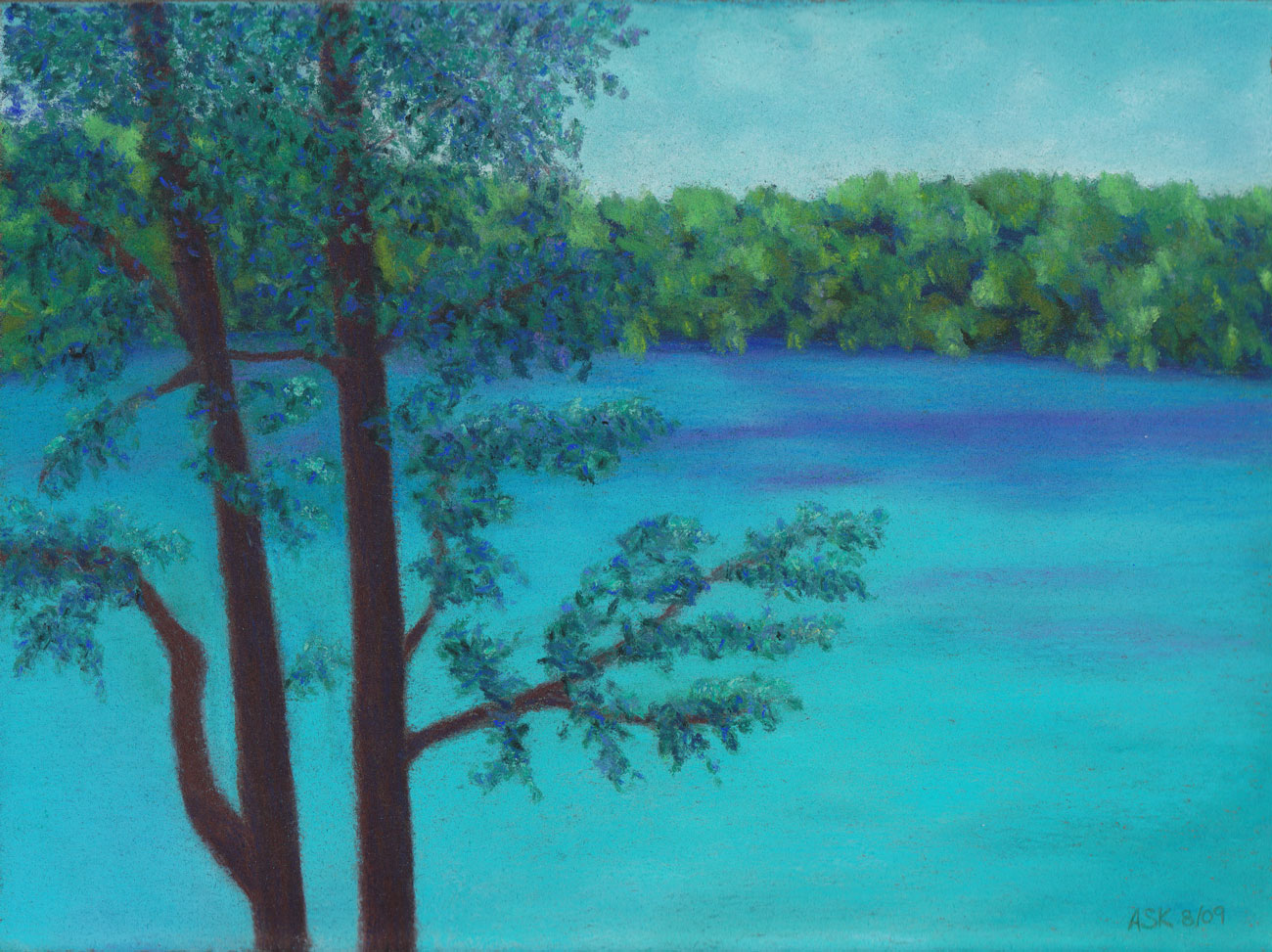
Artwork above: “Thoreau’s View,” by Anne Katzeff

On My Way Through…

“Maybe all we really are is spirit, the spark that draws people to us, the trail we leave behind.”
—Steve Thomas, Spirits Passing Through

In the past couple of years, several friends of mine have passed to the other side, the inevitable destination we call death. In grieving their loss and in contemplating my own future transition, I’ve felt myself coming into a different awareness of living and dying: less specific, more undefined and free-flowing, without parameters. We know so little of what life and death actually are. We think of them as a beginning and an end, but that’s a mental construct. What if there is only Presence, which never begins or ends; it just is? What if humanity itself is one Spirit, made up of sparks that together constitute life on Earth?

I remember my deceased friends as the spirit they embodied in their human forms: dancer/poet, musician/painter, sculptor, political activist. Yet now, they feel greater than those particular creative expressions, more inclusive of all consciousness, within and beyond their individual lifetimes. The longer I live, on my way through the human experience, the more I too feel greater than my physical form and its expressions. I am a writer, but what I write comes through me not from me. And the love I feel for my friends and for my life has no beginning or end. There is an infinite Presence that permeates everything and everyone and stretches to the farthest reaches of the cosmos, and beyond.

I guess what I’m trying to describe is soul, which is at the core of all human beingness and makes itself known through the heart. When I love my life partner, a close friend, a beautiful poem, or a bird singing at dawn, my soul’s presence moves through me into the world. It becomes one with all I see and hear. Soul defies description, yet it fills the world with light endlessly. Our souls came to Earth to be embodied light, to individuate oneness for a lifespan and then flow back into the One.

Perhaps the longer we live, the more we touch on moments of awareness that stretch beyond habitual parameters and open us completely to the universe. Actually, we are the universe, all of it. The universe lives as our souls throughout life, death, and eternity. We know this fully when we die, but that wisdom is within us now. And our life experiences bring it forth. As my life unfolds, the door to infinity opens wider and becomes more welcoming, less frightening. I can see myself and every one of us as infinite spirits of Presence, on our way through, together….
—————
Note: Thank you to my good friend Steve Thomas for the wonderful quote from his CD Spirits Passing Through.


Andrea Gibson: After Life

“I am happiest on the road, when I’m not here or there, but in between, the yellow line running down the center of it all like a sunbeam.”
–Andrea Gibson

I was not familiar with the work of dynamic spoken-word poet Andrea Gibson until after they (preferred nonbinary pronoun) transitioned in July 2025 from ovarian cancer. In November, I happened to see the trailer for a documentary film about Andrea called Come See Me in the Good Light. Next, I stumbled upon a clip of their friend Tig Notaro reading part of Andrea’s poem “Tincture.” Moved to tears, I found the entire poem online and read it through twice, continuing to weep. The kind of tears I had never experienced in quite the same way before: sorrow simultaneous with celebration of life. Andrea’s poetry encompasses both of these in extraordinary ways.

Thus began my hours-long journey across the web, watching every video I could find: Andrea’s poetry performances; Andrea and partner/wife Megan Falley (also a poet) being interviewed; Megan revealing her own feelings after Andrea’s passing; the trailer from the film and the song “Salt Then Sour Then Sweet,” sung by Sarah Bareilles and Brandi Carlile (with Andrea’s words) at the film’s end. Andrea’s website (andreagibson.org) showcases their vividly diverse poetry (lyrical, incisive, humorous, loving). The first poem I heard/saw was “Love Letter from the Afterlife,” written to Megan. I was audibly sobbing by the fourth or fifth line. I’ve listened to it many times since, and it still feels like the most beautifully wise poem ever written. I have been reading poetry all my life but have never run across any quite like hers.

Andrea’s words bridge life, death, and eternity seamlessly, using details recognizable from my own life, from everyone’s life. It all flowed together perfectly as I listened, crying at the heart-wrenching pathos and absolute splendor of life on Earth. Sadness and joy as one inseparable experience. At the end of the afternoon, I felt as if everyone I had ever known had died and come back to life. All at the same time. Everything inside me and outside me as One. That may not make logical sense, but that’s the best way I can describe the experience. Even my tears held the precious poignancy of all life in them.

And then there’s the film. After hearing/seeing all these pieces of Andrea’s life and work, I watched Come See Me in the Good Light, where it all comes together in an extraordinarily honest, funny, and beautiful telling of their (and Meg’s) journey with cancer. Once again, loss of life and love of life are presented as one experience in a way that is both heart-breaking and heart-opening. They share what they went through (for several years) with such vulnerability, humor, and loving sweetness. I laughed, I cried, I felt what they felt right along with them.

 Andrea’s description of coming to inner acceptance and neutrality about so much that had previously “mattered” struck a chord in my own life (I lived through breast cancer a few years ago). They felt parts of their “identity” fall away as they settled into soul awareness. Nothing was as important as the present moment, fully lived and appreciated. I still hear Andrea’s deeply expressive, musical voice at their last poetry performance in Denver in 2024 (shown in the film), the entire theater as one, cheering, laughing, crying, immersed in love.

I believe Andrea Gibson came to Earth to erase the dividing line between life and death. Between all dichotomies, actually. A perfectly nonbinary life and afterlife. Woven into the tapestry of the universe with precisely orchestrated timing for humanity’s deeper awakening. Thank you, Andrea, for your love letter to us all.

“Love Letter from the Afterlife”: https://www.youtube.com/watch?v=QmZHLvq-gDg

“Acceptance Speech After Setting the World Record in Goosebumps”: https://www.youtube.com/watch?v=4XK-hb_bjqU 

Trailer from Come See Me in the Good Light: https://www.youtube.com/watch?v=t0B8sjxR7Mo

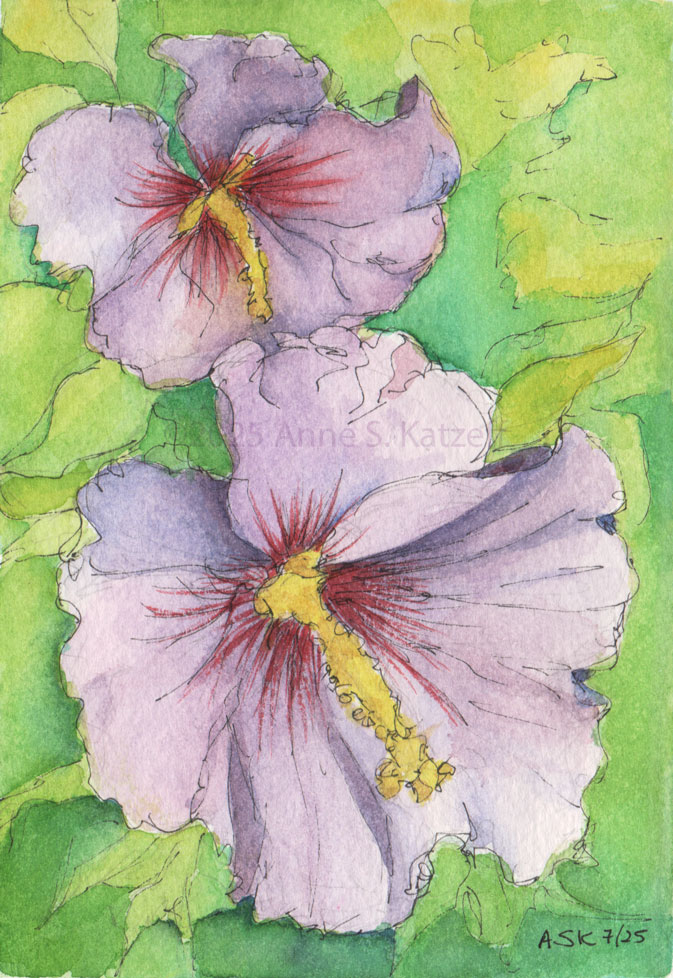
Rose of Sharon art above by Anne Katzeff

Books and Freedom

My grandmother was a librarian and schoolteacher. She loved books. My parents also loved reading, and our house had walls covered with bookshelves and books of all kinds. From the time I could read, I visited the local library regularly. It was a wonderful building—an old Victorian house with bay window seats, fireplaces, and rooms filled with books for all ages: children, young adults, and adults. Worlds opened up to me as I read my way through book after book. There was a freedom in that experience, an opportunity to travel to other times, other places. To expand habitual ways of seeing. Books can change your life. It did mine, and it continues to do so.

A well-written book can take you beyond your usual mental meanderings to locations and thoughts heretofore unseen or considered. It awakens the senses and touches the heart. It leaves you breathless with delight or tearful with empathy. It can engender gratitude for a world full of so many unique individuals and experiences. Such books open a door and welcome you inside, freely.

And this freedom is what is now endangered in the U.S. as books deemed a threat to more conservative belief systems are banned in state after state. Classic books such as Alice Walker’s The Color Purple, Toni Morrison’s Beloved, and The Diary of Anne Frank. Even Charlotte’s Web. When the realm of “acceptable” beliefs constricts to one narrow perspective, freedom vanishes. Both children and adults lose the ability to wander the world in wonder and joy through the pages of diverse authors’ books.

Yet hope is not completely lost. It lives in the libraries and independent bookstores across the country that continue to carry and advocate for books that have been banned. When Anne and I moved to a new community in the Boston area recently, we were heartened to see an in-depth informational exhibit at the local library on book banning. An extensive history of banning books in the world was displayed along with book covers, including African American, feminist, and LGBTQ authors. The library encourages patrons to read these books with an open mind in order to experience varied lives and viewpoints. This is what freedom looks like.

Books are the common denominator of basic human rights. So many people have spoken about the importance of reading. Oprah Winfrey says books changed her life when she was growing up; as an adult, she created a book club to offer that experience to other readers. Reading books has inspired countless individuals and given them deeper self-awareness as well as compassion for others.

My own life would have been very different without books and the life possibilities I saw in them (like becoming a writer myself). I traveled the world, in imagination and then in reality, because of experiences I first had through reading. I learned of the challenges and struggles of others through reading about their lives and often hidden historical events. Books not only offer freedom to the mind and body, but they also give the soul freedom to soar. To me, this is the essence of life on Earth.

Discovering Ann Patchett

I have been an avid reader all my life, from Charlotte’s Web, Anne of Green Gables, and Little Women in childhood through classic and contemporary literature in high school and college. I loved the Transcendentalists, especially Thoreau and Emerson, and that set me on a course of looking for the meaning of life through the books I read, as well as writing about it.

When I was in graduate school, the feminist movement was reaching its apex, and for many years I read mainly women writers, including Alice Walker, Toni Cade Bambara, Virginia Woolf, Doris Lessing, Simone de Beauvoir, Emma Goldman, Rosario Morales, Toni Morrison, Louise Erdrich, Barbara Kingsolver, and so many others. I was part of a Boston-area women’s collective that researched out-of-print authors and wrote and published an annotated bibliography of women’s literature, past and present.

Over time, my interest in exploring life’s meaning became as compelling as feminism, and I began to focus on spiritual authors such as Thich Nhat Hanh, Adyashanti, Brooke Medicine Eagle, Gregg Braden, Yogananda, Sharon Salzberg, Sonia Choquette, Eckhart Tolle, Michael Singer, and Panache Desai. I had many profound experiences at retreats and immersions that expanded my awareness and understanding of life. Eventually I began to write my own books and a blog. In recent years, I have been writing more than reading. Then I discovered Ann Patchett.

About ten years ago, a friend enthusiastically and repeatedly recommended Ann’s books to me. At the time I was ensconced in spirituality, and fiction seemed not as interesting. Then last fall I heard Ann interviewed about her 2021 book These Precious Days, a collection of essays about her life. I loved what she said and immediately took the book out of the library and read it nonstop. I found myself laughing out loud at some of her descriptions and then moved to tears by the beauty and poignancy expressed in others. Next, I read her novels The Magician’s Assistant and Bel Canto, each one remarkable. I was amazed at her ability to so vividly depict both human connection and human loss. I am now reading all her books.

Discovering Ann Patchett’s writing has been one of the best gifts in my lifetime of reading. Her fiction and personal essays are so perfectly crafted that the vulnerability and inner spirit of every person described envelops the reader in a blanket of compassion, not only for those particular individuals but for all people. I am immediately drawn into the story lines and relationships, along with the mysteries that gradually reveal themselves. Her characters are alive to me, so much so that I miss them when I finish each book, like longtime friends who have moved away.

Hers is an extraordinary talent. Her genius and skill in bringing to life such an immense variety of people, places, and events with empathy, honesty, and humor is awe-inspiring. Last December, I visited Parnassus Books, Ann’s bookstore in Nashville, Tennessee, where I bought a signed copy of These Precious Days and another for a friend, who, as she read it, commented, “Everything Ann Patchett writes about becomes fascinating.” Yes.

“As every reader knows, the social contract between you and a book you love is not complete until you can hand that book to someone else and say, Here, you’re going to love this.“—Ann Patchett