The Changing, Yet Familiar, Landscape

I was born in Illinois and grew up in a rural area where farms, cornfields, and scattered houses dotted the landscape. My parents built their home on five acres in the countryside, not far from a small town where I subsequently went to school. My daily life was spent mainly outdoors, playing among the trees, fields, orchards, and gardens my dad planted. It was a small paradise, which I still hold in my heart and have gravitated toward in other places and other landscapes over the years.

As an adult, I’ve lived in or near urban areas (mainly Boston and San Francisco). I’ve loved the convenience and ease of living where I could walk everywhere or take public transportation. Neighborhoods with small gardened spaces and trees around the buildings or houses. Corner stores. But it has been the parks and nature sanctuaries where I have spent much of my time. That was the balance for me, a place to live where I could walk as well as visit natural settings. Easy access to buses, trains, and an airport where I could travel to other places in the world. The towns and yards changed over the years, west and east coasts, but each one seemed to fit my life at the time. Even a few years in Florida recently provided an entirely different experience of Nature.

After moving back to the Boston area three years ago, Anne and I began to look for an affordable place to live, in the midst of rising rents. That meant living further away from the city. We eventually found a place we love, but it has meant an adjustment in how we live our daily lives. There are no neighborhoods or corner stores like those we were used to. Instead, an almost rural landscape stretches around the small group of condos where we live: woods, fields, small houses, roads, and occasional shopping plazas. There is a town about a 50-minute walk away with a train to Boston and Cambridge (which I greatly appreciate!). We are grateful for so much here (birds in the trees outside our windows, open skies clearly visible, quiet), but the walkability factor has required us to let go of previous parameters and expectations.

In doing so, suddenly, one morning I was reminded of my own childhood home. We lived in the country, a rural area not that different (except for the cornfields!) from where we live now. School buses took me in town to school. My parents drove to local markets, etc. Trees surrounded our house. Have I come full circle, returning to a distantly familiar landscape, one I have to accustom myself to but that from that perspective becomes newly interesting?

Life is full of surprises and replays and new beginnings that remind us of past experiences. Everything is both old and brand new in our lives. There is nothing on Earth that has not been lived before in some form or another, and yet at the same time every experience feels like a new discovery. We have lived many lives, within this one and among those in the expansive past of the planet. Often that sense of deja vu touches our hearts deeply and opens us to possibility and a fresh outlook on daily life.

That is where I am now. I am living changes, centered in a new present. Simultaneously, I am being reminded of the rich and diverse past I have already lived. In the distance, a train whistle evokes both past and present-moment awareness. Landscapes shift throughout our lifetimes, and within that motion is the purpose of every life: soul expansion and recognition of our commonality in all experiences and all lifetimes. In that, we realize that every moment, every landscape, is a gift of grace.

Remember

I have just finished rereading the ending of Ann Patchett’s new novel Tom Lake. I am crying—at the poignancy, at the beauty, at the soul wisdom. Last night I watched a 1988 PBS production of the play Our Town, which figures so prominently in Tom Lake, though always in the background (Tom Lake is a summer theater). I wept at that too. There are such deep life lessons in both of them, ones that few remember in their lifetimes. The characters Lara and Emily open to these lessons over the course of events in the novel and play. As does George in the film It’s a Wonderful Life. As are so many of us now at this time on Earth. We are awakening to how extraordinary human life really is.

Don’t miss a second of your life on this remarkable planet. The sadness and suffering as well as the joy and celebration. It’s all such a tremendous unrepeatable experience, like no other in the universe. Each morning, when you wake up, remember. The poet Rumi said it: “The breeze at dawn has secrets to tell you. Don’t go back to sleep,” This is the greatest wisdom of each of our lifetimes, throughout time, and especially now. Don’t go back to sleep. See the living spark of divine light in your partner’s or child’s eyes. Love your friends and family with all your heart. Appreciate them. Love yourself. You are a miracle.

Look around at the beauty of Mother Earth, the birds and trees and flowers. Everywhere there is beauty, even in the smallest detail of the most insignificant blade of grass. Even in a cemetery. A cemetery is a central figure in both Tom Lake and Our Town (and It’s a Wonderful Life). It stands as a coming together point of all life and eventually all the wisdom that arises from living. Spirit lives there. Spirit, which continues throughout time and space.

There is a cemetery that is a central figure in my life as well: Mt. Auburn. It is also a nature sanctuary, and for more than 40 years, I have walked there in the sweet silence and sounds of the natural world. I greet the birds each spring as they migrate and sing their lilting songs. Anne and I were married at Mt. Auburn, under the trees by Auburn Lake, the most beautiful day of our lives. I heard about the death of a friend there, tears streaming down my face as a bright red cardinal appeared on the path before me. I felt my mother’s spirit there after her passing, a cardinal singing nearby then too. And I have sensed my dad’s energy in the trees and the crows calling overhead. One cold November night many years ago, Anne and I watched meteor showers streaking across the cosmos in the deep darkness of Mt. Auburn at 3 a.m. Some of my most powerful moments of connection to something greater in the universe (Spirit, the Great Mystery, God) occurred there. All of life and death coming together as One in my awareness.

In Tom Lake, a cemetery on a rural wooded hillside brings everyone together in love and continuity. I feel that at Mt. Auburn. That is why I return, year after year. It helps me remember. We are all finding our own ways to remember now, we latter-day poets and saints of the 21st century. We came to Earth at this time to become fully awake and aware, to connect with one another, and to see the miracles in everything. In life/death, in pure being. Don’t go back to sleep. Remember. It is the gift of a lifetime, of all lifetimes.

What If…?

What if you found out that today was the last day of your life? How would that affect the way you experienced everything? Would you see and hear the world with fresh eyes and ears, the way a newborn baby does, everything new and wondrous? Would you notice the colors of the trees and flowers, the vast expanse of sky, the music of birdsong, the faces and voices of those you love? Would habit and routine fall away, to be replaced by an appreciation of the miracles we live with on a daily basis?

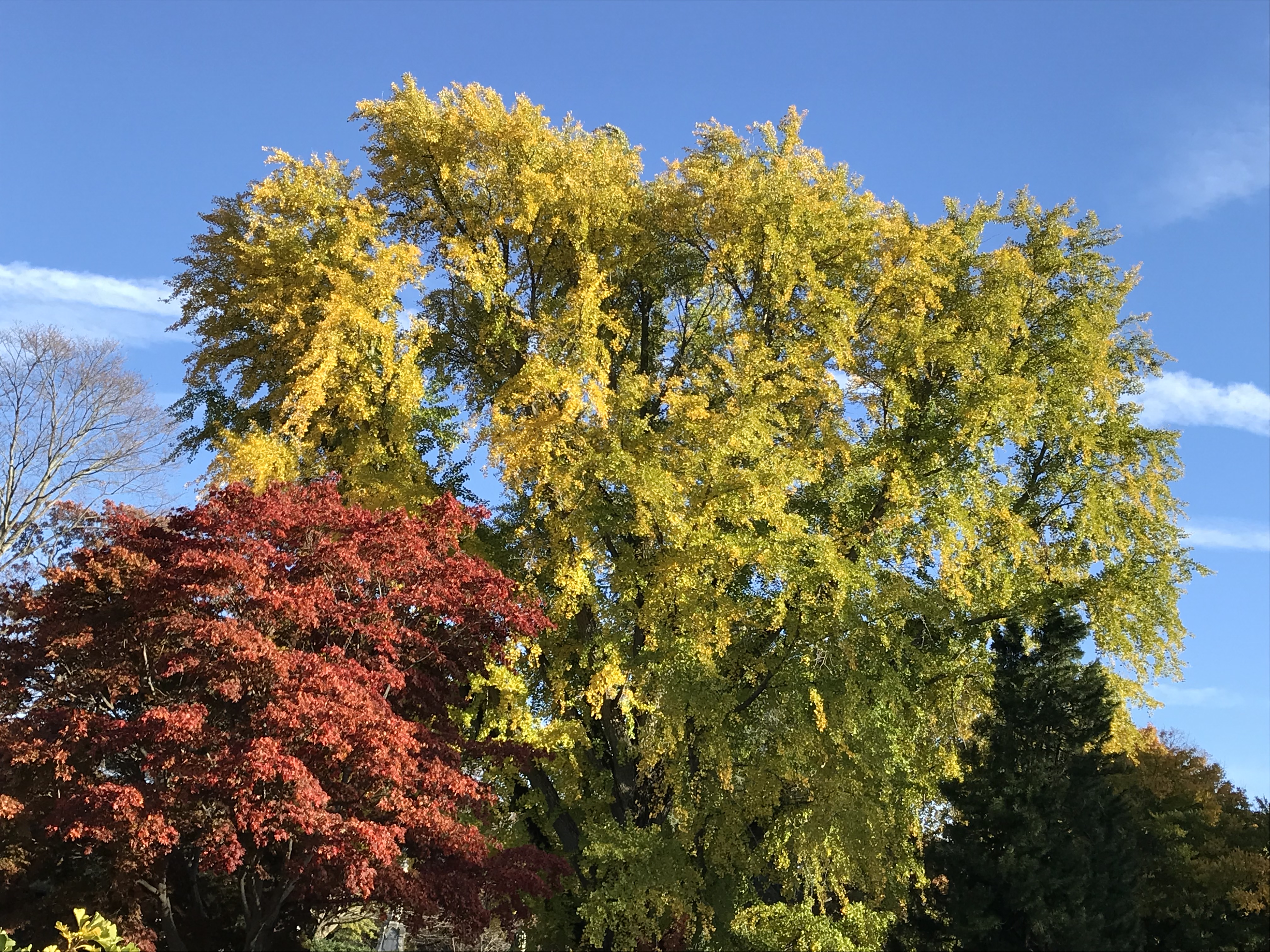
This thought passed through my mind recently as I walked among the autumn-colored trees at Mt. Auburn. I realized that I was a bit distracted, only half-aware of my surroundings, and I consciously made an effort to become fully present. I sat on a wooden bench and closed my eyes for a few minutes, and when I opened them, there was the world before me in full vibrant living color. My heart reminded me of how fleeting each moment is and how extraordinary every detail. Tears rolled down my cheeks.

We have the opportunity each day to remember that, to live it fully. That’s why we came here, to wake each morning and see sunrise, to pass through our days with awe and celebration. We are all strangers on this planet, slowly recognizing that we are actually family. Whether you think of humans as souls, angels, ETs, or just physical organisms, there is a thread of connection among us. A thread that links us to the stars and the galaxies and to all living matter. We are tiny beings in the cosmos, with one life to live here on Planet Earth. One second in universal timelessness. I don’t want to forget that, ever.

As I continued my walk, I found that everything took on a shimmering aliveness, as if I had never seen it before. Gratitude filled my heart. I know I have the opportunity to press this inner “refresh” button each moment of my life. Many of us experience a renewed outlook if we go through a health crisis or lose someone we love. Or if a particular birthday reminds us of aging. Life becomes precious beyond words. We realize at the deepest level how little “time” we have in the greater scheme of things.

In human-created time, today is always the last day of your life because there is really only the present moment. If I am not fully awake and in love with life now, will I ever be? Today I know I am alive with all my heart and soul. May that continue. And may each of us feel the sweet unrepeatable perfection of everything visible and invisible throughout our lives.

Timeless Slow Motion

The experience of calendar- and clock-oriented time has seemed to fade and often dissolve completely over the past two to three years of radical changes in the world. I find that many people I know comment on how they often have no idea what day or month it is until they stop and think about it. Life has given us the opportunity to live the ancient wisdom of present-moment awareness in which time does not exist. Now is timeless. There is only Presence. It may be hard to get used to at first, but gradually there is a letting go into a greater sense of being alive, one that is not constrained by human parameters or mental constructions that explain the world. Being alive and being aware of life is all there is.

In 2018 I moved from Massachusetts to Florida; in 2020 I moved back. Within that span of time, a pandemic brought the world to a standstill. Busy-ness of all kinds subsided. My own life became mainly morning meditation, yoga, writing, and daily walks on a nature trail outside my door. Most other things fell away. In 2021­–2022, as I lived through a breast cancer diagnosis and treatment, even my past identity began to dissolve. I let go completely into appreciating each second of my life. Today, as people try to get back their pre-pandemic lives and return to “normal” activities, I find myself reluctant to become “busy” again. My entire being wants to move in slow motion and be fully present with a minimum of activities, such as writing or walking in Nature. I am most at peace then.

There is no time in Nature. When I walk quietly among the trees, listening to the call of the wood thrush or cardinal, I do not count the minutes and keep track of how much time has passed. I am fully in the moment and nothing else exists. The color of the sky and the movement of the clouds engage my heart and soul. I frequently stop and just stare at the beauty around me. A flower, butterfly, or bee is a tiny miracle; if I walk swiftly, I miss them entirely. “Slow” is a gift; “timeless” is a gift. I am grateful for all that happened in my life that brought me to this space of just plain “being.”

Major events, whether personal (like cancer) or global (like COVID), shatter reality and give us the opportunity to see the world and ourselves with fresh eyes and no past frameworks. If we remain in this open space without refilling it with previous mindsets that keep us spinning in place, then limitless possibilities open up all around us. The most powerful of which is just to see the world each morning with clear vision and no preconceptions.

Allow the present to move you; don’t try to control it or force it along a particular mental path. When you accept each moment as it arises, your soul can guide you in living a life that peacefully flows and flowers, even in the midst of illness or extreme changes in the external world. Indeed, maybe this is why crisis comes to humans—to teach them fluidity and gratitude. Perhaps our souls chose these particular lifetimes on Planet Earth to help humanity evolve into full conscious awareness of timeless presence and connection to something greater in the universe. Slow down, smile, and watch time disappear.

Simplify

I grew up hearing my father repeatedly quoting Thoreau: “Simplify, simplify, simplify.” A life without possessions and attachments. Of course, he was counseling himself because he never threw anything away. Like many of his generation who lived through the Depression era, he acquired a lifelong habit of saving things because “they might come in handy someday.” A philosophy born out of necessity, yet hard to shake decades later when it wasn’t as necessary, and accumulation could become burdensome. Thus, periodically he would announce his intention of moving to a one-room cabin in the woods, as Thoreau had done at Walden Pond. Simplify…

My mother just smiled and continued living her own simplified life. Although also living through the Depression, she had acquired a “clear the clutter” approach to daily living. She threw things away, or donated them, if they were no longer needed. She would get rid of any old, damaged, or extraneous objects lying around the house. My dad would retrieve them from the trash. She had her secret ways of working around his saving reflex. My favorite story about their dynamic took place when she wanted to discard an old braided rug on the back porch which was showing signs of mildew. Every few weeks she removed a braided circle from the outside edge of the rug and surreptitiously threw it away. The rug grew gradually smaller and smaller until she was able to dispose of it completely. When my dad eventually noticed, it then became a family joke. Because even with their differences, they did appreciate and love each other. As did I.

I learned to love both Thoreau and “clearing the clutter” because of my father and mother. In essence, they did live a perfectly simple life together. Neither believed in consumerism or buying unnecessary things. We had all that was needed for a happy life: food, shelter, each other, and gratitude for the small wonders of life, like Nature right outside the door. I grew up in my own version of Walden: five acres in the Illinois countryside. Toys were never as important to me as the trees I climbed (and picked fruit from), the creek I waded in, and the fields I ran across with my dog. When I think of a “simple life,” this is what I see. And, even though I have resided in or near cities for most of my adult life, it is how I live: trees nearby, yards and parks, rivers or ocean.

The natural world, and the simple life, can be found in an urban environment as well as anywhere else. You just have to look for it, and then choose it, consistently. We don’t all have the opportunity to move to a cabin in the woods as Thoreau did, but we can always simplify. To me, that means focusing on Nature’s ever-present miracles and not the passing distractions of the overcomplicated material world. We can build a peaceful, inspirited life based in simplicity. The entire universe lives in those wondrously simple details. That is what Thoreau (and my parents) believed. And the more years I live, the more this essential wisdom guides my life. “Simplify” says it all.