Connections and Distractions

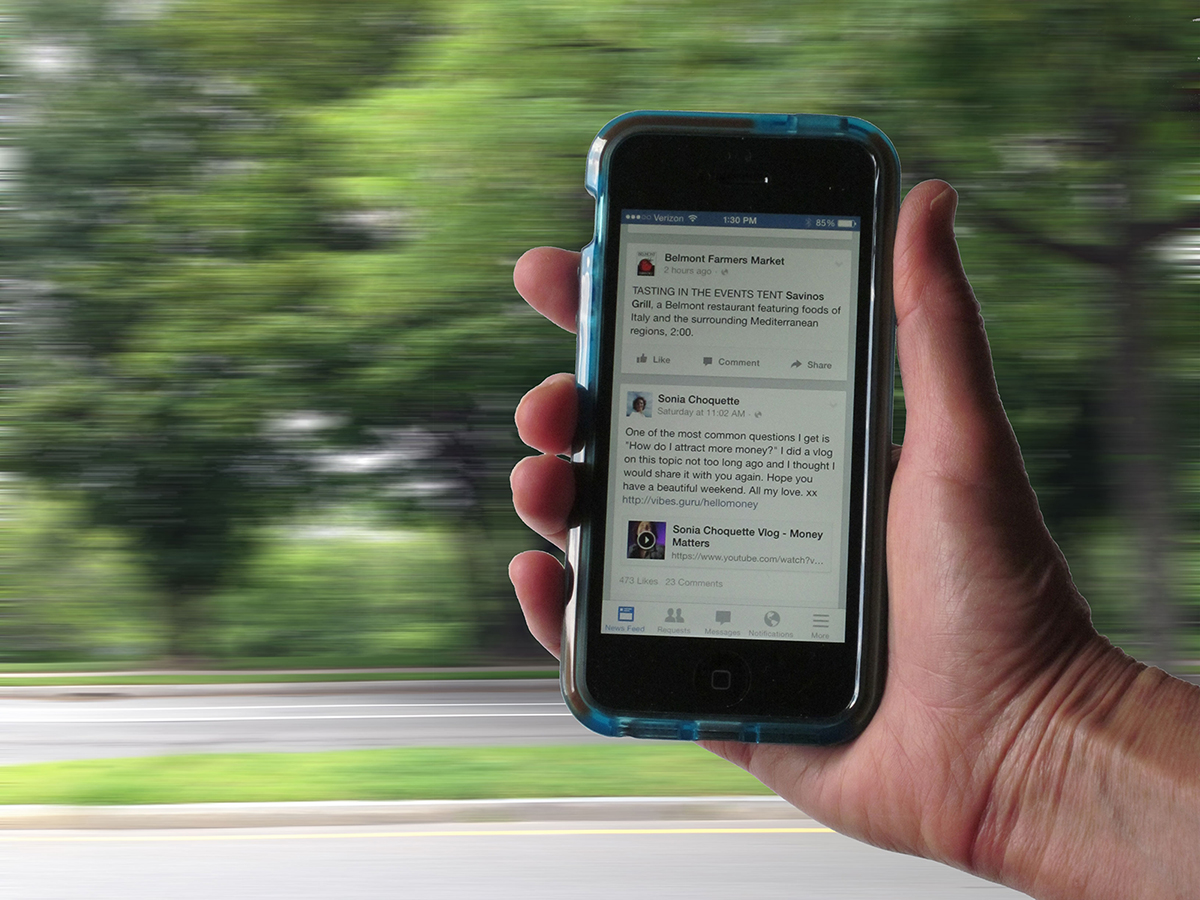
Photograph © 2014 Anne Katzeff
We are connected invisibly all the time, every one of us, through a psychic web of thoughts and emotions. The existence of the Internet has made this web tangible to people around the world. However, we are now in danger of losing our awareness of the power of that connection because of our dependence on technological gadgets that rob us of our intuitive intelligence. Smart phones are dumbing us down by keeping us compulsively plugged in to social media and online information sources.

When I ride the bus and train these days, there are very few riders who are not glued to their smart phones—checking emails, texting, tweeting, posting on Facebook, etc. The world around them goes by in a blur without their noticing. They could be passing urban high-rises or a park with trees and flowering gardens, and they would not look up. Where are they really? Yes, they are interacting with friends or acquaintances, and some of these exchanges are important and worthwhile. But a lot of this constant social back-and-forth is just distraction, avoidance of the present moment. So many of us pass the day in a trance state that blocks natural connections with the people and world right in front of us.

As you might guess, I am not a big fan of cell phones. I have avoided them for years because of the health hazards associated with them and also because I don’t want to be available for phone calls anytime, anywhere. Recently, however, I purchased a cell phone to use when I’m traveling. Because of the almost universal demise of pay phones, it became a necessity. Although my phone is “smart,” I use it only for the occasional call when I’m away. My home iMac is where I read emails and interact with friends via social media. I value these connections greatly, but I know firsthand the addictive attraction of online activity, wherever you are. It seems to have a compelling, magnetic power all its own. The images, posts, and website content draw me in and before I realize it, hours have gone by. I’ve been completely and utterly distracted.

The only way I’ve found to break this pattern is to limit my online activity. I usually check email, Facebook, etc. once a day and only interact for an hour or so. This can be challenging because I’m a writer, so I’m often at my computer anyway. It’s so easy to check in more frequently. I have to be strict with myself in order not to succumb to the sirens’ call to “log in just for a minute.” This is where conscious awareness comes in. Through meditation, yoga, and other spiritual practices, I have come to live more fully in the moment, to be aware of distractions when they ensnare me, if not immediately, then relatively soon. I know that when I spend several hours online, I am less connected to my own internal process and rhythms. The only exceptions are the spiritually related webcasts and communications that I participate in, which do in fact impact me at a deeper level. Other than these, my time offline is the most life-enhancing and soul-enriching: walking, gardening, writing—any quiet activity that centers me in my own peaceful inner core. Actually, spending time doing absolutely nothing except being present to the world around me brings me the deepest soul connection.

So what is the value of online activity? Is it more harmful than helpful? Well, I see it as an interim evolutionary tool to demonstrate to humanity the existence of invisible connections. I think more and more people are starting to become aware of the distractive downside of being perpetually online: smart-phone dependency. I recently read an article by a yoga practitioner whose 9-year-old son asked him, “Daddy, why do you have to check your emails so often?” A wake-up call for him. Perhaps it will be the next generations who show us that we don’t need those phones to be connected. Our own internal intuitive “smarts” that we are born with can handle that just fine, if we learn to access and use them instead of letting them atrophy. Each time we awaken to our own distractions, we take an evolutionary step into that space of awareness and connectivity.

Fractals of Life

Photograph © 2013 Peggy Kornegger
I became fascinated with fractals many years ago when I came across two wonderful photography books on nature: Patterns in the Wild and By Nature’s Design. Fractals, or fragments, display characteristics similar to a larger whole. In nature, fractals form repeating patterns that can be seen everywhere. One example is an oak tree, in which the branching pattern of a leaf is the same as the branch to which it is attached, which is the same as the tree itself. A leafless tree silhouetted against a winter skyline shows countless large and small fractals in its branching. The branching of blood vessels in the human body also looks very much like a tree’s branches, as does lightning in the night sky. The spiraling pattern in the center of a sunflower resembles a spiral-shaped shell on the beach, as well as a spiral galaxy in the heavens. Infinitely complex examples of fractals are visible throughout the natural world. These repeating patterns together make up the greater whole of the universe we are part of.

Photograph © 2014 Peggy Kornegger

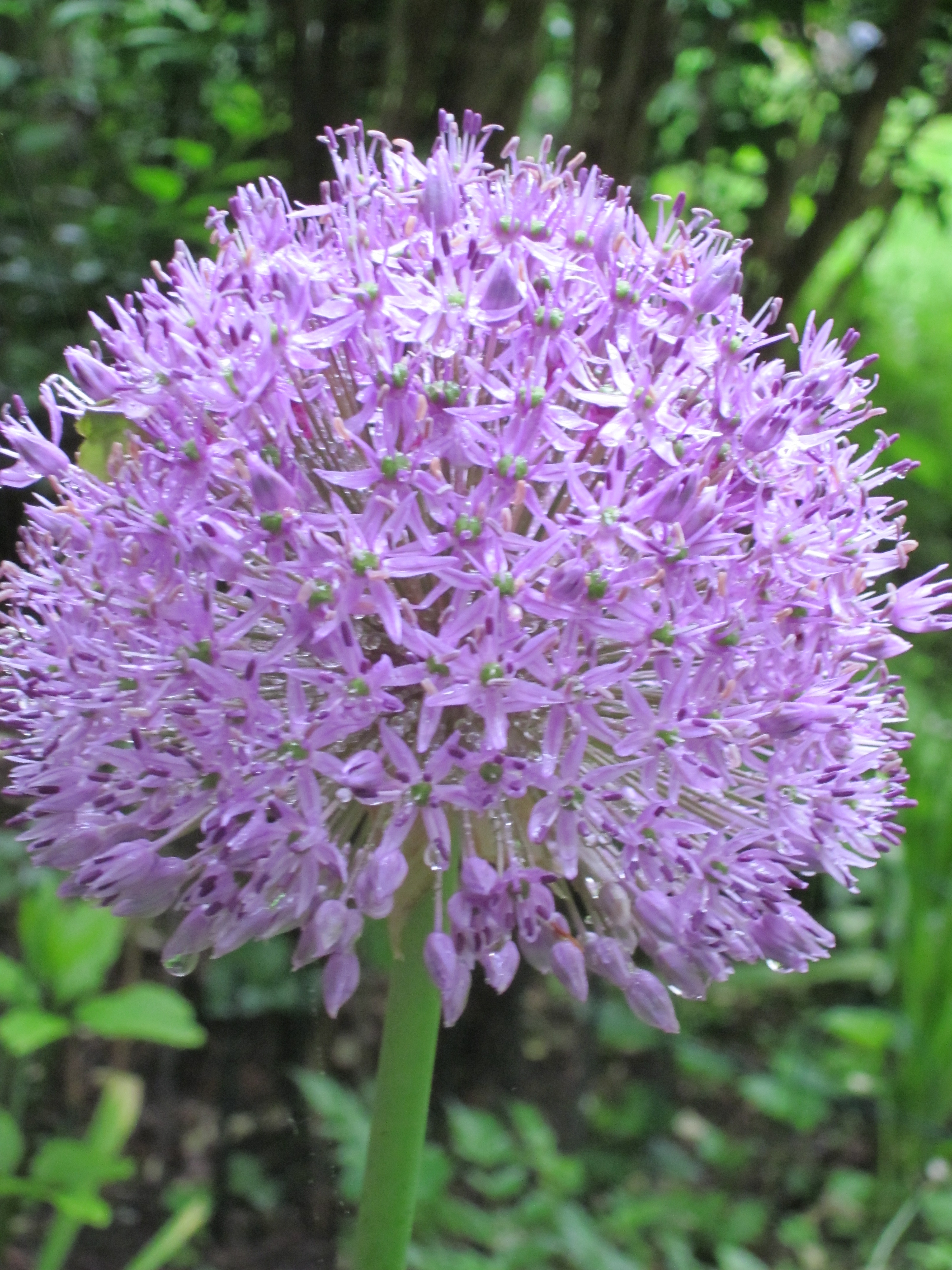
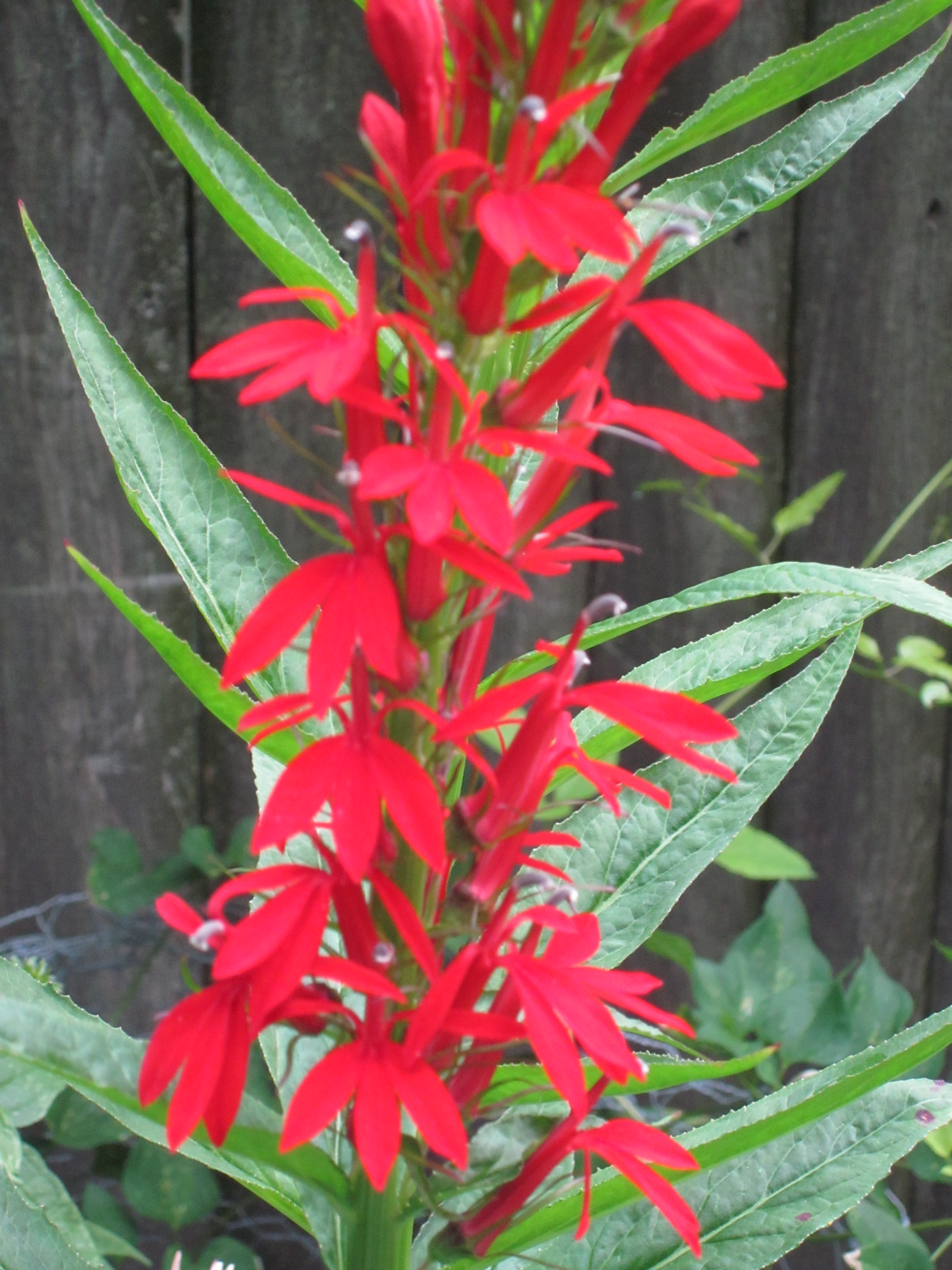
My own backyard and flower garden are full of nature’s fractals. Perhaps that’s one reason why I love being in nature. I am continually in awe of the colorful patterns I see there, whether bird feather, butterfly wing, flower, or leaf. When I sit and gaze at the beauty with patterning in mind, I begin to see the connectedness of everything on Earth. The tiger swallowtail butterflies that visit my butterfly bush in summer call to mind their namesake, the tiger. An allium flower is made up of tiny flowerettes, forming a larger ball that looks like a small lavender planet. Sunflowers, of course, resemble the sun itself, with rays of golden light shining out. Many other flowers are named for what they remind us of. Cleome, or spider flowers, have long thin stamens that resemble the legs of a spider. Cardinal flowers look like smaller versions of the brilliant red feathers of the male cardinal. And pastel-pink bleeding hearts, which hang by the dozen from the branches of the plant, are indeed just like tiny hearts.

When I work outside in the garden, I am reminded again and again of the extraordinary complexity of the living world. Every plant, flower, insect, bird, stone, and piece of dirt is an integral part of something much greater, of which I too am a part. I look at the sunlight filtering down through the trees, the clouds floating by overhead, the hummingbird darting between the honeysuckle and bee balm flowers, and I feel the oneness that connects every small fragment of life everywhere: I am the leaf and I am the tree. I am the wave and I am the ocean. I am the spiral shell and I am the galaxy. We are all fractals in an infinite, perfectly designed and geometrically sacred multiverse. We are all fractals of God.

Married!

Photograph © 2014 Helen Morse
On June 22, almost exactly one year after the defeat of the Defense of Marriage Act (DOMA), my partner Anne and I were married in a small ceremony in Cambridge, Massachusetts. In so doing, we became part of a tidal wave of ongoing historic change in the United States. May and June, in particular, are significant months for the gay/lesbian community. On June 28, 1969, demonstrators spontaneously took to the streets and fought back against a police raid at the Stonewall Inn in New York City. Stonewall became the pivotal rallying focus for the beginning of the gay rights movement in the U.S. A year later, on June 28, 1970, the first annual Gay Pride marches took place in New York and other cities, spreading around the world in the decades since then. In May of 2004, Massachusetts became the first state to allow legal marriages of same-sex couples. Ten years later, here we are, a married couple, after 31 years together.

People often wonder why we waited ten years. Well, primarily because of the tax complications—we would have had to file differently for state and federal since only one recognized same-sex marriage until DOMA was struck down. Also, marriage had never really been on our radar. It wasn’t something that mattered to us, and we had never thought about it as remotely possible. Over the years, we watched state after state and then the federal government pass acts and laws banning same-sex marriage. We both attended national marches on Washington for gay/lesbian/bi equal rights in 1987 and 1993. Finally, unbelievably, the tide began to turn, thanks to the activism of groups like GLAD, as well as countless courageous individuals, well-known and unknown, who came out in their lives and helped to shift public consciousness. In 2004, marriage became an option for those of us in same-sex relationships in Massachusetts.

As Anne and I attended the weddings of gay and lesbian friends, we were deeply moved by the open-hearted love, sharing, and support that took place. We began to consider the possibility of marrying, not so much for legal reasons but for sentimental ones—to share our love with friends and family. We didn’t want to come to the end of our lives and regret not having experienced something so special and really quite sacred. We also wanted to be part of the amazing, expansive energy that was transforming the world around us. So in January of this year, we decided to get married.

Photograph © 2014 Helen Morse

Almost immediately, magic began to stream into our lives. Our dear friend Ji Hyang,who had just moved to California, told us she could fly in and marry us on June 22. Mount Auburn Cemetery, a beloved nearby nature sanctuary, was available for an outdoor wedding ceremony on that date. From California, Nevada, Illinois, Washington, DC, New York, and Massachusetts, friends and family told us that they “wouldn’t miss” being there. So many people offered to help with the wedding and backyard reception that we were moved to tears of gratitude again and again by the generosity and genuine happiness everyone expressed. Even the two clerks at our town hall were excited and welcoming when we applied for our marriage license. They took our picture and sent us off for celebratory ice cream.

So, on the day after the summer solstice, Anne and I awoke to a morning of the most perfect weather imaginable. Blues skies and lush green foliage framed Auburn Lake, where the ceremony took place. Friends who hadn’t seen each other in decades came together in joyful reunion to celebrate our wedding. The ceremony we had created played out in the most wondrous of ways: flute, guitar, songs, poetry, metta (loving kindness), reflections, and vows flowed seamlessly into an exquisite tapestry of love and light. Looking out at the radiant, loving faces that surrounded us, Anne and I felt like we had been lifted to a higher vibration, our hearts overflowing with love. Every hug, every word spoken, every tear shed, was a miracle that opened up into yet another miracle. Toward the end of the ceremony, a sudden strong wind moved powerfully through the trees overhead, as if Spirit were mirroring back our feelings and blessing each and every one of us. It was a day unlike any I have experienced in my lifetime. A day of the extraordinary and the miraculous—and, as several friends told us, “the most beautiful wedding ever.”

The Magic of Springtime

Photograph © 2014 Peggy Kornegger

Every year in early May, I spend three to six hours each morning at nearby Mt. Auburn Cemetery. Why? you may wonder. Well, Mt. Auburn, with its woodlands, lakes, and gardens, is a magnet for songbirds during their annual spring migration. They fly in by the hundreds on the way north from South and Central America. Some of them nest in the cemetery; others continue further to northern New England and Canada. But during the small window of time that they grace our local flowering trees and bushes, birdwatchers are blessed with up-close views of the colorful and musical birds of the tropics. Each year, I see or hear something new: a chestnut-sided warbler and a ruby-throated hummingbird having a territorial faceoff; a flycatcher singing next to a kinglet displaying its usually hidden ruby crown; a Baltimore oriole weaving a hanging nest in a tall maple tree; a wood thrush singing its fluted song on the path a few feet in front of me. These moments are magical—a fleeting glimpse into nature’s secret world.

Equally as exciting at this time of year are the perennial plants and flowers that break through the soil reaching to the light. How do they know when to move upward, when to grow stems, leaves, and flowers from their buried roots? It’s a yearly miracle that I witness both at Mt. Auburn and in my own backyard garden. Tightly furled leaves and flower buds appear first, gradually opening to the sun’s warmth and the longer light-filled days. A plant like Solomon’s Seal begins as a blunt grey/green finger pointing up out of the ground. Day by day, the finger slowly becomes a tall thick stem that bends and arches with opening leaves of fernlike delicacy. Beneath the leaves, along the arching stem, small white buds form and eventually open into a line of belled flowers. Swaying in the wind, Solomon’s Seal is one of the special visual gifts of spring, along with lilies of the valley, violets, grape hyacinth, columbine, and so many others.

Year after year, spring flowers and nesting birds remind me of life’s cycles of rebirth and renewal. After a long icy-cold Massachusetts winter like the one we have just experienced, this is a welcome message. Even in the freezing temperatures, even in the dark, life continues. The birds migrate south and return to raise their families; the plants withdraw into the earth to rest before emerging to bloom again in spring. Humans, too, have their cycles, though many of us have forgotten how to align ourselves with life’s rhythms of rest and renewal. If we look to the natural world, we can see that each living being has its own cycle of birth/flowering, rest/renewal, rebirth. In our over-scheduled, busy lives, we often careen out of control and crash in exhaustion. Yet, if we let go of so much trying and effort and allow life to unfold in cycles of activity, rest, renewal, and rebirth, we will feel so much more in tune with ourselves and all of life.

In spring’s wonders, there is great beauty, but there is also great wisdom, showing us firsthand the ever-turning circle of life/rest/rebirth that we too are part of. Something more powerful than our own attempts to control daily life is at play here. If we surrender to the flow of life that is so stunningly visible in springtime, we open ourselves to both inner peace and connection to spirit.


Looking Back Looking Forward

Photo Courtesy of Mike Dubrovich
Recently, a childhood friend posted on Facebook a vintage black-and-white photograph of our first grade class. What a strange experience to look at that picture of unfamiliar school children and slowly begin to see familiarity in their faces. Names from the past popped up out of distant memory. I did not, however, recognize myself. I told my friend that I must have been out sick the day the photo was taken. He wrote back, “Isn’t that you on the far left end of the second row?” I peered at the picture more closely and realized in amazement that he was right. Fascinated, I stared at that blondish little girl with big dark eyes, gazing out into her own future. My future. I looked through her eyes and saw myself looking back. Time ceased to exist in that moment of backward-forward perception.

How often do we stumble across those flashes of memory that stop us in our tracks momentarily, lost somewhere between the past and the present? Some say human life is a series of beginnings and endings out of which we fashion our remembered sense of self in the world. Yet we are so much more than our memories, which are really just a long parade of Instagram photographs that we identify as our personal history, our life’s story. Beyond the mental perceptions of time and our place in it, however, is consciousness itself—an awareness that is greater than any one life. In those brief moments of backward/forward memory jumps, we are given an opportunity to see our life from the soul’s point of view, wherein all time is simultaneous, and everything is occurring now. There is no real distinction between a past, present, or future self. The soul sees one being, experiencing time but not defined by it.

Why would we want to see things from the soul’s perspective? Well, if we completely open to soul vision, we see everything is of a piece, whole. We perceive the oneness at the core of all life. Conflicts, comparisons, and judgments fall away. We can never fail our childhood selves and the dreams they had for the future, because we are those children and we are living those dreams now. We are not lost, nor have we taken a wrong path or made a wrong decision. Everything is unfolding in a way that is perfect for our soul’s growth and evolution.

When I looked back at my childhood self in that photo, I wondered, Where is the “I” that is all of me, girl and woman? My soul answered: I am no where. I am now here. I am present. I AM. Taking a long, deep breath, I felt the wholeness of that “I AM,” a timeless soul presence beyond “where.” No separation—the adult and the child are one. If we open our hearts to the soul’s vision of oneness, we can embrace all possibilities and all selves, and life begins to flow in a less fragmented, graceful way. We are able to see the perfection that is at the heart of our own infinitely expansive lives. Within that perfection, there is no backward or forward; there is just fluid, unbroken, loving presence.