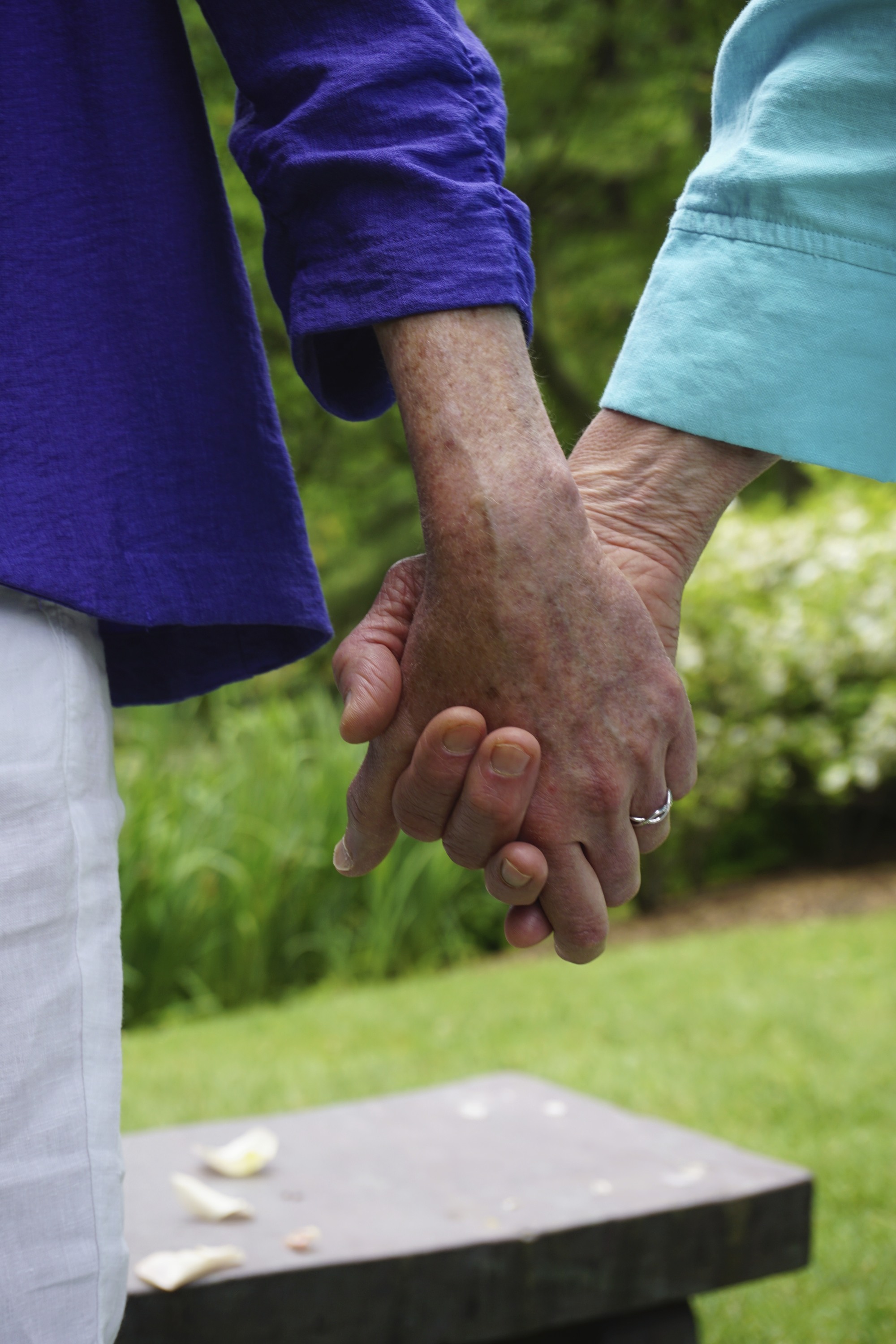
Learning to Listen

Copyright © 2013 Peggy Kornegger

We learn to talk when we are babies, expressing ourselves in sounds and eventually words that make sense to those around us. Speech and verbal communication are encouraged and celebrated. What an achievement that first word is—a rite of passage in the human journey! Listening, however, is not given quite the same emphasis or encouragement. In school, we take classes in speech but not in listening. Within the context of polite behavior, we are told to listen and not interrupt, but learning to be silently present with focused attention in a variety of situations is not part of the curriculum. Neither is quiet time spent in meditation or contemplation. Western society is noisy and wordy and very distracting, and we learn to live with it in whatever way we can, often to the detriment of our inner spirit.

As an only child, I played quietly by myself as much as with friends, but I didn’t begin to learn the true value of silence and of listening until I was well into adulthood. Although from a rural background, I acclimated easily to the novelty of living in cities and thought little of urban noise for years. At some point, however, I began to notice, and then couldn’t stop noticing, the lack of quiet everywhere. I sought out silence—in meditation classes, in parks, on vacations to natural settings away from the city. I took up bird watching as a way of immersing myself in nature, and it was then that I really began to learn how to listen.

In order to observe birds closely, you have to be willing to stand or walk in absolute silence, your senses of sight and hearing keenly attuned. When you are silent and motionless, the natural world gradually resumes its normal activity, which it had ceased at the appearance of a noisy human. What a miracle this was to me when I first experienced it. The more I listened, the more I heard: birdsong, bees buzzing, squirrels chattering, chipmunks scampering through the bushes, the wind rustling tree leaves and creaking branches. My soul was in silent communion with everything around me. Over the years, my listening deepened to the point where I felt I could actually hear flowers growing in my garden in the early morning stillness. Sounds fantastic, I know, but when you quiet yourself enough and truly listen, the world opens up its secrets to you.

Birds and flowers weren’t the only ones to teach me about listening. The elder parents in my life also taught me this sacred life lesson. Both my father and my partner’s mother experienced memory loss and related dementia in their later years. What you learn first in that situation is not to rush or finish the other person’s sentences, but to allow them time/space/silence to find the words they want to say. And if they don’t find the words, so what? Really the words themselves are unimportant. You learn to listen to the spaces between the words to hear what is really being communicated. I listened with my heart, with my soul. The last time I saw him, my father and I shared a lifetime of love just by looking in each other’s eyes. When he spoke, I heard his heart’s voice beneath the words. And during the afternoons when my partner and I sat quietly with her mother listening to 1940s tunes, we experienced together the beauty of the songs as well as the silence between the songs. Our spirits were connected in that peaceful space.

Perhaps what I am describing can’t really be taught in school, but only in life. We learn to listen as we learn that there is more to this world than the physical dimension. The longer we live, the wider our perception and awareness grows (if we are fortunate), and the closer we come to the essential stillness that is at the core of being and at the center of the cosmos. Out of silence, sound is born, life is born. When we listen deeply enough, we hear the sound of silence itself. And that is the place where our souls speak to one another, without words.


Simply Being

Photograph © 2011 Peggy Kornegger

As I meditate for longer and longer periods of time (1­–2 hours) at daybreak each morning, I am finding complexity and simplicity are merging into one flowing experience. Seems contradictory, I know, but only because of the constraints of language. Put another way, layer upon layer of awareness is opening up within me, yet all the layers are part of one whole, one seamless state of being. I’m discovering it is possible to feel inner peace at the same time that I’m feeling sadness or distraction. I am aware of silence at the heart of all sound, of light at the center of darkness. Beyond the illusion of separation, there is wholeness. Within complexity itself is infinite simplicity. Perhaps the best way to describe all of this is oneness, feeling one with everything, at times just resting without thought in simply being, in simply breathing.

Various spiritual traditions speak of such moments. The Sanskrit word samadhi refers to union or merging with God or the Divine, and the Hebrew word devekut describes intense melding or deep communion with God in prayer or meditation. Humans have tried with words to approximate an experience of Divine union or universal oneness that really defies description. Yet we try.

Because I am a writer, I have always felt a deep compelling urge to describe my own spiritual journeys. Yet, the deeper I dive, the harder it is to find the exact words to replicate what I am feeling. Indeed, during one of my deepest inner experiences of infinity (in a session with Panache Desai), I completely lost the desire to write or describe at all. For several hours, I remained in a state of infinite peace. My journal lay untouched nearby. Lately, as I spend longer periods of time in meditation, this same experience is recurring. Words are unnecessary within pure being, the soul silently witnessing. Language arises from thought, and when thoughts float by without attachment or disappear, there is no need to speak or write. Only, later, as I come to the surface from these depths, do I reach for my pen.

This is not to say that the goal of life is to give up speaking or writing. I guess that what I am getting at here is that the experience of peaceful oneness without words changes you. I perceive the world a little differently. The need for constant intervention and effort diminishes. Events seem to flow of their own accord without my monitoring them. There is a recognition of a higher intelligence at work, an intricate tapestry of which I am but one fiber. And my purpose, as that fiber, is to simply be myself, not orchestrate the entire universe. There is a humility in this, a letting go. It doesn’t mean lack of doing; it means doing that arises from being—a softer, less frenetic approach to life. When I write, the words flow from my soul more than my mind.

Am I in this space all the time? No, of course not. I am human. My mind gets busy, and I start to make lists, feel rushed, etc. But those experiences are becoming more transitory, less all-consuming. My soul self knows better, and that connection grows ever stronger. All of us have that connection, and we are gradually learning its importance. There truly is an inner core of peace. When we open to that peace, one breath at a time, it simplifies everything.

A Life Well-Lived

Photograph © 2014 Peggy Kornegger

When folk singer and political activist Pete Seeger died recently, at age 94, I was filled with great sadness. His larger-than-life presence and spirit, head thrown back in song, will be missed in this world. I also thought, though, that his was truly “a life well-lived,” as the saying goes. From the 1940s to the last years of his life, he spoke out and sang songs for peace (“Where Have All the Flowers Gone?”), civil rights (“We Shall Overcome”), workers’ rights, saving the environment (the Hudson River), and more recently, the Occupy movement. He was tireless, fearless, dedicated, and his heart and soul were in all he did, for human rights, community, and the Earth.

There are so many others who have lived long full lives: Nelson Mandela, Howard Zinn, Simone de Beauvoir, Adrienne Rich, to name only a few. Of course, not all well-lived lives belong to the famous. My own parents, who passed away at 81 and 94, lived long wonderful lives, deeply connected to the natural world around them and to the friends and family they loved. And age is not necessarily a factor either. My dear friend Michael, actor, poet, and musician, died at 39. His life had been creatively filled to the brim while he was alive.

However long they’re here on Earth, some people seem to embody full-out living, treating each moment as a glorious opportunity to experience all of life’s wonders. They stand out in our minds as vital and vibrantly alive. When Pete died, as I thought about the people I know and know of, it occurred to me that perhaps more and more of us are choosing to live our lives as he did. It is a time of great change on our planet, filled with transformation and evolution of all kinds. Many of us are struggling just to survive, but even within those struggles, there is often a deep desire for more than just the material. Our hearts long for human connection, for spiritual connection, and within community and shared experience, we are finding it. There is so much more to life than we can perceive with our physical eyes. Our souls know this, and as we awaken at that level, we will open up to all the possibilities of life, both imagined and beyond imagination.

So, let us take a page from Pete Seeger’s songbook. However long our life’s transit is, let’s live with our heads thrown back, singing, laughing, celebrating every single moment. No half-lives or shelf lives. No sitting on the sidelines and longing for a chance to dance in the circle of life. Let’s step forward fearlessly, heart open, eyes full of light, and fully embrace this precious gift of life we’ve been given. If time is an illusion, as we’re coming to realize, then it’s the quality not the quantity of the years that matters. Let’s make each moment an entire “life well-lived”—expansive, soaring, and full of sweet appreciation.

In memoriam, Pete Seeger, may your beautiful singing spirit continue to inspire us all:

http://www.youtube.com/watch?v=H4YwKPOgz5o

It’s All Just Divine!

© 2011 Anne S. Katzeff / Artist
Divine is an interesting word, with more than one meaning, depending on context. The adjective divine means godly, angelic, or heavenly, in the spiritual sense. Divinity, or the Divine, is another name for God in some traditions. Then, somehow, the “heavenly” reference came to also mean splendid or sensational, especially with regard to food. “This chocolate cake is divine!” There is even a kind of fudge called divinity. The experience of God and the experience of food can both be transcendent, as we all know!

In my spiritual exploration over the past 20 years, I have often used Divine as an alternate name for Spirit, Source, or God/dess. I like the word because it has a shining, translucent aspect to it, like something floating between this dimension and another. Which is, I suppose, what God is, really—a luminous, non-localized presence. Within my own meditation and yoga practice, I have experienced that Divine presence at different times as shivers all over my body, tears in my eyes, inner vibration, pulsing in my palms, or deep expansive peace. More and more, I know that I am not alone and heavenly guidance is available to me 24/7 if I just breathe deeply and tap into that space of inner peace. This connection is not always instantaneous (to say the least), but if I just remember that it’s there, then I am halfway home.

One morning recently, I found myself unable to quiet my busy mind and the endless stream of distracting thoughts that filled my consciousness. Self-judgment followed. Then, I heard again the inner guidance I had heard before when I was trying to understand why I suddenly felt so much sadness in the midst of feeling peaceful: “It’s all Divine.” Right. I forgot. That’s the wisdom that keeps gently tapping me on the shoulder and whispering in my ear. God is in the thoughts and in the space between the thoughts, in the emotions and in the peace. There is no place where God is not. When I let go of judging and embrace my active mind and my sadness, I am at peace. Peace is always present within the soul’s silent awareness. The soul is quietly observing the Divine (itself) having the experience of being human, and there is no separation anywhere from that vantage point. It’s all human and Divine.

Each time my mind won’t settle down or I’m distracted by neighborhood noise during meditation now, I am remembering more and more easily: My spinning thoughts, the roaring garbage truck, and the water drops sparkling on the tree branches in the morning sun are all part of the same oneness. As I take deep breath after deep breath, I slowly relax into the inner peace that is awareness without attachment or judgment: It’s all just Divine….

Winter’s Spring Song

Photograph © 2014 Peggy Kornegger

The cardinal is a favorite bird on Christmas cards—that startling red presence against the white snow. But for me, cardinals are always linked in my heart to the first sign of spring in a frozen winter world. On some random day in mid- to late February, the male can be heard heralding the coming seasonal change with his “cheer, cheer, cheer” spring song. Sitting on a branch at the very top of a leafless tree in the bright winter sunshine, he sings of the coming of warmer, light-filled days, of flower bulbs pushing up out of the ground, of grass turning green. And of the spring migration of birds who have wintered in Central and South America.

House finches and chickadees begin singing their spring songs in February too. Soon, over-wintering robins and returning red-winged blackbirds, goldfinches, and phoebes are part of the morning chorus. By late April and early May, migrating birds are passing through New England in large numbers. This is what we in Massachusetts dream of and look forward to during winter’s months of snow, ice, and freezing rain. Especially those of us who will soon spend countless hours with binoculars pressed to our eyes, craning our necks upward in order to catch a glimpse of migrating warblers, orioles, tanagers, and thrushes.

This has been a challenging winter. The frigid temperatures and seemingly endless snowstorms, coupled with heavy layered clothing indoors and out, have made me daydream longingly of California and Florida. Better yet, Costa Rica, where many of our migrating birds spend the winter, and others live year-round. Still, here I am in the Northeast, and I am reminded that loving “what is” is part of living each moment to the fullest on planet Earth, wherever you happen to be. The sun rises and sets in an extraordinary display of color and light in any given month, no matter the weather. The cardinals brighten our days all winter long. Their very existence holds the promise of spring.

And, on that February day when the male cardinal begins to announce his territorial presence with song, all other thoughts recede into the background. Spring is coming, no doubt about it. The earth is giving birth to life one more time. How can you not celebrate with such a steadfast harbinger of hope and wonder—the bright-red, cheer-full cardinal?