Perfect Imperfections

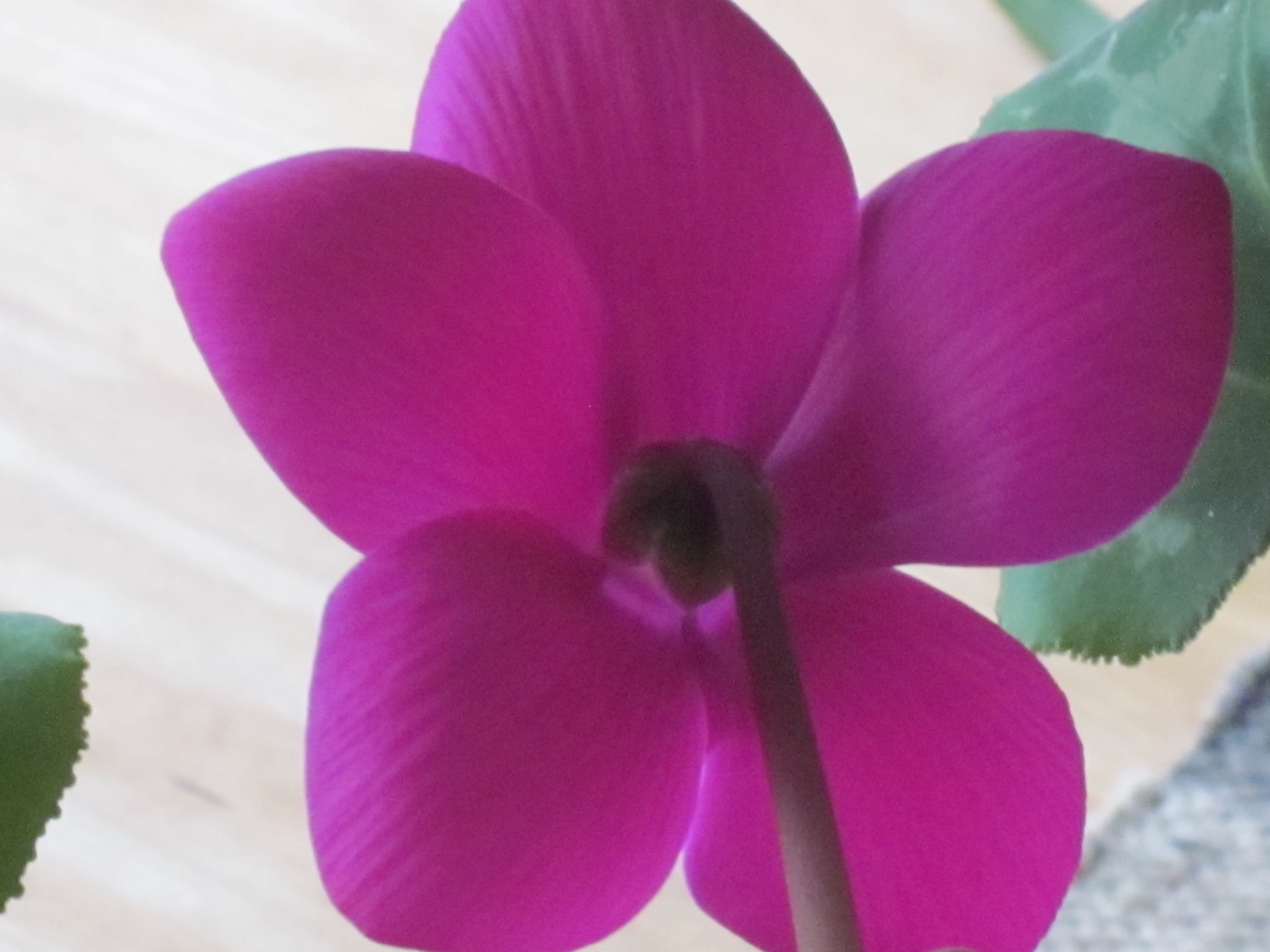
Photograph © 2014 Peggy Kornegger

The idea of perfection is something we all carry around in our heads, applying it to ourselves, our loved ones, strangers, and to every experience in our day-to-day lives. We want to live up to a standard we have set for ourselves—or someone else has set for us. We want others to live up to that same standard, and even more important, we want life to live up to this standard as well. Whatever the standard of perfection is, it involves judgment—and almost inevitably failure, disappointment, frustration, anger. People or events let us down, we disappoint ourselves, and life becomes an experience of disillusionment rather than joy. We have not yet learned to embrace “what is” as the true perfection of life.

Every day in my backyard flower garden, I learn this lesson over and over again. Reluctantly, and sometimes with great frustration, I am forced to give up my mind’s idea of a perfect garden with every flower and leaf intact: no violet leaves ragged with rabbit bites, no hyacinths bitten off by woodchucks, no potted coleus uprooted by squirrels, no rose buds eaten by worms. Each morning is a practice in letting go into loving what is, in seeing the perfection in everything. I prune dead flowers and chewed leaves, remove worms and aphids, but I also stand back and gaze at the beauty of what continues to bloom and flourish. Nature includes all living things (yes, rabbits too), and my role as a gardener is to find a way to live in balance with that wholeness. The curves and jagged edges; the perfect symmetry of inclusiveness. And after an hour or two in the garden, I am always more at peace, more accepting of all of life because I am surrounded by such incredible beauty. Beauty that is constantly changing, just as life is. Nothing remains the same, and that is the miracle of being alive.

Photograph © 2012 Peggy Kornegger

If God or Source energy is in all things and everything I see is shining with that inner divinity, then “what’s not to love?” as the saying goes. Same with animals, same with people. When I judge myself or others against some mental standard of what I think I or they should live up to, I am not appreciating the absolutely perfect creation that we each are. If I stand in judgment of people, life’s events, or my own “failure” to be as enlightened as I think I should be, then I am missing the miraculously orchestrated unfolding of all things in the universe. Nothing is out of place, and everything is evolving and expanding into more. Flowers, animals, insects, and human beings are all playing their parts. So this is a gentle reminder to celebrate all of life’s perfect imperfections as you go through your day—in the garden, in your home, and out in the world. Heaven is all around you, and everyone you meet is an earth angel—absolutely perfect.

Inconsolable Loss

© 2013 Anne S. Katzeff / Artist *
Robin Williams’ death two weeks ago has reminded us all of how devastating deep depression can be and of how thoughts of suicide plague so many individuals. The death of a close friend or loved one—or in this case, a beloved well-known comedian/actor—is never easy, but suicide is particularly difficult to take in and assimilate. I know this firsthand because a dear friend of mine died by his own hand 25 years ago. There is no real consolation for that kind of death. To say that his “time on Earth was complete” sounds hollow and meaningless, even though on one level it may be true. Those left behind are often haunted by feelings of horrified shock, disbelief, and helplessness. In our heartbreak and grief, we feel robbed of years of that person’s living presence in our lives. Such feelings never disappear entirely. We just learn to live with inconsolable loss as part of life.

Robin was a comic genius—unscripted, outrageous, wildly clever and ridiculous at the same time. You couldn’t keep up with his rapid-fire humor: if you laughed out loud, you missed the next hilarious gem. He could take any interviewer’s questions and turn them into a comic riff so packed with spontaneous unrehearsed one-liners that listeners became dizzy from the nonstop barrage of funniness. Robin was the master of on-the-spot improv that took audiences on a rocket ride through his high-speed, ultra-connected mind. Yet, that same mind took him to painful, sad places that he struggled to come back from. Perhaps it was that inner sorrow that informed his deeply moving portrayals of complex characters in films like Dead Poets Society and Good Will Hunting. He was a man of extraordinary, multifaceted talent, loved by millions, yet on the inside, he suffered. The joy he brought to the world was not enough to dissolve his pain.

My friend Michael was multitalented too—an actor, poet, and musician who excelled at all three. He was also one of the funniest people I’ve ever known. From the moment we met, we were instant friends, as if we’d experienced many lifetimes together and were picking up where we left off: “Oh, there you are….” We worked as proofreaders at the same company for seven years, both of us finding ways to express our creativity elsewhere but making our work life an occasion for constant back-and-forth joking all day long. Michael was just so silly and physically funny—like the schoolroom class clown who makes you laugh uncontrollably. Still, like Robin, Michael had his demons, and ultimately they got the best of him. Perhaps his deep sensitivity, which made him such a great actor and poet, also made him especially vulnerable to inner insecurities, fears, and mental anguish. After his death, we all tried to understand why it had come to that, but ultimately, there were no real answers to the questions we asked ourselves over and over.

Both Robin and Michael ended their lives to end the terrible suffering they were experiencing. Sometimes the pain of living is just unbearable. We have all probably felt that to some degree. Life on this planet is filled with reasons to wish you were elsewhere, and there is no safe harbor or respite from the constant turmoil of a changing world. We are all at risk for toxic overload from global events, coupled with personal challenges or tragedies. We feel the tension in our physical bodies and in our psyches. Yet, hope exists. It quietly appears every time we reach out to a friend or stranger in distress. It becomes stronger when we hold hands and hearts in our families, in our communities, and around the world. In time, perhaps the love we share will shift the balance, and those tottering on the edge will be able to step away from the precipice and return to the center of life. May we all find comfort, compassion, and loving connection in our lives. And may Robin’s and Michael’s sweet souls rest in peace.

*The flower iris is named for the Greek goddess Iris, who was seen as a link between heaven and earth.

Connections and Distractions

Photograph © 2014 Anne Katzeff
We are connected invisibly all the time, every one of us, through a psychic web of thoughts and emotions. The existence of the Internet has made this web tangible to people around the world. However, we are now in danger of losing our awareness of the power of that connection because of our dependence on technological gadgets that rob us of our intuitive intelligence. Smart phones are dumbing us down by keeping us compulsively plugged in to social media and online information sources.

When I ride the bus and train these days, there are very few riders who are not glued to their smart phones—checking emails, texting, tweeting, posting on Facebook, etc. The world around them goes by in a blur without their noticing. They could be passing urban high-rises or a park with trees and flowering gardens, and they would not look up. Where are they really? Yes, they are interacting with friends or acquaintances, and some of these exchanges are important and worthwhile. But a lot of this constant social back-and-forth is just distraction, avoidance of the present moment. So many of us pass the day in a trance state that blocks natural connections with the people and world right in front of us.

As you might guess, I am not a big fan of cell phones. I have avoided them for years because of the health hazards associated with them and also because I don’t want to be available for phone calls anytime, anywhere. Recently, however, I purchased a cell phone to use when I’m traveling. Because of the almost universal demise of pay phones, it became a necessity. Although my phone is “smart,” I use it only for the occasional call when I’m away. My home iMac is where I read emails and interact with friends via social media. I value these connections greatly, but I know firsthand the addictive attraction of online activity, wherever you are. It seems to have a compelling, magnetic power all its own. The images, posts, and website content draw me in and before I realize it, hours have gone by. I’ve been completely and utterly distracted.

The only way I’ve found to break this pattern is to limit my online activity. I usually check email, Facebook, etc. once a day and only interact for an hour or so. This can be challenging because I’m a writer, so I’m often at my computer anyway. It’s so easy to check in more frequently. I have to be strict with myself in order not to succumb to the sirens’ call to “log in just for a minute.” This is where conscious awareness comes in. Through meditation, yoga, and other spiritual practices, I have come to live more fully in the moment, to be aware of distractions when they ensnare me, if not immediately, then relatively soon. I know that when I spend several hours online, I am less connected to my own internal process and rhythms. The only exceptions are the spiritually related webcasts and communications that I participate in, which do in fact impact me at a deeper level. Other than these, my time offline is the most life-enhancing and soul-enriching: walking, gardening, writing—any quiet activity that centers me in my own peaceful inner core. Actually, spending time doing absolutely nothing except being present to the world around me brings me the deepest soul connection.

So what is the value of online activity? Is it more harmful than helpful? Well, I see it as an interim evolutionary tool to demonstrate to humanity the existence of invisible connections. I think more and more people are starting to become aware of the distractive downside of being perpetually online: smart-phone dependency. I recently read an article by a yoga practitioner whose 9-year-old son asked him, “Daddy, why do you have to check your emails so often?” A wake-up call for him. Perhaps it will be the next generations who show us that we don’t need those phones to be connected. Our own internal intuitive “smarts” that we are born with can handle that just fine, if we learn to access and use them instead of letting them atrophy. Each time we awaken to our own distractions, we take an evolutionary step into that space of awareness and connectivity.

Fractals of Life

Photograph © 2013 Peggy Kornegger
I became fascinated with fractals many years ago when I came across two wonderful photography books on nature: Patterns in the Wild and By Nature’s Design. Fractals, or fragments, display characteristics similar to a larger whole. In nature, fractals form repeating patterns that can be seen everywhere. One example is an oak tree, in which the branching pattern of a leaf is the same as the branch to which it is attached, which is the same as the tree itself. A leafless tree silhouetted against a winter skyline shows countless large and small fractals in its branching. The branching of blood vessels in the human body also looks very much like a tree’s branches, as does lightning in the night sky. The spiraling pattern in the center of a sunflower resembles a spiral-shaped shell on the beach, as well as a spiral galaxy in the heavens. Infinitely complex examples of fractals are visible throughout the natural world. These repeating patterns together make up the greater whole of the universe we are part of.

Photograph © 2014 Peggy Kornegger

My own backyard and flower garden are full of nature’s fractals. Perhaps that’s one reason why I love being in nature. I am continually in awe of the colorful patterns I see there, whether bird feather, butterfly wing, flower, or leaf. When I sit and gaze at the beauty with patterning in mind, I begin to see the connectedness of everything on Earth. The tiger swallowtail butterflies that visit my butterfly bush in summer call to mind their namesake, the tiger. An allium flower is made up of tiny flowerettes, forming a larger ball that looks like a small lavender planet. Sunflowers, of course, resemble the sun itself, with rays of golden light shining out. Many other flowers are named for what they remind us of. Cleome, or spider flowers, have long thin stamens that resemble the legs of a spider. Cardinal flowers look like smaller versions of the brilliant red feathers of the male cardinal. And pastel-pink bleeding hearts, which hang by the dozen from the branches of the plant, are indeed just like tiny hearts.

When I work outside in the garden, I am reminded again and again of the extraordinary complexity of the living world. Every plant, flower, insect, bird, stone, and piece of dirt is an integral part of something much greater, of which I too am a part. I look at the sunlight filtering down through the trees, the clouds floating by overhead, the hummingbird darting between the honeysuckle and bee balm flowers, and I feel the oneness that connects every small fragment of life everywhere: I am the leaf and I am the tree. I am the wave and I am the ocean. I am the spiral shell and I am the galaxy. We are all fractals in an infinite, perfectly designed and geometrically sacred multiverse. We are all fractals of God.

Married!

Photograph © 2014 Helen Morse
On June 22, almost exactly one year after the defeat of the Defense of Marriage Act (DOMA), my partner Anne and I were married in a small ceremony in Cambridge, Massachusetts. In so doing, we became part of a tidal wave of ongoing historic change in the United States. May and June, in particular, are significant months for the gay/lesbian community. On June 28, 1969, demonstrators spontaneously took to the streets and fought back against a police raid at the Stonewall Inn in New York City. Stonewall became the pivotal rallying focus for the beginning of the gay rights movement in the U.S. A year later, on June 28, 1970, the first annual Gay Pride marches took place in New York and other cities, spreading around the world in the decades since then. In May of 2004, Massachusetts became the first state to allow legal marriages of same-sex couples. Ten years later, here we are, a married couple, after 31 years together.

People often wonder why we waited ten years. Well, primarily because of the tax complications—we would have had to file differently for state and federal since only one recognized same-sex marriage until DOMA was struck down. Also, marriage had never really been on our radar. It wasn’t something that mattered to us, and we had never thought about it as remotely possible. Over the years, we watched state after state and then the federal government pass acts and laws banning same-sex marriage. We both attended national marches on Washington for gay/lesbian/bi equal rights in 1987 and 1993. Finally, unbelievably, the tide began to turn, thanks to the activism of groups like GLAD, as well as countless courageous individuals, well-known and unknown, who came out in their lives and helped to shift public consciousness. In 2004, marriage became an option for those of us in same-sex relationships in Massachusetts.

As Anne and I attended the weddings of gay and lesbian friends, we were deeply moved by the open-hearted love, sharing, and support that took place. We began to consider the possibility of marrying, not so much for legal reasons but for sentimental ones—to share our love with friends and family. We didn’t want to come to the end of our lives and regret not having experienced something so special and really quite sacred. We also wanted to be part of the amazing, expansive energy that was transforming the world around us. So in January of this year, we decided to get married.

Photograph © 2014 Helen Morse

Almost immediately, magic began to stream into our lives. Our dear friend Ji Hyang,who had just moved to California, told us she could fly in and marry us on June 22. Mount Auburn Cemetery, a beloved nearby nature sanctuary, was available for an outdoor wedding ceremony on that date. From California, Nevada, Illinois, Washington, DC, New York, and Massachusetts, friends and family told us that they “wouldn’t miss” being there. So many people offered to help with the wedding and backyard reception that we were moved to tears of gratitude again and again by the generosity and genuine happiness everyone expressed. Even the two clerks at our town hall were excited and welcoming when we applied for our marriage license. They took our picture and sent us off for celebratory ice cream.

So, on the day after the summer solstice, Anne and I awoke to a morning of the most perfect weather imaginable. Blues skies and lush green foliage framed Auburn Lake, where the ceremony took place. Friends who hadn’t seen each other in decades came together in joyful reunion to celebrate our wedding. The ceremony we had created played out in the most wondrous of ways: flute, guitar, songs, poetry, metta (loving kindness), reflections, and vows flowed seamlessly into an exquisite tapestry of love and light. Looking out at the radiant, loving faces that surrounded us, Anne and I felt like we had been lifted to a higher vibration, our hearts overflowing with love. Every hug, every word spoken, every tear shed, was a miracle that opened up into yet another miracle. Toward the end of the ceremony, a sudden strong wind moved powerfully through the trees overhead, as if Spirit were mirroring back our feelings and blessing each and every one of us. It was a day unlike any I have experienced in my lifetime. A day of the extraordinary and the miraculous—and, as several friends told us, “the most beautiful wedding ever.”