Bird’s Eye View

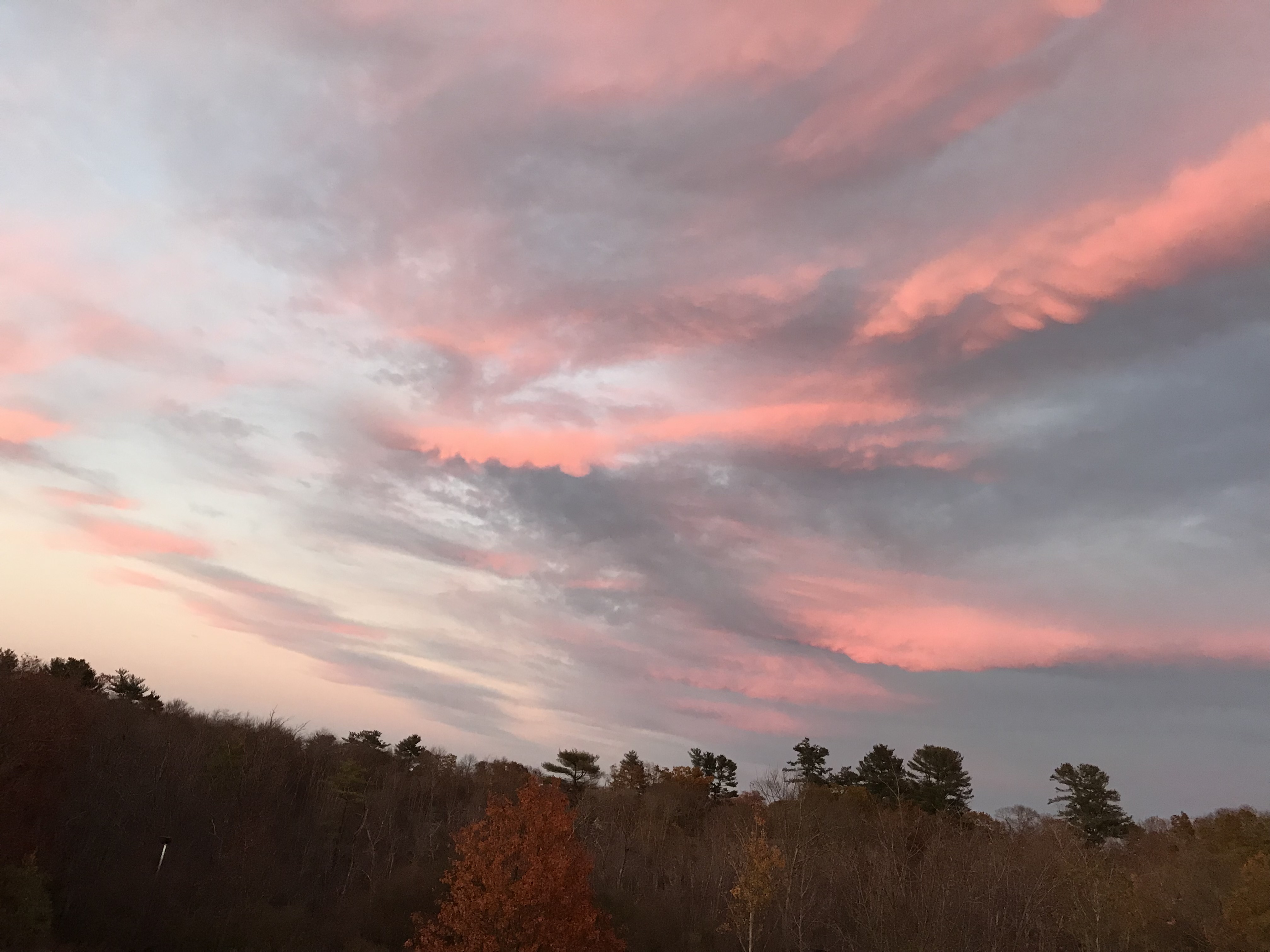
Anne and I live now in a third-floor condo overlooking an expanse of woods. In the past, we’ve always lived in second-floor apartments, so this is a change of perspective. We are at bird level. Blue jays and robins fly past our windows. We see more of the sky and continuously changing cloud formations. The sunlight moves into the trees at sunrise and fades to shadow at dusk. From a distance, we see flocks of birds land on the tree branches. As they fly through the sky and perch in the treetops, birds take in a multi-level overview of their environment. From our windows, I am coming to know a bit of how they experience the world.

I’m a birdwatcher/birder, so I love to see birds close up, but I am learning more about their sounds in living here. Now I often hear the birds before I see them. Because I am familiar with many of their calls and songs, I can usually identify which birds are nearby (e.g., nuthatch, chickadee, goldfinch, flicker, Carolina wren, cardinal, downy and red-bellied woodpeckers); I recognize them from their sound vibration instead of the visual cues. As the weeks go by, I am finding my hearing is becoming fine-tuned. I hear the bird calls and songs more readily and more distinctly now. My experience of being with birds has become as much sound as sight, like listening to an invisible avian orchestra in the trees.

There is a legally blind woman who visits Mt. Auburn Cemetery during the spring bird migration, as I do. She has been a birder for more than 30 years, and as her vision declined, she learned to identify birds solely by sound (after two cochlear implants for hearing loss). In fact, her ability to recognize bird calls and songs is so highly developed that she often hears what others can’t yet see. Or is able to identify a bird that some are hearing but can’t find in the trees. As her physical circumstances changed, her life experience also shifted. She meets the world in a different way now, through sound.
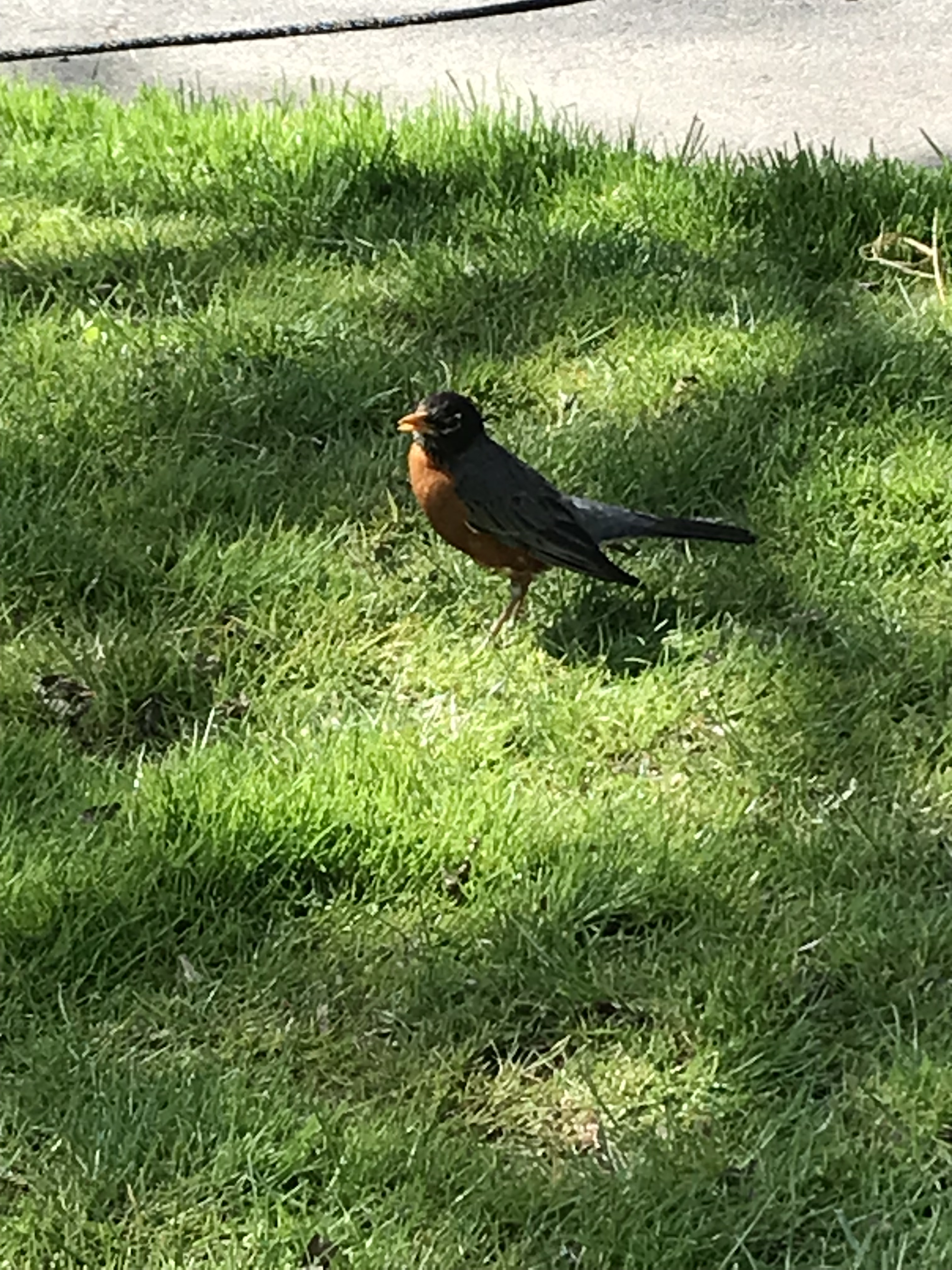
The Maya calendar symbol Tzikin stands for “vision” and is represented by the eagle, who sees a vast panorama of Earth from the skies. Intuition and clairvoyance are traits associated with this sign. Thus, “vision” can mean inner seeing in addition to outer. I would add that it can also mean sound as well as sight. Flying overhead, owls hear the sound of a tiny mouse beneath the snow; robins hear earthworms moving below the grass and soil. We may not be as aurally skilled as birds, but how we each experience the world depends on our own unique physical abilities and life experiences. All of life involves an inner/outer process, so every time we move from one place to another, whether a few feet or many miles, our perspective shifts. Also, as our physical form changes, so too does the way we perceive and receive life.

My “bird’s eye view” where I live now, on an upper floor, includes a wider lens in many ways. But it also includes a deeper listening at every level. Taken together, I experience the world in a more expansive way. Each day I am reminded how the universe is composed of an infinite number of interconnected fractals, which give me and all living beings the opportunity to encounter worlds of wonder in every sight, sound, scent, taste, or touch as we move through our lives.
Solstice and Light

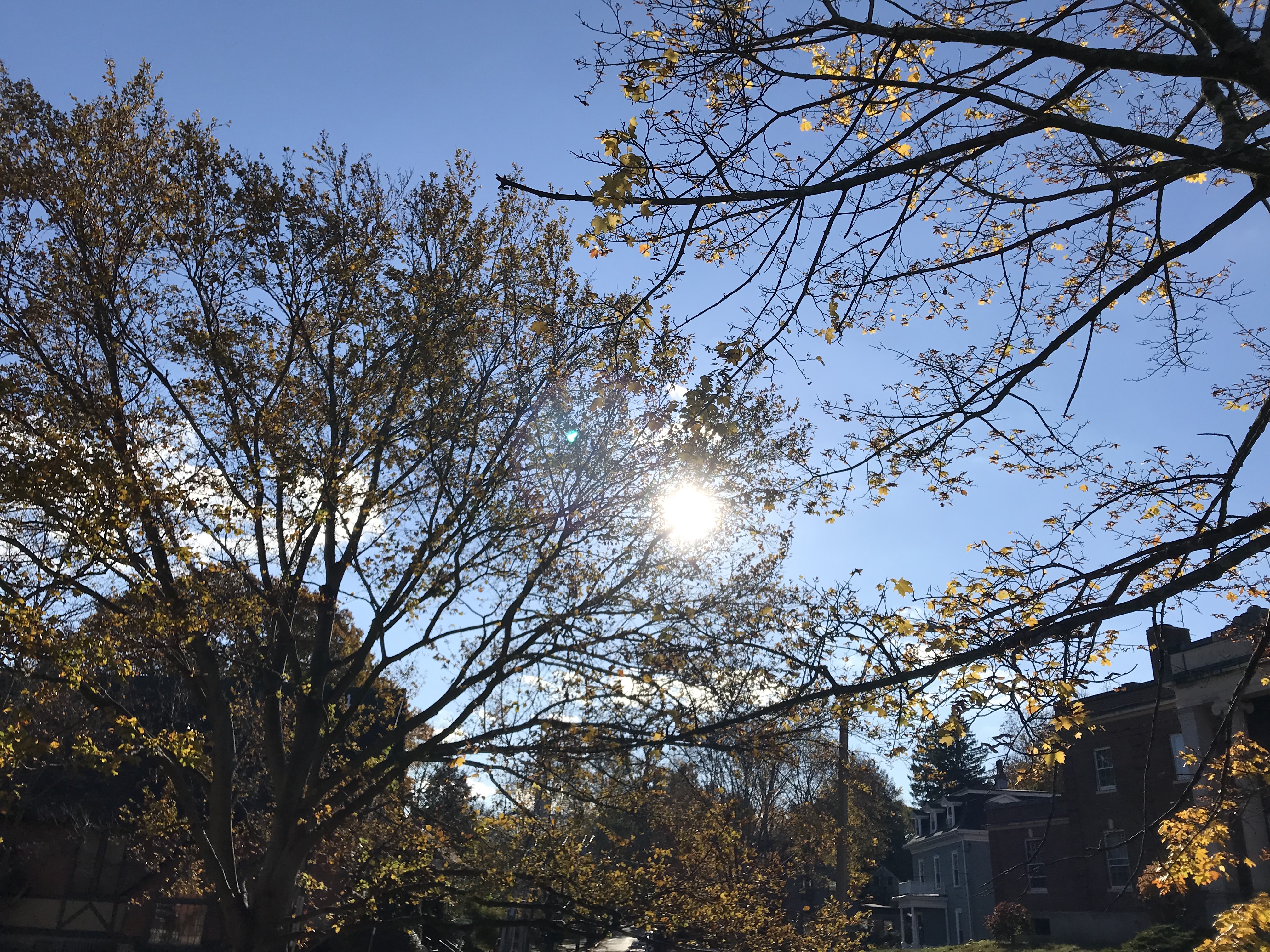
Today, December 21, is the Winter Solstice here in the northern hemisphere, the shortest day (and longest night) of the year. Tomorrow the light begins to increase infinitesimally until it reaches the Summer Solstice fullness in June. The Winter Solstice has been called the “Return of the Light.” An illusion, of course, because the sun never leaves. It is our experience of its light that shifts over the course of a year. And what a miracle it is that our particular planet, Earth, is perfectly placed in our solar system so that life is possible as it rotates and revolves around the sun with mathematical precision each day.

People since the beginning of time have acknowledged and celebrated how light moves through our lives, yearly and daily. Ancient structures like those at Stonehenge in England and Chaco Canyon in New Mexico have been built to exactly show astronomical alignments. I remember when I first saw a film in high school about how the sun appears through a small aperture in the huge standing rocks of Stonehenge exactly at dawn on the solstice. Such amazing alignment and synchronicity! How can you not believe in greater meaning in the universe when you witness such a phenomenon?

Over the years I have always been drawn to magical moments at sunrise or sunset, wherever I lived or traveled. In college in San Diego, two friends and I often drove across town to the beach to see the sun setting into the Pacific Ocean. In Hawaii, I watched sunset through wispy clouds at the top of Haleakala Crater on Maui. Hiking at Bryce Canyon in Utah, Anne and I saw the rock spires magically illuminate like candles as the rising sun touched them. In Guatemala with Maya elders, a group of us rose before dawn to witness sunrise from the top of a Tikal temple, the jungle birds and animals awakening below us. On the other side of the world, the animals in South Africa came to the Olifants River at sunset to drink and eat as we humans watched the sun burn brilliantly red in the evening sky.

All living beings seem to respond to the sun’s light. Our cat Lily used to sit on the back of the sofa in the late afternoon, eyes closed, as the setting sun shone on her face and fur. I have sometimes seen groups of birds sitting in trees watching the rising or setting of the sun. Just yesterday evening, I noticed a dozen or so finches perched at the very top of a tree, facing west, their breasts shining with light, like tiny angels silhouetted against the sky. A perfect solstice alignment—did they know instinctually?

The mystery and power of Light and its relationship to Earth have been part of our collective consciousness for thousands of years. We carry memories of dawn and dusk ceremonies in our genes. Whether instinct or historical memory, we Earth creatures have known that light is at the center of our lives, and we are moved to celebrate it, whether individually on a beach or gathered together at a temple for ceremony. Somehow, deep within us, we realize that we ourselves are made of light. We shine in this world, a reflection of the suns and stars in the greater cosmos we are part of.

Empty Hands

I don’t use apps much or carry my cell phone everywhere I go. To me, they can be distracting, even burdensome. I want to move through my day-to-day life with my hands, heart, and mind open. For instance, when I go bird-watching, I bring my binoculars and anticipation. That’s it. While others around me are holding their phones up, using an app to identify a bird call, I am just listening—and looking. I don’t want a cell phone to come between me and my experience of the wonder of birds. I leave it at home. If I can’t always identify the bird I am seeing, that’s okay. The wonder is there.

Not everyone would agree with that. Apps can help birders identify what they see, just as books and CDs did when I first started birding years ago (and they are still useful). I understand. It’s exciting to be able to recognize and name a bird that appears before you. Yet, relying too much on human inventions to filter life’s experiences may create separation instead of connection. We lose the thrill of discovery, the immediacy and excitement of being fully present and alive. And of course, it’s not just about birds. It’s about everything. As I ride the bus or walk down the street, I see people looking at what is streaming on their cell phones rather than the reality streaming all around them.

When I was on a whale watch a few years ago, a humpback whale breached nearby, and everyone on the boat was holding their cell phones out in front of them, taking photos. They were viewing the miracle of this huge whale in such close proximity indirectly, through a human-made device. And this happens all the time. Taking photos of reality or watching a video instead of experiencing it directly. Granted, I like to take pictures too, but not all the time. I don’t want to completely replace direct perception with images and miss the real thing.

If I fill my consciousness with mental filters and my life with cell phones and digital cameras, I can get lost in the midst of them. The soul of who I am in this lifetime misses out. I didn’t come to this Earth for substitutes and simulations. I came here to be fully present in each moment, no preconceptions or imitation reality. An impossible task, you say? Perhaps. And yet I try to move in this direction every day, emptying out the unnecessary so I can fill myself with the experience of each moment, uncluttered and free.

There is pressure all around me (and you) to engage in virtual reality instead of the real thing. I have to consciously remind myself to “be here now” in every living second. I believe it is possible, not just for me but for all of us. Put down your cell phone, walk out the door, hands empty, and look around—real life is everywhere, just waiting for you.

Sentinels of Song

In spring and summer, I wake up each morning to the robin’s cheery song outside my window. S/he sings at the very top of the tree in our backyard for several minutes, then flies to another tree, then another, and another, then back again to the backyard. At night I fall asleep to the sounds of a mockingbird’s wonderful medley of various bird songs, and at dawn s/he is still singing. Robins and other songbirds do this to establish their home “territory” or attract a mate. Feathered sentinels, they seem to watch over the area with care, enveloping it in song. I can actually feel the vibration of living presence surrounding me as I listen.

I also hear cardinals, song sparrows, house finches, white-throated sparrows, Carolina wrens, mourning doves, and chickadees singing the day into being. Canada geese call as they fly overhead. Each of their songs is unique and a delight to hear. My heart is uplifted as I walk through my neighborhood every morning. Sometimes, late at night, the soft haunting call of a screech owl can be heard in the trees outside the window. And when I go to nearby Mt. Auburn Cemetery for each year’s spring migration, the songs of orioles, tanagers, thrushes, flycatchers, and warblers of all kinds fill the air. I am reminded of the birds that were part of my childhood in rural Illinois, and my heart expands with love for the world. In spite of human conflict and thoughtless neglect of the environment, birds continue to bring joy to the world with their songs, weaving a musical tapestry. They are like guardians of happiness on Earth.

Perhaps every one of us is meant to do this in our lives: be sentinels of our individual human songs. Each of us in our own way is unrepeatable and colorful, like a songbird in spring. And we each have a unique gift to bring to the world. A song of the soul, if you will. When we “sing” full out, lovingly, heart open, we lift the hearts of those around us. A magical alchemical vibration!

By “singing,” I mean simply being yourself. Birds don’t pretend to be something other than who they are; they are completely aligned with Nature and their “birdness” as they sing. If you and I also align ourselves with the natural world around us and forget about trying to become something other than who we were born to be, “song” flows from us like light. It is the music of the soul and the love in our hearts, which we came into this life to share.

This may sound like a nice story with little connection to the real world, but if you pause a moment and listen to the next bird you hear singing, you may realize exactly what I mean. If each of us was created to live on Earth for a particular reason, to bring to the world a particular gift, what is yours? What is the soul music you came here to share? If birds are sentinels of song, perhaps human beings are sentinels of the heart. When we love fully, the music of the spheres flows through us.

Step Outside…

In the past couple of years, as the planet has been experiencing a frightening pandemic, intense political conflict, and extreme weather patterns (among other things), many of us have found ourselves hesitant to leave our apartments or houses. We learned to work at home and avoid crowded public places, which held potential dangers. Even now, as we begin to venture out more, a kind of post-traumatic stress seems to linger in our consciousness. We have to break through a fear barrier just to go outdoors. It takes a real effort to walk to the corner store, let alone take a plane to another city.

We have collectively fallen into the habit of fear-based inertia, believing it is safer and easier to stay put in our living rooms than to go out into the risk-ridden world. We choose the simulated reality of Netflix or social media over the shining, ever-expanding world outside our doors. This scenario is unlike anything we have ever experienced in our lifetimes, and as we look into the future, we can’t foresee it changing. Perhaps it is we who have to change. Choose to open the door instead of lock it.

For example: On a winter’s day in February when cold or snow could trap you indoors, fearful of the icy sidewalks and the frigid wind, go outside anyway, even for ten minutes. Walk around your neighborhood or in a local park. Breathing the fresh air will clear your lungs—and your mind. So many things have kept us indoors recently. How about using a peaceful but invigorating walk as the daily movement challenge to get you beyond your door, whatever the weather? I promise you it will help break the stay-at-home inclination and also make you feel a lot better physically.

I am finding that when I begin to feel tired or depressed and unwilling to move, that is exactly the time when I need most to take a walk outdoors. If I consciously remind myself how much better I feel when I go outside, then I am able to make the extra effort to walk out the door. And every single time I am rewarded with some special moment in the world around me. In spring it is colorful flowers and newly green leaves; in winter, tree silhouettes and wild geese against brilliant blue skies. Always there are bird calls and the smell of fresh air. And the faces of individuals I pass on the street, who smile brightly if I say hello. All of this is a refresher jumpstart for my body and soul, which I would have missed entirely if I had stayed inside.

So next time you feel incapacitated by the gravity that keeps you immobile in your own living room, not fully engaged in life, make an effort to break free. Step outside and breathe in the beauty of the planet you live on. It’s not as scary as it might seem. In fact, it is still the wondrous place it always was, filled with a variety of climates, habitats, and people. We are just going through birthing pains on our beloved Earth. See them as temporary. Look up at the sun and the always changing sky, listen to the birds singing, smile at your neighbors, and you will start to walk with a sparkle in your eyes and spirit in your steps.