You Are Perfect Now

Photograph © 2018 Peggy Kornegger
Perfection is not something beyond you. Something out there, to reach for and aspire to. It’s right here, right now. This is a small gem of wisdom that I sometimes forget. Small but it is at the core of all that is. There are no flaws in God’s universe (or in you within that universe). Everything is part of a seamless, intricately interwoven tapestry of divine creation. When I fully embrace this truth, I can let go of striving, comparing, and dissatisfaction. I can live with appreciation and gratitude in every moment for the perfection everywhere. I may not know the “why,” but I can trust in the reasonless reason for all Being.

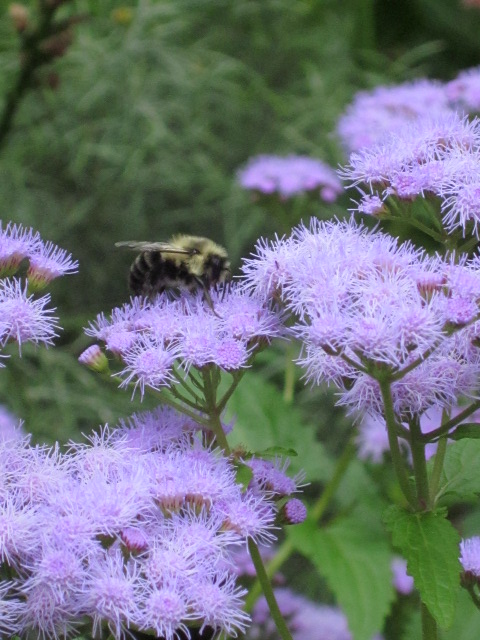
This morning before dawn, I sat on the sofa of our new home in Florida and cried as I remembered my garden in Massachusetts. I ached inside at the memory of my colorful flowers and the butterflies and bees who visited them. There, I was part of the seasonal flow of nature. The robins called to me if I didn’t fill the birdbath early enough each summer morning. The squirrels and rabbits occasionally sat near me as I worked quietly in the yard. The hummingbirds darted rapidly from the bright-red cardinal flowers to the native honeysuckle. The goldfinches balanced atop the purple coneflowers as they ate the seeds in autumn. I missed them all.

Yet I knew it had been time to leave. The house was sold, neighbors were moving, and Florida was calling. It was all perfect. Today, that perfection met me when I went for a walk after my predawn cry. The immense stunningly white clouds against the intensely blue sky stopped me in my tracks. The skies are always breathtaking in Florida. At all times of the day I am in awe at the color and light. And then there are the tropical flowers and birds right outside my door: hibiscus, plumeria; ibis, egret, heron. I love my new home, even when I miss my Massachusetts garden.

At times I think I should always be upbeat and smiling. Centered in my inner God wisdom and flowing along life’s path in complete synchronicity with every experience. The crazy truth is that I am synchronized, whether I’m crying or laughing. Perfection is not the exclusion of certain feelings; it’s the inclusion of all of them. There is absolutely nothing that is not the way it should be in my life, and yours. Our human design is so tightly constructed that every part is essential. If any of it was missing, we would not be who we were created to be, and there would be a hole in the fabric of the universe. Everything is unfolding as it’s meant to, for the greater evolution of life.

In essence, none of us is flawed and nothing is wrong with us; we are perfect just the way we are, here on this planet to live an experience that is uniquely ours. God experiences life on Earth through us, and the universe expands through God’s own loving expansion (and ours). The entire cosmos is a finely tuned and orchestrated symphonic work of genius in which nothing is off-key or discordant. This is the “music of the spheres,” which spiritual seekers have sometimes heard on their journeys beyond the individual egoic self.

From this perspective, all is well, and if I accept whatever presents itself in my life moment to moment, with love in my heart, I tap into a deeper awareness and clearer vision which guides me through my life without suffering or judgment (of self or others). No mistakes have been made. The Divine is an all-encompassing energy that moves the universe beyond time and space or human questioning. What exists in your life and mine, and in the world’s, exists for a reason that is not necessarily logical or even intuitive. It just is. This is absolute Being, of which we are an inseparable part. Thus, everything we do arises from the evolutionary potential of the universe. We live and die, we grow and evolve, because we are Being itself, eternally expanding into new levels of beingness.

Sound wacky? Abstract? A little frightening? Only on the surface. At the deepest level, beyond whatever you or I may feel/think individually, this is our collective global direction now at this key time. In the midst of all the extremes of our lives, we are coming into full conscious awareness of exactly who we are and why we are here. We are God, living out infinite variations of the love that created the universe. The more clearly I see that, the more I can relax and just live my life, one perfect moment at a time. So can you.

 

Celebrating Solitude

Photograph © 2018 Peggy Kornegger
Even though I’ve been in a couple for 35 years, I love being alone. It’s been a part of my life since childhood. I grew up as an only child on five acres in rural Illinois, where I spent a good portion of my childhood playing outdoors alone (or with my dog) and sitting in trees reading. I don’t ever remember feeling lonely. My parents and I were close, so I was with them a lot too, and I had school friends who came to visit, but at the core of my life was time spent in solitude. It became the peaceful center from which I lived outward into the world. As an adult, I always relied on time alone to come back to myself, away from jobs and social situations. Don’t get me wrong—I loved my friends, but there was a certain point at which I had to step away and be alone. It was like breathing to me.

I have so many memories that involve finding joy in being by myself. One of the most vivid was when I worked for a senator as a student intern in Washington, DC, in college. One lunch hour I wandered around outside the Capitol Building alone and then sat in the sun in a quiet spot where no one else was walking. I can remember having a sudden flash of absolute exhilaration when the thought crossed my mind, “No one else on Earth knows where I am right now.” There was something incredibly exciting about that to a 19-year-old living in a new city, trying out grown-up life on her own. I’ve never forgotten that feeling—of being an alive, independent, free spirit in the world.

When I took up bird-watching many years later, I felt a similar thrill being alone in nature: a magical aura that surrounded a sudden encounter with a migrating bird in a bush or tree. If I were absolutely still and silent, the birds came closer and continued with their bird lives as if I weren’t there. It was a precious gift. There were even times when a wood thrush or warbler would land in a branch close to me and sing its heart out. Some kind of special connection occurred then—a living awareness that passed between us. I treasured those moments. It was perhaps my first conscious experience of the spirit of life that is in all beings.

After I embarked on a spiritual path in my 30s, time spent alone in meditation or contemplation became central to my journey. I found it absolutely key to have those daily periods of solitude in order to connect with my own soul and with God. In solitary silence, “stillness speaks,” as Eckhart Tolle has written. Divine connection is an inner experience that comes only when we set aside all external distractions and open our hearts and souls to something greater, beyond the material world.

These quiet moments are extremely precious to me. They are at the core of my life as a human/spirit on this Earth. Ultimately, too, they bring me closer to those around me. I am fortunate in having a life partner who understands and supports my wish to have alone time. She too needs time to herself. When we come together from our separate solitudes, our connection is even deeper and more loving.

Words are often unnecessary with friends and family who share this kind of connection. Something beyond verbal language is passing between us. We recognize and celebrate one another’s souls when we are together and carry our heart connection with us when we are apart. This is life on Earth at its most expansive and wonderful. To me, time spent alone is an essential part of being human, of being conscious spirit in physical form, which is why we incarnated at this particular time on this particular planet. The world is full of so many distractions. It is only in stepping aside and looking inward that we find the true nature of who we are in this extraordinary universe. Every day I say a prayer of gratitude for the solitude that is a sanctuary of peace in my life.


The Magic of Springtime

Photograph © 2014 Peggy Kornegger

Every year in early May, I spend three to six hours each morning at nearby Mt. Auburn Cemetery. Why? you may wonder. Well, Mt. Auburn, with its woodlands, lakes, and gardens, is a magnet for songbirds during their annual spring migration. They fly in by the hundreds on the way north from South and Central America. Some of them nest in the cemetery; others continue further to northern New England and Canada. But during the small window of time that they grace our local flowering trees and bushes, birdwatchers are blessed with up-close views of the colorful and musical birds of the tropics. Each year, I see or hear something new: a chestnut-sided warbler and a ruby-throated hummingbird having a territorial faceoff; a flycatcher singing next to a kinglet displaying its usually hidden ruby crown; a Baltimore oriole weaving a hanging nest in a tall maple tree; a wood thrush singing its fluted song on the path a few feet in front of me. These moments are magical—a fleeting glimpse into nature’s secret world.

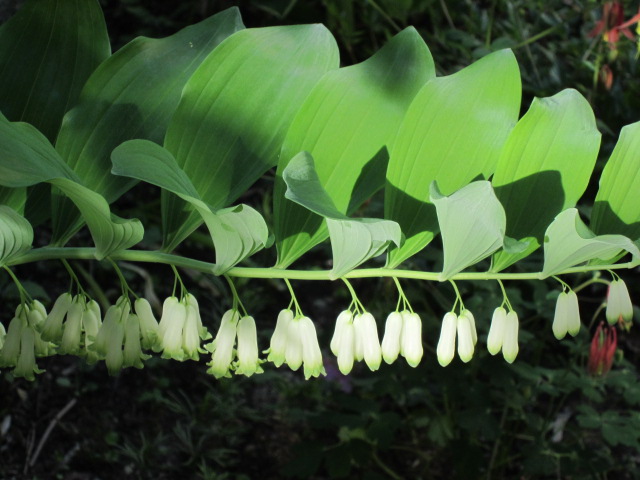
Equally as exciting at this time of year are the perennial plants and flowers that break through the soil reaching to the light. How do they know when to move upward, when to grow stems, leaves, and flowers from their buried roots? It’s a yearly miracle that I witness both at Mt. Auburn and in my own backyard garden. Tightly furled leaves and flower buds appear first, gradually opening to the sun’s warmth and the longer light-filled days. A plant like Solomon’s Seal begins as a blunt grey/green finger pointing up out of the ground. Day by day, the finger slowly becomes a tall thick stem that bends and arches with opening leaves of fernlike delicacy. Beneath the leaves, along the arching stem, small white buds form and eventually open into a line of belled flowers. Swaying in the wind, Solomon’s Seal is one of the special visual gifts of spring, along with lilies of the valley, violets, grape hyacinth, columbine, and so many others.

Year after year, spring flowers and nesting birds remind me of life’s cycles of rebirth and renewal. After a long icy-cold Massachusetts winter like the one we have just experienced, this is a welcome message. Even in the freezing temperatures, even in the dark, life continues. The birds migrate south and return to raise their families; the plants withdraw into the earth to rest before emerging to bloom again in spring. Humans, too, have their cycles, though many of us have forgotten how to align ourselves with life’s rhythms of rest and renewal. If we look to the natural world, we can see that each living being has its own cycle of birth/flowering, rest/renewal, rebirth. In our over-scheduled, busy lives, we often careen out of control and crash in exhaustion. Yet, if we let go of so much trying and effort and allow life to unfold in cycles of activity, rest, renewal, and rebirth, we will feel so much more in tune with ourselves and all of life.

In spring’s wonders, there is great beauty, but there is also great wisdom, showing us firsthand the ever-turning circle of life/rest/rebirth that we too are part of. Something more powerful than our own attempts to control daily life is at play here. If we surrender to the flow of life that is so stunningly visible in springtime, we open ourselves to both inner peace and connection to spirit.


Learning to Listen

Copyright © 2013 Peggy Kornegger

We learn to talk when we are babies, expressing ourselves in sounds and eventually words that make sense to those around us. Speech and verbal communication are encouraged and celebrated. What an achievement that first word is—a rite of passage in the human journey! Listening, however, is not given quite the same emphasis or encouragement. In school, we take classes in speech but not in listening. Within the context of polite behavior, we are told to listen and not interrupt, but learning to be silently present with focused attention in a variety of situations is not part of the curriculum. Neither is quiet time spent in meditation or contemplation. Western society is noisy and wordy and very distracting, and we learn to live with it in whatever way we can, often to the detriment of our inner spirit.

As an only child, I played quietly by myself as much as with friends, but I didn’t begin to learn the true value of silence and of listening until I was well into adulthood. Although from a rural background, I acclimated easily to the novelty of living in cities and thought little of urban noise for years. At some point, however, I began to notice, and then couldn’t stop noticing, the lack of quiet everywhere. I sought out silence—in meditation classes, in parks, on vacations to natural settings away from the city. I took up bird watching as a way of immersing myself in nature, and it was then that I really began to learn how to listen.

In order to observe birds closely, you have to be willing to stand or walk in absolute silence, your senses of sight and hearing keenly attuned. When you are silent and motionless, the natural world gradually resumes its normal activity, which it had ceased at the appearance of a noisy human. What a miracle this was to me when I first experienced it. The more I listened, the more I heard: birdsong, bees buzzing, squirrels chattering, chipmunks scampering through the bushes, the wind rustling tree leaves and creaking branches. My soul was in silent communion with everything around me. Over the years, my listening deepened to the point where I felt I could actually hear flowers growing in my garden in the early morning stillness. Sounds fantastic, I know, but when you quiet yourself enough and truly listen, the world opens up its secrets to you.

Birds and flowers weren’t the only ones to teach me about listening. The elder parents in my life also taught me this sacred life lesson. Both my father and my partner’s mother experienced memory loss and related dementia in their later years. What you learn first in that situation is not to rush or finish the other person’s sentences, but to allow them time/space/silence to find the words they want to say. And if they don’t find the words, so what? Really the words themselves are unimportant. You learn to listen to the spaces between the words to hear what is really being communicated. I listened with my heart, with my soul. The last time I saw him, my father and I shared a lifetime of love just by looking in each other’s eyes. When he spoke, I heard his heart’s voice beneath the words. And during the afternoons when my partner and I sat quietly with her mother listening to 1940s tunes, we experienced together the beauty of the songs as well as the silence between the songs. Our spirits were connected in that peaceful space.

Perhaps what I am describing can’t really be taught in school, but only in life. We learn to listen as we learn that there is more to this world than the physical dimension. The longer we live, the wider our perception and awareness grows (if we are fortunate), and the closer we come to the essential stillness that is at the core of being and at the center of the cosmos. Out of silence, sound is born, life is born. When we listen deeply enough, we hear the sound of silence itself. And that is the place where our souls speak to one another, without words.


Winter’s Spring Song

Photograph © 2014 Peggy Kornegger

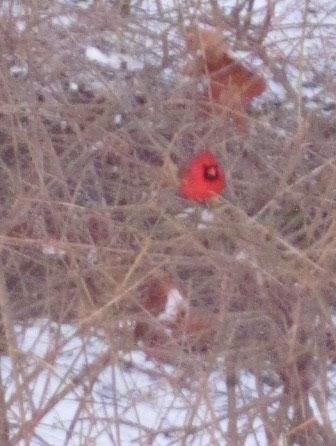
The cardinal is a favorite bird on Christmas cards—that startling red presence against the white snow. But for me, cardinals are always linked in my heart to the first sign of spring in a frozen winter world. On some random day in mid- to late February, the male can be heard heralding the coming seasonal change with his “cheer, cheer, cheer” spring song. Sitting on a branch at the very top of a leafless tree in the bright winter sunshine, he sings of the coming of warmer, light-filled days, of flower bulbs pushing up out of the ground, of grass turning green. And of the spring migration of birds who have wintered in Central and South America.

House finches and chickadees begin singing their spring songs in February too. Soon, over-wintering robins and returning red-winged blackbirds, goldfinches, and phoebes are part of the morning chorus. By late April and early May, migrating birds are passing through New England in large numbers. This is what we in Massachusetts dream of and look forward to during winter’s months of snow, ice, and freezing rain. Especially those of us who will soon spend countless hours with binoculars pressed to our eyes, craning our necks upward in order to catch a glimpse of migrating warblers, orioles, tanagers, and thrushes.

This has been a challenging winter. The frigid temperatures and seemingly endless snowstorms, coupled with heavy layered clothing indoors and out, have made me daydream longingly of California and Florida. Better yet, Costa Rica, where many of our migrating birds spend the winter, and others live year-round. Still, here I am in the Northeast, and I am reminded that loving “what is” is part of living each moment to the fullest on planet Earth, wherever you happen to be. The sun rises and sets in an extraordinary display of color and light in any given month, no matter the weather. The cardinals brighten our days all winter long. Their very existence holds the promise of spring.

And, on that February day when the male cardinal begins to announce his territorial presence with song, all other thoughts recede into the background. Spring is coming, no doubt about it. The earth is giving birth to life one more time. How can you not celebrate with such a steadfast harbinger of hope and wonder—the bright-red, cheer-full cardinal?